Commentary: LGBTQ+ suicide hotline must be restored
Published in Op Eds
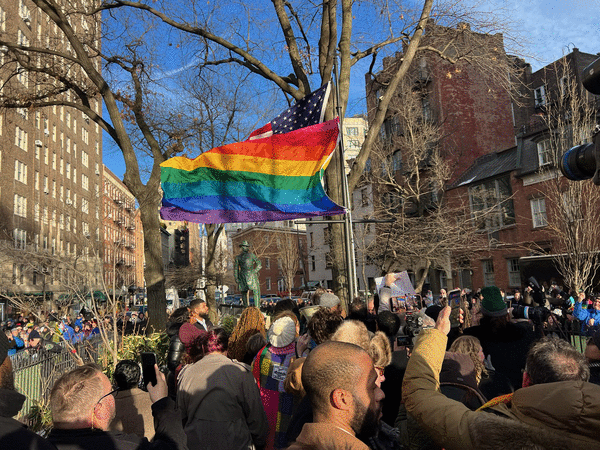
A new report released by the Trevor Project in early May found that an astonishing one in 10 LGBTQ+ young people attempted suicide last year, and more than a third seriously considered attempting suicide.
These findings add urgency to the call for the federal government to restore the LGBTQ+ youth option for its national 988 Suicide & Crisis Lifeline, which was discontinued in 2025. Health and Human Services Secretary Robert F. Kennedy Jr. has since promised to restore the LGBTQ+ hotline program, and asserted to Congress on April 21 that Health and Human Services was “working on getting it up now.” But more than a month later, the line remains down, and every day without the service leaves young people without critical support.
When the federal government launched the 988 Lifeline in 2022, it included dedicated services for three high-need groups: veterans (Press 1), Spanish-speakers (Press 2), and LGBTQ+ youth (Press 3). In July 2025, the Trump administration eliminated the Press 3 option, claiming that funds had run out and that there was no need to “silo” LGBTQ+ youth care.
But the need is demonstrably clear — and by all metrics, the Press 3 option was a resounding success. During its nearly three-year operation, nearly 1.6 million LGBTQ+ youth used the service, accounting for roughly 10% of the Lifeline’s total call volume.
The Press 3 option filled a critical gap, connecting these young people to specially trained crisis counselors who understood their unique challenges, including bullying and discrimination based on their LGBTQ+ identities.
Most importantly, the Press 3 option allowed LGBTQ+ youth to seek care from their personal devices, without parental consent. Roughly half of queer youth who want mental health care aren’t able to get it, according to the new report. Accessing support with the click of a button largely eliminated geographic barriers and spared queer youth from difficult conversations with their caregivers, while providing a haven from potentially hostile environments.
In fact, the 988 Lifeline has been an enormous success overall. In April, a study in the Journal of the American Medical Association (JAMA) linked the Lifeline to decreased suicide deaths among youth, drawing praise from families, mental health professionals and policymakers. This well-documented success makes the exclusion of LGBTQ+ youth — who consider and attempt suicide at three times the rate of their heterosexual peers — even more outrageous.
In canceling the Press 3 option, the government argued that LGBTQ+ youth didn’t need dedicated support—but declined to make a similar argument in regard to veterans, who also have an elevated suicide rate.
The answer seems clear: The program’s termination signaled the federal government’s antipathy toward the LGBTQ+ community. It led to queer youth feeling betrayed and hurt. And it made them feel less trusting of — and thus, less likely to use — the 988 Lifeline, especially in the current political environment. (The American Civil Liberties Union is currently tracking more than 500 anti-LGBTQ+ bills in states across the nation in 2026 alone.)
In my research into this issue as a mental health advocate, I interviewed 15 senior executives from Lifeline centers across the country. Many of them were blindsided by the decision to cancel Press 3. Some didn’t learn of the termination until the day it was announced. Every one of them worried about how the closure would affect their call volume.
If the 988 lifeline is truly meant to be the nation’s easiest way to get help, then it must be within everyone’s reach.
For this to happen, the federal government and states must train all Lifeline crisis counselors on LGBTQ+ issues, following the lead of New York, California and Washington. It must also put real, sustainable funding behind 988, not just unpredictable (and often political) appropriations.
Fortunately, states already have a way to fund these efforts. They can enact surcharges or telecom fees in the same way that 911 is funded. While only a handful currently do, this funding source is reliable and proven to work. States need to leverage this to improve care for LGBTQ+ youth during their time of need.
For the 988 Lifeline to live up to its promise of serving every American experiencing a mental health crisis, it must truly serve everyone. Too many young lives are at stake.
____
Trace Terrell is a mental health advocate who has worked with several of the nation’s leading mental health organizations, including Inseparable, the National Alliance on Mental Illness and Mental Health America. He is a Public Voices Fellow with The OpEd Project and Hopelab. This column was produced for Progressive Perspectives, a project of The Progressive magazine, and distributed by Tribune News Service.
_____
©2026 Tribune Content Agency, LLC.




















































Comments