Commentary: America at 250 -- A nation drifting from its ideals -- As unchecked power corrupts
Published in Op Eds
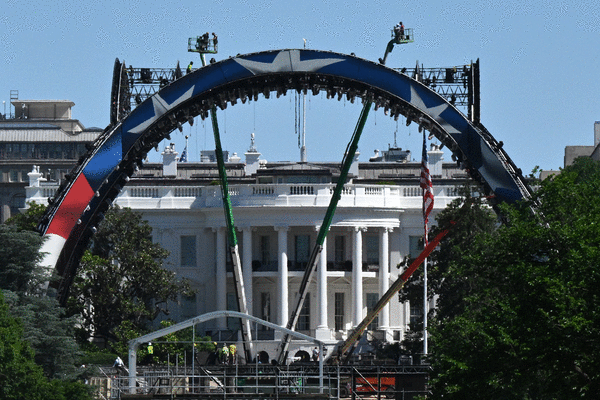
As the nation approaches its 250th Anniversary, Americans should be entering a moment of pride, reckoning, and aspiration — honoring our founding ideals, confronting our injustices, and committing to a shared, inclusive future. But millions cannot reach that place.
They are living in a country where the most basic democratic promise — that no one, not even the president, is above the law — is no longer true. And they are asking a question no democracy should ever force its people to ask: How do you confront injustice when leaders erase the history, hide the evidence, excuse the wrongdoing, and protect the perpetrators?
People are watching January 6 perpetrators not only be pardoned, but now discussed as victims deserving compensation — while others who committed far lesser offenses remain in prison. They are watching families who lost loved ones, officers who were attacked, and judges who were threatened receive no acknowledgment, while those who carried out the violence are elevated. They are watching Epstein victims still seeking closure while Maxwell lives comfortably. And they are watching Congress and the courts fail to check a president who intimidates, retaliates, enriches himself, and bends institutions to serve him.
This is not a moment of national pride. It is a moment of national disorientation. People are trying to live their lives, raise their families, and hold onto hope while watching the guardrails of democracy bend in plain sight. They see a president who rewards loyalty over law, who uses public office for personal gain, who threatens opponents, and who treats institutions as tools for retribution. They see leaders in Congress who enable it, courts that hesitate to confront it, and a political culture that shrugs at behavior that would once have ended careers.
Selective accountability. Truth rewritten. History sanitized. Wrongdoing reframed as patriotism. Victims forgotten. Perpetrators elevated. This is the opposite of the ideals the nation claims to honor.
Power corrupts — not only through threats and retaliation, but through the steady misuse of public authority for personal benefit. In this administration, corruption is carried out in public view: foreign payments and business entanglements that raise emoluments concerns, political loyalty rewarded with pardons, critics targeted with state power, and federal agencies pressured to serve the interests of one individual rather than the nation. This is what happens when power goes unchecked — when institutional guardrails are weakened, ignored, or deliberately dismantled, and the public is taught to expect impunity rather than accountability.
People are not confused about what they are seeing. They are watching public power used not to uphold the law, but to protect the powerful — a reversal of the very purpose of democratic institutions. They are watching a president openly threaten political opponents, promise retribution, and use the language of vengeance.
They are watching members of Congress echo those threats, minimize violence, and elevate individuals who attacked their own workplace. They are watching courts delay rulings, narrow accountability, or avoid confronting the full scope of wrongdoing. They are watching institutions that once stood as guardrails now bend under pressure.
This is not the America people were taught to believe in. It is not the America they want to pass on to their children. And it is not the America that deserves a 250th Anniversary celebration.
That is why this anniversary demands more than celebration — it demands clarity. Anniversaries have always forced nations to confront both their ideals and their failures. Every major milestone in American history has required a reckoning with the gap between promise and practice — and this one is no different.
America’s ideals — liberty, equality, self‑government, the rule of law, the protection of rights, and the consent of the governed — have always defined who we claim to be. Yet those ideals are drifting out of reach.
The Semiquincentennial is supposed to be a moment of reflection — a chance to embrace those ideals, honor where we’ve been, measure where we are, and imagine where we’re going. But reflection requires honesty. It requires confronting the truth, not burying it. It requires acknowledging harm, not excusing it. It requires accountability, not avoidance.
Those ideals are being reversed. Unchecked power corrupts by punishing those who speak out, rewarding those who stay silent, and bending institutions away from the public good. This is how a nation drifts from its ideals: when truth becomes optional, accountability becomes selective, and the Constitution becomes secondary to the ambitions of one individual.
When power goes unchecked, the burden always falls on ordinary people. Millions of Americans are not refusing to celebrate out of cynicism. They are refusing because celebration without accountability is not patriotism — it is denial. They understand that a nation cannot move forward if it refuses to confront what it has become. They understand that justice cannot function when power shields itself from consequence. And they understand something else: A country that cannot tell the truth about its past or its present cannot shape a just future.
Families who lost loved ones on January 6 still wait for acknowledgement. Officers who defended the Capitol still carry physical and emotional scars. Judges and election workers still face threats. Survivors of sexual exploitation still wait for justice. Meanwhile, those with power and proximity to power are shielded, protected, or rewarded.
Those who upheld their duty are unprotected. Those who violated theirs are elevated. This is the fracture at the heart of the moment.
Fractures like this do not heal on their own. They require action — from all of us. To keep the nation from drifting further from its ideals, every part of American democracy must reclaim its role.
The people must demand transparency, reject narratives that excuse wrongdoing, and stay engaged beyond election cycles. Congress must reassert its oversight powers, enforce subpoenas, strengthen ethics laws, and restore the checks and balances the framers designed. The courts must apply the law consistently and protect judicial independence, ensuring that no one — not even a president — is above the law. Institutions must resist political pressure, protect whistleblowers, and uphold the principle that public office is a public trust. And the nation as a whole must confront the truth, reinforce civic education, and treat accountability not as a political weapon but as a constitutional obligation.
And the presidency itself must return to the oath it demands — to preserve, protect, and defend the Constitution. That oath is not symbolic; it is the legal boundary that restrains executive power. A president must respect the guardrails that prevent corruption: the separation of powers, the independence of the Justice Department, the prohibition against using public office for private gain, and the expectation that truth, not loyalty, guides public service. When those guardrails are ignored, weakened, or dismantled, corruption is not an accident — it is the predictable outcome of unchecked power.
So as America approaches this milestone, the question is not whether people should celebrate. The question is whether the nation’s leaders will honor the principles they swore to uphold.
Whether they will restore the promise that has been broken. Whether they will show the courage to confront wrongdoing, even when it comes from within their own ranks. Whether they will choose the Constitution over convenience, the rule of law over loyalty, and the country over themselves.
And until accountability returns — not as a slogan but as a constitutional obligation — millions of Americans will remain unable to celebrate a nation that refuses to confront what it has become or honor the future it still claims to promise.
_____
Carolyn Goode is a retired educational leader and national advocate for ethical leadership, civic literacy, and government accountability. She writes about democratic principles, institutional integrity, and the responsibilities of citizenship in a constitutional republic.
_____
©2026 The Fulcrum. Visit at thefulcrum.us. Distributed by Tribune Content Agency, LLC.
















































Comments