Commentary: Who deserves freedom this Fourth of July?
Published in Op Eds
As we celebrate America’s 250th anniversary, we reflect on the founding ideals of the United States—liberty, responsibility and the moral character required to sustain a nation. These principles were never meant to remain static. From the beginning, they invited reflection, growth and a broader understanding of what—and who—deserves moral consideration, including those who happen not to be human.
The founding fathers revealed early expressions of stewardship, curiosity and thoughtful questioning about the natural world. George Washington was known for his careful attention to the animals in his care and expected those around him to treat them humanely. Thomas Jefferson approached the natural world with curiosity, studying animals closely and documenting their behavior. Benjamin Franklin famously wrestled with the ethics of eating animals, at one point going vegetarian and later reflecting on the contradictions of his choices.
These moments reflect something important: an awareness that our treatment of other living beings matters. That awareness would continue to grow as the nation matured.
In the 19th century, influential thinkers and cultural figures began to connect American values more directly with compassion for animals. In his 1854 book "Walden," Henry David Thoreau predicted that humanity would one day move beyond eating animals altogether, describing it as part of our human progress.
American folk figure Johnny Appleseed was widely known for his gentle philosophy toward all living beings, which included not eating them. Reformers like Sylvester Graham—whose ideas inspired the creation of graham crackers and who is often called the father of vegetarianism in the United States—advocated for dietary reform as part of a healthier, more virtuous society. This ethic also found expression in broader movements for justice, embraced by leaders like Coretta Scott King, who in the late 20th century advocated vegan eating as part of a philosophy of nonviolence.
American innovation has reflected this shift, as well. John Harvey Kellogg and his brother Will Keith Kellogg promoted meat-free eating and helped introduce foods like cereal to the mainstream, making meat-free breakfasts more accessible to everyday Americans. Their contemporaries, including C.W. Post, further expanded the reach of ready-to-eat grain foods. Generations later, in the 1970s and 1980s, advocates such as Nathan Pritikin would continue promoting plant-forward diets for health and longevity, helping pave the way for the growing variety of meat-free foods available today.
Taken together, these figures illustrate a quiet but persistent thread in American history: a belief that progress includes expanding our circle of concern. Just as the nation has worked—however imperfectly—to extend rights and protections to more people over time, there has also been a growing recognition that animals are not resources but living beings who feel pain, form bonds and value their lives.
Today, that understanding is clearer than ever. Research continues to confirm what many have long seen with their own eyes: All animals are intelligent, emotional individuals. Meanwhile, the meat, egg and dairy industries confine and kill billions of animals each year, in ways that would have troubled even the most pragmatic early Americans. The word “slaughterhouse” is not one to celebrate.
Independence Day offers a moment to reflect not only on how far we’ve come but also on where we’re headed. If liberty and justice are truly guiding principles, they challenge us to think more deeply about how our decisions affect others—including the animals who share our nation and our world.
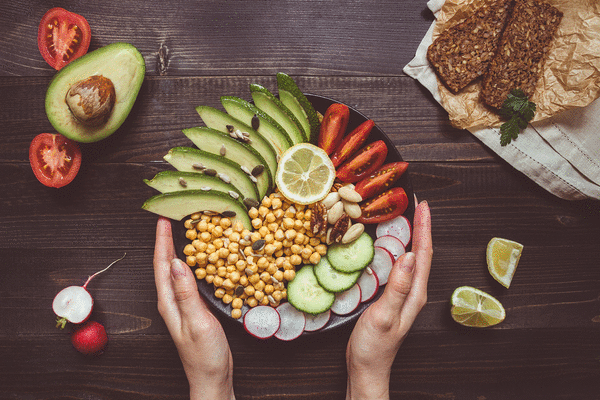
Choosing vegan food and clothing is one way to put those values into practice. It’s a step toward reducing suffering, conserving resources and aligning our daily habits with the ideals we celebrate each Fourth of July.
The American story has always been one of growth—of recognizing that our responsibilities extend beyond what previous generations imagined. Expanding compassion to animals is a continuation of our founding values.
_____
Ingrid Newkirk is the founder of PETA, 501 Front St., Norfolk, VA 23510; www.PETA.org.
_____
©2026 Tribune Content Agency, LLC.




















































Comments