Michael Hiltzik: The Republican assault on Obamacare has created a healthcare bloodbath, with worse yet to come
Published in Op Eds
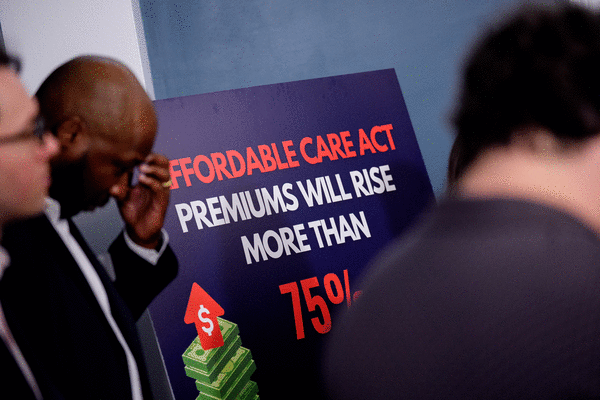
Since the Affordable Care Act's enactment in 2010, the Republican mantra about the law has been "repeal and replace."
On the surface, the GOP never got what it wanted. The key moment in this campaign arrived in July 2017, when the late Sen. John McCain, R-Ariz., stood on the Senate floor and issued a thumbs-down gesture to kill repeal.
But that's misleading. The latest statistics on Obamacare enrollments and pricing show that for millions of Americans, repeal indeed has happened.
The expiration of enhanced ACA subsidies as of Jan. 1 prompted millions of Americans to either give up their Obamacare health plans or shift to plan levels with lower premiums but higher co-pays and deductibles.
Although official statistics for the 2026 plan year are not yet complete, expectations are that the number of enrollees could fall to as few as 16.5 million. That would be a decline of more than 26% from the 22.3 million beneficiaries last year, and the first such decline since the ACA marketplaces opened in 2014. The scale of the decline is still unclear, because people's abandonment of ACA plans isn't final until they fail to pay their first-month premiums, and statistics on that trend aren't yet fully available.
What has happened, however, is that average premiums have increased by 58% nationwide this year, rising to $178 per month from $113, according to the healthcare research organization KFF. Average deductibles rose by 37%, or by $1,027 per person, KFF calculated, reaching a record high of $3,786.
That's "the steepest increase in deductibles ever seen in this market," KFF reported. The underlying cause was the shift by enrollees from silver-level plans with relatively low deductibles to bronze plans with much higher deductibles.
In California, where the Covered California state ACA marketplace is the largest in the country, a standard silver plan costs roughly $580 per month per person, but a bronze plan can be had for a premium of about $290. (The rates can vary by ZIP code and age.) But co-pays are higher for bronze plans — $60 for primary care visits versus $50 for silver plan visits. Deductibles also are higher — $5,800 per year per person for bronze plans versus $5,200 for silver plans.
The original ACA subsidies capped premiums on a sliding scale, ranging from 2.07% of income for those earning 138% of the federal poverty line to 9.83% of income for those at 400% of the poverty line.
The ACA's drafters knew from the outset that these subsidies were inadequate. Especially troubling was the sharp cutoff of any subsidies for families earning even a dime above 400% of the poverty level — the so-called subsidy cliff. But that was a budgetary compromise, and the expectation was that Congress would get around to fixing the cheeseparing subsidy at a later date.
The pandemic forced Congress to act. In the 2021 American Rescue Plan Act, Congress refashioned the subsidies so families with income up to 150% of the poverty level could find decent Obamacare plans for free. The act eliminated the subsidy cliff by capping premiums for families at 400% or more of the poverty line at 8.5% of applicable income.
The benefits were seen almost immediately. ACA health plan enrollments roughly doubled to 19.3 million from 9.7 million in the three years after the subsidies were increased. But Congress failed to extend the enhanced subsidies past their expiration last Dec. 31.
California backstopped the federal subsidies for the lowest-income enrollees — mostly those for households earning up to 150% of the federal poverty level, or $23,940 for individuals and $49,500 for a family of four. That premium support, which was funded out of a $190-million state reserve fund, averaged about $45 per month, Covered California said.
The state subsidies mitigated the damage from the expiration of the federal assistance, says Charles Gaba, the indefatigable private analyst of Obamacare financials. Even so, he calculated, "Covered CA enrollees are paying 36% higher net premiums on average this year, along with a 17% average increase in out of pocket costs." Put it together, and California enrollees are paying, on average, about $1,100 more in healthcare costs.
It's almost certain that things will get worse. President Trump's hostility to the Affordable Care Act has long been manifest. He pushed hard for the repeal act that McCain shot down in 2017 during his first term. He also has implemented changes in ACA practices that reduce access to healthcare and increase paperwork.
Within weeks, insurance carriers will start calculating their premiums for 2027. They'll be using their current experience to do so, including the higher sickness and death rates they're seeing thanks to a higher uninsured or underinsured population. In itself, that points to higher premiums next year.
"A new Affordable Care Act (ACA) marketplace rule finalized by the Centers for Medicare & Medicaid Services adds to the burdens of millions of people in the United States who are already struggling to afford their health care costs," concludes the Center on Budget and Policy Priorities, a progressive think tank.
A rule just made final for 2027 ACA plans will have the effect of reducing access to healthcare and increasing paperwork and costs. Among the changes is an increase in out-of-pocket limits for bronze plans, which have been chosen this year by a record 40% enrollees because of their lower up-front costs. The new limits are $15,600 for individuals and $31,200 for a family, up from $10,600 and $21,200 this year.
That could leave some individuals and families on the hook for all their medical expenses, the CBPP observed. As the organization reports, "$15,600 is about a third of median personal income, and roughly the entire income of a person at the federal poverty level."
Among other provisions of the new rule is one that would allow "non-network" health plans into the ACA marketplace beginning in 2028. These are plans that don't maintain a roster of providers who agree to accept the plan's payments as payments in full for services so that their patients don't face additional charges. Non-network plans set forth a schedule of fees; providers can charge more, sticking the patients with responsibility for paying the excess — the dreaded "balance billing" effect.
The rule, observed Sabrina Corlette, Jason Levitis and Lindsey Murtagh of Georgetown, the Urban Institute and Brown "would violate minimum requirements of the Affordable Care Act, harm consumers, and significantly destabilize the ACA Marketplaces, leaving consumers with fewer and more expensive coverage options."
The new rule will eviscerate many patient protections written into the ACA. It says it would allow patients to "negotiate prices among available providers to find a provider who will accept the plan's benefit amount as payment in full." This is a familiar chimera offered by enemies of the ACA.
The idea is that patients can shop among doctors to find the cheapest option. But its promoters know full well that patients rarely do this — it's time-consuming, requires more knowledge about prices than patients generally have, and doesn't work to protect those needing care that is "not reasonably shoppable, such as non-elective procedures, non-emergent services that must be performed rapidly, or services for which there is limited provider choice," the researchers noted. And what about patients "who are very sick or otherwise unable to engage in one-on-one price negotiations with providers"? They'll be on their own.
The White House announced the new rule with a press release bristling with meretricious claims that it "strengthens program integrity, expands consumer protections, promotes plan innovation and consumer choice, and restores greater authority to states." In truth, it undermines program integrity, eliminates key consumer protections, forces consumers into choices that are not to their benefit and saddles states with higher costs.
The Republican healthcare strategy is now fully rolled out. They no longer feel the need to "repeal and replace" the Affordable Care Act. Instead, they'll leave it in place while eliminating or hamstringing all the elements that have bolstered its popularity (Americans approved of the act by 57% to 35%, according to a Gallup poll taken in November) and its effectiveness.
The ACA began the process of revolutionizing American medicine, but it left a lot undone. For some reason, the fear that more will be done to make American healthcare more accessible, affordable, efficacious and humane grips Republican hearts. Go figure.
That said, Trump and the GOP have provided Democrats with a road map to reforming American healthcare: Start by looking at all the changes made by the Republicans, and reverse every last one of them.
____
_____
©2026 Los Angeles Times. Visit at latimes.com. Distributed by Tribune Content Agency, LLC.




















































Comments