Commentary: Agreement is not understanding
Published in Op Eds
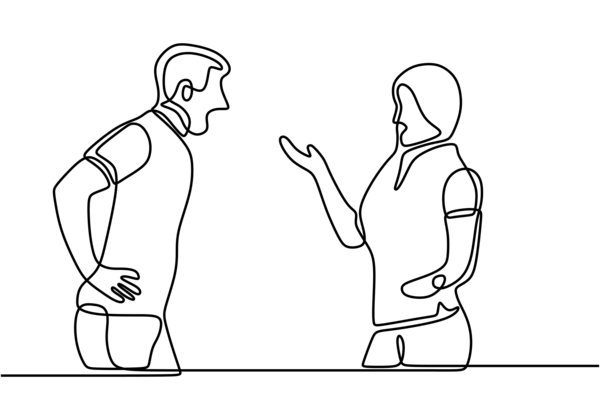
During a recent conversation, my 16-year-old son told me I did not understand him.
Parents know these moments well. What begins as a disagreement about something practical can quickly become something larger. A conversation about rules, expectations, timing, priorities, or responsibility suddenly transforms into a referendum on whether your child feels seen, heard, and respected.
At first, I responded the way many parents do: by focusing on the issue at hand. But as we continued talking, I realized something more important was happening beneath the surface.
When my son said I did not understand him, what he often meant was that I did not agree with him.
That distinction matters more than we may realize.
To his credit, he was articulating something many adults struggle to name. We often confuse understanding with endorsement. If someone does not validate our conclusion, mirror our emotions, or support our position, we assume they have failed to hear us. We interpret disagreement as dismissal.
But understanding and agreement are not the same thing.
Understanding asks whether I can grasp how you arrived at your perspective. Agreement asks whether I share it. One is rooted in empathy and curiosity. The other is rooted in alignment.
A person can fully understand your frustration and still think you are wrong. A spouse can understand your feelings and still see the situation differently. A colleague can understand your concerns and still choose another path. A parent can understand why a teenager wants more freedom and still say no.
Somewhere along the way, many of us learned to collapse these differences into one demand: If you love me, respect me, or care about me, you will agree with me.
I know this because I once believed it too.
As I reflected on that conversation with my son, I realized I grew up carrying a similar assumption. Agreement felt like validation. Disagreement felt like rejection. If someone challenged my view, it could feel as though they were challenging my worth.
Many people never outgrow that framework. They simply carry it into adulthood and apply it to marriages, friendships, workplaces, and civic life.
You can see it everywhere.
National data suggests many Americans feel the same strain. Eight in 10 U.S. adults say Republican and Democratic voters cannot agree on basic facts about important issues. A record 45% of Americans now identify as political independents, and 85% say politically motivated violence is increasing. These numbers point to more than policy disagreement. They reflect a country struggling to stay in a relationship across differences.
When agreement becomes the price of being understood, curiosity disappears. Conversations become negotiations for emotional validation rather than opportunities for learning. Listening becomes performative. People stop asking questions and start defending positions. Every difference feels personal.
And perhaps most damaging of all, we become fragile in the face of ordinary disagreement.
That fragility shows up in homes as much as it does in headlines.
As a parent, I could have ended the conversation the old-fashioned way. I could have pulled rank, asserted authority, or dismissed his frustration with some version of “because I said so.”
But I wanted something different for my son.
I wanted him to understand that someone can hear you deeply and still not side with you. That love does not require surrendering judgment. That being challenged is not the same as being devalued. That emotional maturity includes tolerating the discomfort of not getting consensus.
Most of all, I wanted to model that difficult conversations can still be kind.
This is not just a parenting lesson. It is a civic one.
A pluralistic society depends on people who can remain in relationships despite disagreement. Families need it. Friendships need it. Workplaces need it. Communities need it. Democracies certainly need it.
If every disagreement is interpreted as disrespect, then only echo chambers feel safe.
We do not need less conviction. We need stronger relational skills. We need the capacity to hold our values without requiring universal affirmation. We need to listen for meaning instead of only listening for compliance.
My son may not have realized it, but he gave me a useful reminder.
Being understood feels good. Being agreed with feels good too. But they are different experiences, and confusing them can damage relationships we care about most.
One of the most important lessons we can teach our children—and ourselves—is that disagreement is not abandonment.
Someone can love you, hear you, respect you, and still see things differently.
In an age where so many conversations collapse under the weight of that confusion, learning the difference may be one of the most necessary skills we have left.
____
Randi McCray is the associate director of school community and culture at the Yale School of Public Health, where she works to build inclusive dialogue across differences, and a Public Voices fellow of The OpEd Project in partnership with Yale University.
____
©2026 The Fulcrum. Visit at thefulcrum.us. Distributed by Tribune Content Agency, LLC.





















































Comments