Commentary: Why billionaires shouldn't fuss over the wealth tax
Published in Op Eds
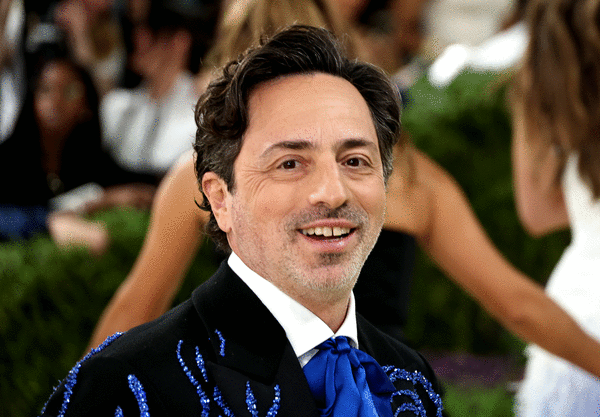
Billionaires and their closest allies recently launched a full-court press against California’s proposed wealth tax, which would levy a one-time 5% tax on billionaires’ net worth. Google co-founder Sergey Brin, now worth nearly $300 billion, likens the tax to Soviet oppression and has spent roughly $57 million to oppose it. He and a few fellow billionaires are even threatening fleeing the state to avoid it.
Some critics of the proposed tax argue that it’s poorly designed, that there is no reliable way to assess taxable value of assets other than cash and that wealth taxes generally have high administrative costs and disappointing revenue. Other detractors raise fears that this one-time assessment could become permanent, or eventually be applied to nonbillionaires, including pension and retirement benefits for working-class Americans.
But you have to wonder what all the fuss is about, since any billionaires who pay the tax will earn it back in just a few months. Money begets money, and 50% rates of return aren’t unusual for the ultra-wealthy. Compounded over 20 years, that turns $1 million into $3.3 billion. Want to verify that? Simply pull up your calculator, multiply a million by 1.5, and then repeat that 19 more times.
California’s proposed wealth tax would do virtually nothing to stop this level of wealth accumulation. “Unrealized gains” remain otherwise untaxed, and billionaires still have all kinds of ways to avoid triggering a taxable event, keeping them unrealized.
Working Californians on the other hand have taxes withheld before their paychecks ever reach their bank accounts. Apart from tax-qualified retirement plans, everything in their savings comes from after-tax income. Federal, state and payroll taxes on what they earn, save and invest amount to about 40%.
Billionaires’ taxes amount to zero. So long as they don’t sell any of the shares that made them rich, they’re not actually forced to pay taxes on the skyrocketing value of those shares. A “wealth tax” worthy of the name would ensure they pay the same as the rest of us, around 40%. That would not prevent them from amassing fortunes. Their $1 million would still grow to $190 million over 20 years — which is colossal, just not as colossal as $3.3 billion.
Another way to express this is that billionaires’ fortunes are more than 90% attributable to unpaid taxes. In California, more than 30% of their fortunes is attributable to not paying state taxes, year after year. A one-time 5% wealth tax would hardly make a dent in that.
In fact, it could be argued that billionaires’ wealth isn’t theirs at all. It really belongs to the federal and state governments deprived of the taxes that would have been paid if billionaires were taxed like the rest of us. Ordinary taxpayers have to make up for those lost revenues that cover the costs of vital public services including healthcare, education and food assistance programs.
The tax structure that enables this has turbocharged economic inequality, leaving working Americans struggling to pay their bills and their taxes. Whatever happens with California’s ballot initiative, we need reform in states across the country as well as at the federal level.
States have the power to tax wealth and unrealized gains. There is a complicated debate about whether it is constitutional for the federal government to do so, though there are ways it could tax realized gains to make up for lost revenues from unrealized gains. A Billionaire Minimum Income Tax proposal is pending in Congress, drawing on the work of several drafters of California’s wealth tax proposal. A similar proposal was introduced in the Vermont state legislature.
A sensible guiding principle here is to figure out how much of accumulated wealth is attributable to not paying taxes, and then set rates accordingly. For example, if 90% of Brin’s approximately $300-billion fortune comes from not paying taxes on unrealized gains, any income he realizes ought to be taxed at 90%. If Brin wanted to spend, say, $57 million on his campaign to defeat California’s wealth tax, he would need to sell or otherwise monetize $570 million (about 0.2% of his fortune) and pay 90% of it in taxes to have a lobbying war chest of $57 million left over.
What would be so wrong about limiting the massive wealth and influence of billionaires in this way? As things stand now, 90% of what Brin spends is the public’s money, and a large chunk just got spent on trying to keep the public’s money away from the public.
Something’s got to give. Roughly 900 U.S. billionaires — 0.00026% of the population — own somewhere around $7 trillion to $8 trillion. They have all that money, but the rest of us have the votes. Once we understand how billionaires’ wealth comes out of our pockets, we can pass tax reforms to fix the problem, and Brin and his ilk will be nostalgic for the days when all they had to worry about was a one-time 5% state tax on their wealth.
____
Stephen Land is a retired tax attorney and former chair of the New York State Bar Association’s Tax Section.
©2026 Los Angeles Times. Visit at latimes.com. Distributed by Tribune Content Agency, LLC.




















































Comments