Commentary: The United States may be the best place to build universal healthcare
Published in Op Eds
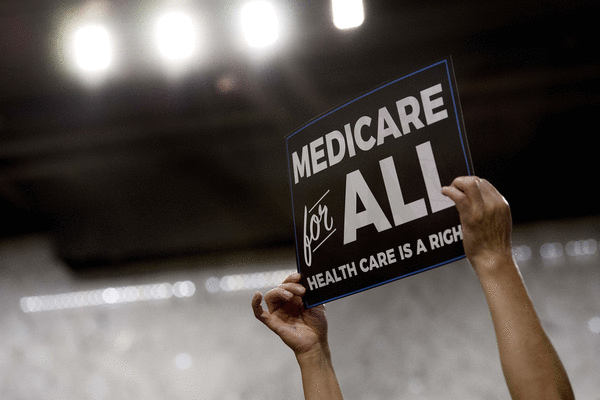
The debate over health insurance in the United States has returned to the forefront as the Affordable Care Act faces political pressure, insurance premiums continue to climb and physicians experience increasing restrictions from insurance companies. A recent poll shows that roughly 62% to 68% of Americans believe the government has a responsibility to ensure healthcare coverage for all. Yet after more than a century of debate, the federal government has taken only small steps toward universal coverage. Today, the United States spends a relatively high amount per person on healthcare, but Americans die younger and are less healthy than residents in other high-income countries.
Having experienced different healthcare systems firsthand, I am deeply aware of how universal healthcare can impact life. Surprisingly, I have also realized that the United States may actually have one of the systems best suited to making it work.
During my doctoral training in Japan, I enrolled in the national health insurance program. At one point, I needed a root canal, and the dentist asked which type of crown I wanted. One option was a basic, reliable material fully covered by insurance. Another was of higher quality but not covered. I chose the basic option, and the total cost for the entire treatment was about $50 after reimbursement. Later, when living in the U.S., I was told that another tooth might require the same procedure—and that even with insurance, a basic crown would cost around $1,000.
This experience gave me a front-row view of a primary benefit of universal healthcare: It protects access to a reasonable care option. By contrast, in the current American system, even the basic choice is expensive.
Of course, universal healthcare is not perfect. Most failures are due to rigid bureaucracies and weak transparency, which can lead to inefficiencies and increased cost while reforms lag behind. This is where the United States has a unique advantage.
American institutions are built around transparency, public oversight and decentralized authority, all of which help to expose inefficiencies and promote improvements. That ability to self-correct is one of the country’s defining institutional strengths.
Ironically, the current American health system is an outlier; it is often less transparent than many other public systems in the U.S. Patients frequently do not know the price of medical services until weeks after treatment. The complexity of multiple insurers, billing codes and administrative layers makes the system difficult for both patients and physicians to navigate.
A universal system would remove unnecessary intermediaries and simplify payment structures. This, in turn, would improve transparency while lowering administrative costs and allowing doctors to spend more time caring for patients instead of negotiating with insurance companies. With strong oversight and reduced bureaucracy, the United States would be well-positioned to identify problems quickly and adjust policies when needed.
Some skeptics argue that universal healthcare represents a form of socialized medicine, government control of the market, or even a dangerous step toward collectivism. These concerns resonate in a country whose economic success has long been tied to free markets and private innovation.
But universal healthcare does not eliminate markets. It establishes a foundation. By guaranteeing access to essential care, it allows individuals to remain healthy enough to work, create, and pursue opportunities and improved well-being.
The government does not control every medical decision in a universal healthcare system; rather, it guarantees a basic level of coverage while markets continue to operate above that baseline. And markets function better when they rest on a stable foundation. When essential needs are reliably met, private providers and insurers can focus on offering higher-quality services, innovative treatments, and specialized care.
Another common concern is that broader access will lead to excessive use of medical services and overwhelm the system. In reality, when care becomes accessible, utilization often increases in ways that add value rather than waste.
Today, roughly one-third of American adults report skipping or postponing needed medical care because of cost. When illnesses are left untreated in early stages, they often progress into more serious conditions that require far more complex and expensive interventions. Preventive visits, early diagnosis and regular treatment reduce the need for expensive emergency care later. Again, this is something I know first-hand: I chose to delay my own treatment, even though I was warned that if my tooth decay worsened, the fix would be even more expensive.
Universal healthcare is not a symbol of socialism; it is a guard of basic human dignity. In the United States, it could become something distinctly American: a practical system grounded in transparency, flexibility, and accountability. The country that pioneered so many innovations could also build a healthcare model that protects its people while preserving the strengths of its market economy.
____
Wei Zhang is a postdoctoral researcher of Cardiovascular Medicine at Yale University and a Public Voices fellow with The OpEd Project, specializing in vascular surgery and public health. A physician-scientist trained and licensed in surgery in China, Wei completed doctoral training through joint research programs in China and Japan and now conducts cardiovascular research at Yale.
____
©2026 The Fulcrum. Visit at thefulcrum.us. Distributed by Tribune Content Agency, LLC.





















































Comments