Editorial: The Navy's new battleship is a boondoggle in the making
Published in Op Eds
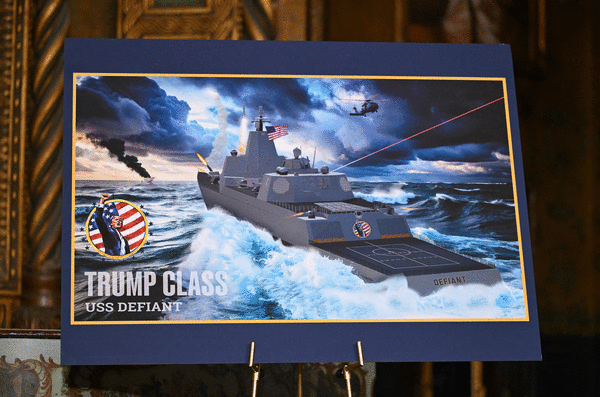
The U.S. Navy says it plans to buy 15 hulking “battleships” over the next 30 years. The number of such behemoths it actually needs comes closer to zero. The sooner Congress recognizes that fact, the better off American taxpayers, and indeed the Navy, will be.
The president introduced the first new warship, dubbed the USS Defiant, in December. Having long touted the beauty and power of World War II-era battleships, he claimed that the new class of battleships would be 100 times more powerful than their predecessors and bigger than any current U.S. surface combatants. They’d bristle with cutting-edge weaponry — including lasers, hypersonic missiles and rail guns — and be armed with nuclear-capable cruise missiles. The Navy now says they’ll also be powered by nuclear reactors.
Strategists who’ve studied the issue for the Navy say there’s a case for a warship somewhat larger than current Arleigh Burke-class destroyers, which displace less than 10,000 tons and carry a little under 100 vertical launch cells for missiles and interceptors. The war in Iran has underscored how vital it is to be able to launch strikes from safe distances and parry incoming missiles and drones. Packing more cells onto a slightly bigger ship could usefully increase US capabilities.
But building much larger vessels — the Defiant class is intended to displace roughly 30,000 to 40,000 tons — would only inflate costs and create fatter targets, without offering dramatically new operational capacity. Each one would need to stock more interceptors and operate with escort ships to fend off attacks. Some analysts have dismissed them as “bomb magnets.”
Even if Congress approves the president’s request for nearly $1.5 trillion in defense spending next year — which remains far from certain — the Navy can ill afford such extravagance. The Congressional Budget Office has estimated that the first Defiant-class ship could cost as much as $20 billion — making it the most expensive warship ever built. (By comparison, America’s newest aircraft carrier, the USS Gerald Ford, cost $13 billion.) The chances of Congress consistently signing off on budgets big enough to accommodate more than a few such vessels are slim. And the fewer of them there are, the more expensive each will be to construct and sustain.
That’s assuming they can even be built. Several of the advanced weapons systems the battleships are intended to field remain in development; the Navy hasn’t yet shown they can be integrated successfully onto a ship. Naval shipyards are already overstretched and desperate for skilled workers: Adding a massive new project will inevitably divert scarce resources from more important priorities, including nuclear-powered aircraft carriers and submarines.
For less than the price of one such vessel, the Navy could add a fleet of unmanned surface and undersea vehicles that could address a broad range of risks. Autonomous task forces of drones could be assigned to defend against specific threats — Russian subs sneaking into the Atlantic Ocean, say, or a possible amphibious landing on Taiwan. That would greatly expand the Navy’s capabilities without putting its most valuable resources at risk.
The White House has asked for nearly $2 billion in next year’s budget for R&D and advance procurement of the Defiant class. Congress would be wiser to cut off the program now, or at least direct that the money be used to research capabilities that could be deployed on the kind of midsize guided-missile cruiser the Navy might actually need. Getting warships into the water is hard enough without wasting funds on vessels unlikely ever to sail.
____
The Editorial Board publishes the views of the editors across a range of national and global affairs.
©2026 Bloomberg L.P. Visit bloomberg.com/opinion. Distributed by Tribune Content Agency, LLC.





















































Comments