Commentary: Congressional gerrymandering is a circular firing squad
Published in Op Eds
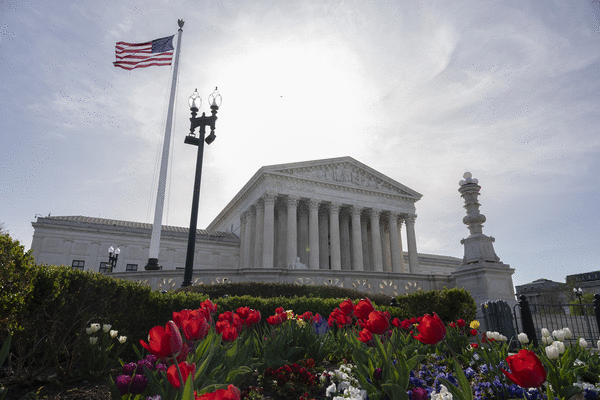
Frenzied congressional gerrymandering across the states has become a circular firing squad. Both parties mow down the other’s representation, with Lady Democracy and the public caught in the crossfire.
Readers of editorial pages by now know the arguments. To recap, extreme gerrymandering:
• Makes the primary of the dominant party the election, depriving about 7 of 8 registered voters a role in the election process, as they don’t vote in that primary.
• Reduces competition and voter turnout, increasing cynicism toward Congress, which is already at a low ebb.
• Treats voters as pawns in the game, moved around by computer remapping to ensure reelection for incumbents and political control by the party in the majority.
• Drives polarization. Primary nomination winners can ignore voters outside their very narrow support base, in both elections and governing.
• Diverts quality candidates, who refuse to play the game and join voters on the sidelines.
Prior to 1962, many states had not redrawn their congressional and state legislative districts in generations. As a result, for example, one state senator in California represented 5,000 people, whereas another, in Los Angeles County, represented 5 million. In Baker v. Carr (1962) and subsequent decisions, the U.S. Supreme Court dictated that all districts have equal populations, drawing upon the equal protection clause of the U.S. Constitution.
My back-of-the-envelope reckoning shows that at present, with more partisan changes likely, Republicans across the South from Texas to South Carolina and Florida are projected to capture 83 congressional seats to 22 for Democrats. To counter, Democrats in the major blue states of California, Illinois and New York are set to win 84 seats versus 11 for Republicans. Regional polarization, you say?
In my state of Illinois, the majority Democrats are publicly talking about creating a congressional map that could result in 17 Democrats and no GOPers! This, in a state in which statewide elections in recent years have tended to be about 54% to 46% Democrat over Republican. And they would call this representation?
Further, state legislative leaders in Illinois have floated a state constitutional amendment on redistricting that, in a literal reading, would not require that districts be contiguous (within unbroken boundary lines). Think of unconnected nodes of voters in the same district. Don’t put anything beyond mapmakers in the present, perfervid environment.
For readers who skipped history in college, be admonished that democracy is a rather fragile construct. Just ask descendants of our Grand Army of the Republic, or our friends in otherwise civilized Germany, Italy, France and central Europe.
Furthering short-term, hyperpartisan goals over representativeness risks destabilizing our system of government.
The U.S. Supreme Court has stated firmly it won’t intervene in partisan redistricting. So, members of Congress must stand back from the mayhem and provide the states (which do the redistricting) with reasonable guidelines that would result in fair, not perfect, districts. Article I, Section 4 of the U.S. Constitution provides Congress the authority to do this.
My insider friends say Congress will never act. Never is a long time. In the 19th century, they said women would never get the vote.
Indeed, nothing will happen in the present environment. However, the path to the 2030 Census and 2031 redistricting will be paved with change. Donald Trump has been the agitator for extreme gerrymandering and will be gone after 2028. The 2030 Census will also focus public attention on the 2031 redistricting process. Further, voters don’t like being played for fools.
A poll taken in 2025 by Fair Maps Illinois found that 76% of voters in the state were repelled by gerrymandering; 73% of Democrats and 82% of Republicans. Advocates for fair mapping will continue telling voters that elected officials who pull us apart, rather than draw us together, are not to be trusted.
Members of Congress interested in public service over personal and strictly partisan goals should create an informal study group now to look at fair-mapping guidelines to be used by the states.
In addition to equal population per district, these provisos might include compactness, the following of governmental boundaries wherever possible and a prohibition on the use of partisan voting history in drawing districts.
The circular firing squad must stand down. Congress has to put its own house in order.
____
Jim Nowlan is a former Illinois state legislator, statewide candidate, senior aide to three unindicted Illinois governors, campaign manager for U.S. Senate and presidential candidates, chair of the Illinois Executive Ethics Commission and professor of politics at the University of Illinois.
___
©2026 Chicago Tribune. Visit at chicagotribune.com. Distributed by Tribune Content Agency, LLC.


















































Comments