Commentary: Chinese oppression is a personal affront to all people
Published in Op Eds
In the summer of 2024, I began working with former Kansas Gov. and Sen. Sam Brownback on a book—it was released last week—about the struggle for religious freedom in China.
I assumed it would be just another gig, nothing more.
Religion had never mattered much to me. I cared about sports, having co-written books with Phil Jackson, Scottie Pippen, Sugar Ray Leonard and others.
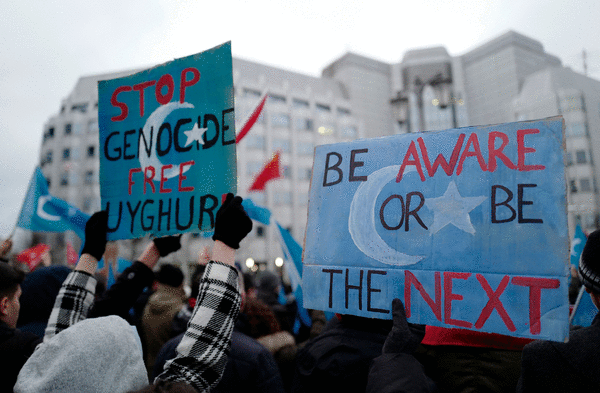
I was wrong. This was not another gig. I found that out the evening we chatted with Mihrigul Tursun, a member of the Uyghurs, a mostly Muslim ethnic group from northwest China. Under Xi Jinping, the Chinese government has subjected the Uyghurs to mass detention, surveillance and a campaign to erase their culture and faith. Tursun, 36, told us that her newborn son — one of triplets — had been killed by the Chinese Communist Party and that she was tortured in internment camps. She has lost most of the hearing in her right ear.
No surprise Tursun wakes up screaming in the middle of the night, and wonders if it might be better if God were to take her away.
“I wanted to kill them all,” she said, “to destroy all of the Chinese government.”
After that interview, I found myself consumed by rage, wanting justice for what she endured.
Why had I gone from “just another gig” to this rage? It had to do with my Jewish upbringing — I had the first of my two bar mitzvahs at the Wailing Wall in Jerusalem — and with the fight I was part of a half century ago, for the refuseniks, the Jews who yearned to escape the Soviet Union. The fight in the People’s Republic of China is essentially the same: heroic individuals who are being persecuted for their religion.
After the interview with Tursun, the refuseniks were on my mind every time I spoke to a victim of Chinese oppression.
Take Wang Chunyan — a 70-year-old Falun Gong practitioner who spent seven years in prison, in two separate terms. She printed and distributed fliers.
Or Pastor Pan Yongguang, 48, who helped 63 members of his house church — renamed the Mayflower Church — flee to an island in South Korea, then to Thailand and, eventually, to Midland, Texas, where they live and worship today.
Or Arjia Rinpoche, 75, a high lama from Tibet, who was 8 in 1958 when Chinese soldiers arrested about 500 monks from his beloved monastery, many never to be seen again.
Two months ago I spoke to Natan Sharansky, the well-known refusenik who spent nine years in captivity in the Soviet Union in the 1970s and ’80s. I asked him why we, in the United States, should be concerned with the oppression in China.
Sharansky, 78, who lives in Israel, said that we should care “because you are part of this world and they are part of this world.”
As he spoke, I thought back to a story I wrote in March 1978 for the Michigan Daily, my college newspaper in Ann Arbor, about Sharansky’s wife, Avital.
Avital was generating support for her husband, who had been arrested a year before and charged with treason, and other Soviet dissidents.
I rediscovered the article recently.
“To write letters,” she had said through an interpreter, “is not enough. You must show all Soviet citizens in this country what your attitude is. The more you protest, the better the situation will be.”
What Avital said remains truer than ever today. We who enjoy religious freedom — thanks to the foresight of our nation’s founders — must protest. I don’t care if that might harm our economic relationship with China. As President Kennedy said in June of 1963, about the struggle for civil rights in America, “We are confronted primarily with a moral issue.” China is committing mass atrocities against three groups: the Uyghurs, Falun Gong and the people of Tibet.
Remarkably, sadly, the world is silent. That includes the United States.
Even so, I remain hopeful. I’ve seen cause for hope before, in unlikely places.
On a Friday night in September 2016, I went to a synagogue in the city of Tver, about two hours from Moscow.
Only nine men were there, and you need 10 Jewish men in an Orthodox synagogue to constitute what’s known as a minyan and hold a group service.
With me, they now had 10.
I was incredibly moved to make it possible for them to pray together, and I thought how far we had come from the days my teacher in high school met with Jews in the Soviet Union. That progress is thanks, in no small part, to President Reagan, Pope John Paul II and Mikhail Gorbachev.
Things looked bleak for Jews in the Soviet Union in the 1970s, and they look bleak for the people of faith in China today.
But things can change. If we stand up and never give up.
____
Michael Arkush is a former Times staff writer.
©2026 Los Angeles Times. Visit at latimes.com. Distributed by Tribune Content Agency, LLC.





















































Comments