Allison Schrager: Trump accounts are a new way to redistribute wealth
Published in Op Eds
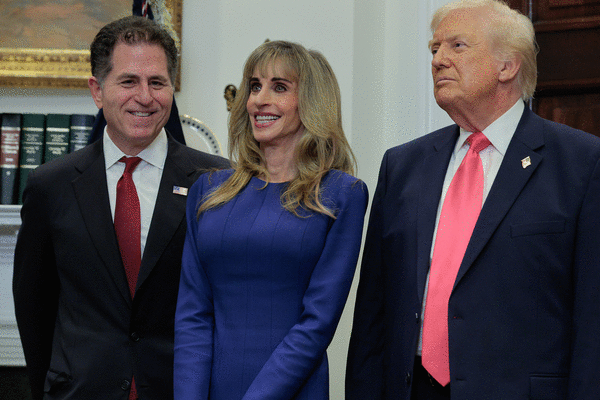
Economists may disagree about how important the issue of wealth inequality is, but politicians don’t. With a majority of Americans saying the gap between rich and poor is a very big problem, punitive wealth taxes are gaining in popularity and some elected officials are feuding with their wealthiest citizens.
Now the wealthy are responding — not just by moving to walled compounds in Miami, but in a more productive way: by giving their money directly to children in lower-income families. First Michael Dell and his wife donated $6.25 billion last year to seed so-called Trump accounts for up to 25 million children with $250 each. Now there are reports that the administration is considering a plan to allow these accounts to accept direct donations of stock from billionaires, who are said to be interested in the idea.
It may be a pittance compared to how much billionaire wealth is redirected through the tax system or charitable giving. But it could mark a big shift in how the wealthy donate.
The rich have reason to worry. The last time the world experienced profound technological change was during the Industrial Revolution of the 19th and early 20th centuries, when wages stagnated, working conditions were miserable and a few got rich. In the end, wages caught up and prosperity did spread — but it was a long and difficult process, full of righteous anger, and some countries adopted a version of Marxism that ended badly for everyone involved.
Today we are dealing with another technological advance that may profoundly change the structure of the economy. It is unclear how the AI boom will play out, but there is a lot of anxiety. If it is like last time, at least initially, the biggest beneficiaries will be owners of capital. When wages don’t go up or, worse, people lose their jobs, things will get worse.
There are reasons to think this time will be different. There are better working conditions and labor standards. In the 19th century there was a stark divide between owners of capital and labor. Now nearly 60% of Americans own stock, and there is a large middle class and a growing upper-middle class. But the risk of too many people falling behind is still too great. Of the 40% of the population that does not own stock, most have little or no wealth. That not only makes them more financially vulnerable, unable to buy a home or pay for education, but they also have less of a stake in the economy’s growth.
In many ways, the philanthropic culture of the U.S. today is a product of the last Gilded Age. The generosity of so-called robber barons such as Rockefeller and Carnegie was critical to the growth of charities and nonprofit foundations, which have become a large part of the economy and provide many needed services, even as they face the same trust issues that afflict other U.S. institutions. Many nonprofits supplement government benefits, so donating to them is a form of redistribution. The alternative would be to increase government spending on social benefits, which would require higher taxes. The difference is that the wealthy give to charity at their pleasure (though they do get a tax benefit) and can direct their money to causes they favor.
Putting money directly into Trump accounts is fundamentally different: It goes directly to the beneficiaries. Whether it will be more effective at improving prosperity or reducing populist anger is unclear. The public/nonprofit model can be better targeted and address specific societal needs, such as hunger or education. And giving people shares in companies or a market fund exposes them to risk: If the market goes down, they may not be able to pay for college or buy a home. Benefits, either from the government or charity, act as insurance — they pay off when you most need them. That insurance can be especially valuable for low earners with volatile income.
On the other hand, putting money in the accounts addresses wealth inequality more directly. Individuals may bear more risk — but that also comes with upside. If the economy grows from an AI productivity boom, more Americans will share in the benefits. Individuals may also have a better sense of their own needs than the government or a charity. The system may also be more efficient, as more money goes directly to the people who need it rather than bureaucrats or nonprofit workers. People may appreciate the accounts more since they are more transparent. And some studies have found that cash transfers are more effective than government benefits, aid or charity.
Trump accounts will not displace government benefits, nor should they; the insurance aspect of the welfare state is too valuable to abandon. But they may mark a turn in how the very wealthy give back to society. The accounts may disrupt a system of charitable giving that has mostly served the U.S. well since the late 19th century. But just as the 21st-century economy has invented new ways to create wealth, it may also require new ways to redistribute it.
____
This column reflects the personal views of the author and does not necessarily reflect the opinion of the editorial board or Bloomberg LP and its owners.
Allison Schrager is a Bloomberg Opinion columnist covering economics. A senior fellow at the Manhattan Institute, she is author of “An Economist Walks Into a Brothel: And Other Unexpected Places to Understand Risk.”
©2026 Bloomberg L.P. Visit bloomberg.com/opinion. Distributed by Tribune Content Agency, LLC.



















































Comments