Commentary: Why the Iranian regime's 'fortress' is failing
Published in Op Eds
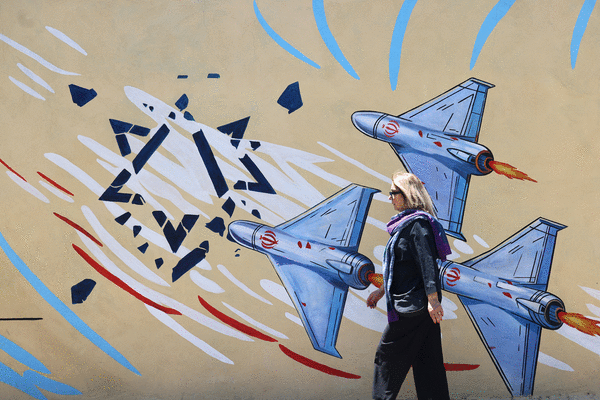
In Tehran today, a single fried egg costs a million rials. This staggering price tag is not just an economic anomaly; it is the sound of a regime’s foundation cracking. While the world’s attention remains fixed on the military hardware of Iran’s regional proxies, the Islamic Republic’s greatest threat to survival has proved to be not the United States, but its own disillusioned and starving people. Following a war that began Feb. 28 and a ceasefire that started April 8, it has become clear: Tehran is no longer just fighting for regional dominance. It is fighting a losing battle for domestic legitimacy.
The Iranian economy is currently facing an unprecedented crisis. According to the Persian-language news organization Iran International, the exchange rate for the U.S. dollar has surged to 1.8 million rials. In Tehran, where the minimum wage sits just above 200 million rials a month, the daily struggle for basic sustenance has become a catalyst for revolt. Calls for government accountability have become routine on Iranian social media and are even surfacing within the state-controlled press.
Niccolò Machiavelli, in his 16th century political treatise “The Prince,” writes in Chapter 20 about how it is a custom of leaders to hold their states securely by building fortresses as a refuge from foreign attacks. Today, the Iranian regime’s “fortress” is both physical and human. It consists of sprawling subterranean “tunnel cities” in Lebanon and a ring of aggressive proxies — stretching from Hezbollah to the Houthis in Yemen. These proxies serve as the regime’s external walls, designed to outsource instability and keep the threat far from Tehran. However, Machiavelli offers a sobering warning: The best possible fortress is “not to be hated by the people.”
The “Prince” in Tehran is profoundly hated, and his walls are cracking. While the Israel Defense Forces continue to dismantle the physical fortress — recently demolishing the largest Hezbollah tunnel network in southern Lebanon— the Iranian people are dismantling the regime’s internal legitimacy. Reports of emergency meetings of Iran’s Supreme National Security Council reveal a leadership in panic, terrified of a populace that has reached its limit. Yet, at this critical junction, European leaders such as German Chancellor Friedrich Merz are floating the idea of sanctions relief. Offering a diplomatic lifeline now is a strategic blunder; it provides the very resources needed to repair the “Prince’s” crumbling walls and suppress the domestic uprising that Machiavelli predicted would be his ultimate undoing.
The failure of past diplomacy, most notably during the 2016 transfer of $1.7 billion in cash under President Barack Obama, was not merely an inability to win hearts and minds. It was a structural failure to recognize that resources provided to the regime are never intended for the people. Instead of addressing the domestic crisis, these funds were immediately diverted to cement the regime’s regional fortress — funding the Houthis, Hezbollah and the construction of the tunnel cities. Any economic relief provided to the regime is a direct investment in its proxies, not a relief for its subjects.
The West faces a definitive choice: to stand with the Iranian people or to throw a lifeline to the “unloved Prince” they seek to overthrow.
Any pivot toward diplomacy that includes sanctions relief — whether proposed in Washington or Berlin — ignores the fundamental Machiavellian truth that a regime hated by its own people cannot be saved by its external fortresses, but it can be artificially sustained by foreign gold. History will judge today’s leaders not by the temporary stability of a flawed ceasefire, but by whether they chose to empower a crumbling tyranny or the courageous populace ready to replace it.
As the physical tunnels of the regime are unearthed and destroyed, the West must refuse to build new diplomatic ones. It is time to stop repairing the ayatollahs’ walls and start supporting the people who are ready to bring them down.
____
Bradley Martin is executive director of the Near East Center for Strategic Studies. Dr. Liram Koblentz-Stenzler is the head of the Global Extremism and Antisemitism Desk at the International Institute for Counter-Terrorism at Reichman University in Herzliya, Israel, and a visiting scholar at Brandeis University.
___
©2026 Chicago Tribune. Visit at chicagotribune.com. Distributed by Tribune Content Agency, LLC.





















































Comments