John M. Crisp: The good death is still very elusive
Published in Op Eds
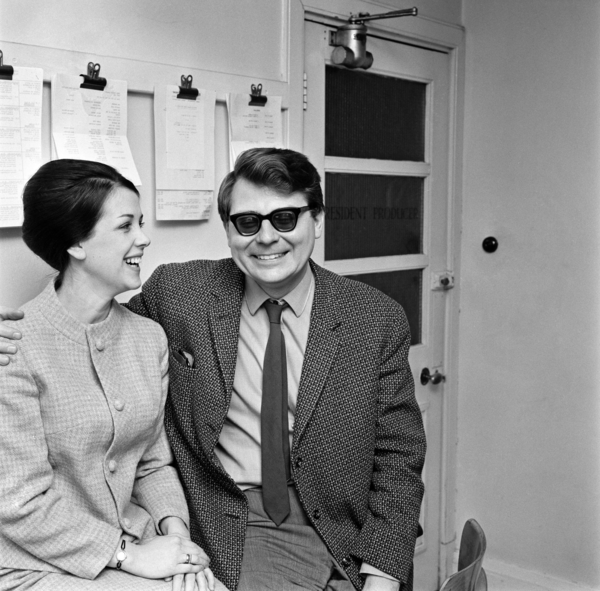
In 2009, I wrote a column about Sir Edward Downes and his wife, Lady Joan.
They were remarkable people. Sir Edward, 85, had a long career as a conductor with the Royal Opera House, and he led symphony orchestras worldwide. His specialty was opera, particularly Verdi. Lady Joan, 74, was a dancer with the Royal Ballet, as well as a choreographer and television producer.
They were married for 54 years. Lady Joan said, “It has been a happy and interesting life and I have no regrets.… Enjoy it while it lasts.”
Sir Edward and Lady Joan had a good life. They also had a good death, or so I contended in 2009.
Lady Joan was in the last stages of pancreatic cancer and had only a short time to live. Sir Edward wasn’t terminally ill, but he was nearly blind and deaf, which, Beethoven notwithstanding, must feel close to death for a long-time conductor of symphony orchestras.
The Downes family, husband and wife, son and daughter, flew from Britain to Zurich and checked into a clinic operated under Switzerland’s liberal assisted suicide laws.
After long successful careers in the arts and decades of happy marriage, Lady Joan and Sir Edward lay down in adjacent beds and, holding hands, died together within 10 minutes.
Their son said, “They wanted to be next to each other when they died.” Which they were, with the benevolent help of a few sips of a combination of barbiturates.
I thought of the Downes recently, when I came across the story of the Posners, Ruth, 96, and Michael, 97. It turns out that 16 years after the Downes’ fatal trip to Zurich, people who want the same good death still have to go to Switzerland.
Ruth was a Holocaust survivor who arrived in Britain when she was 16, speaking no English. She trained as a dancer, then an actress and eventually became a member of the Royal Shakespeare Company. Michael was a chemist who worked for Unilever and the United Nations Children’s Fund. They traveled the world together for Michael’s work.
A friend described Ruth as “frail,” and Michael had macular degeneration and poor hearing. Near the end of their long lives and 75 years of marriage, “They were exhausted and felt the time had come. They did not want to live without each other, so they decided to die together.”
They went to Switzerland and left this world with droll British understatement, informing their friends with an after-the-fact email: “Sorry not to have mentioned it, but when you receive this email we will have ‘shuffled off this mortal coil’.”
It’s far beyond the scope of this column to parse the complexities of assisted suicide and euthanasia, a slope that’s both steep and slippery. The potential for abuse is significant. Policies that are too liberal could encourage the temporarily depressed to end their lives before other remedies have been explored. Impatient beneficiaries of wills and trusts might have an incentive to nudge their elderly parents prematurely into the Great Beyond.
The religious may feel an obligation to endure all of the pain, suffering and indignity that typically accompany decline and death. God alone should determine when we are born and when and how we die.
These are all important concerns. But I’m moved by the arguments that support personal freedom in how we die. Others may choose to endure the calamities of late-stage old age and the pain of death, but shouldn’t individuals have the right to choose to forgo them?
Of course, they already do; it’s called suicide.
But consider Lady Joan and Sir Edward and Ruth and Michael: A murder/suicide? Unpalatable, illegal and probably impossible. Instead, they found a rational solution and ended their lives on their own terms, with dignity and, let’s face it, a touch of romance.
Couldn’t we take some of the fear, anxiety and pain — the “sting” — out of death by taking more control of it?
Switzerland is a wonderful country, but we shouldn’t have to fly there to die according to our wishes.
___
©2026 Tribune Content Agency, LLC



















































Comments