Commentary: Here's how we hold federal agents accountable for their actions
Published in Op Eds
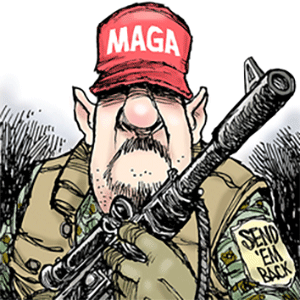
President Donald Trump does not like Chicago. That is obvious. He regularly belittles elected officials — calling Chicago’s mayor a “low IQ” person — and gleefully trumpets gun violence in our city. A feature of Trump’s obsession with public safety in Chicago has been the repeated claim that he can fix the city’s public safety issues. First, he claims Chicago will be safer if he is allowed to send a phalanx of federal forces into our city. But he also believes that these federal officers should be able to act without any accountability when patrolling our neighborhoods, especially our Black, brown and immigrant communities.
The inanity of Trump’s approach to public safety was laid bare by events of recent months. Under the guise of enforcing civil immigration law, Trump ordered hundreds of masked, heavily armed federal agents into cities. But the flood of forces in places such as Los Angeles; New Orleans; Memphis, Tennessee; Minneapolis; Charlotte, North Carolina; and Chicago undermined rather than enhanced public safety.
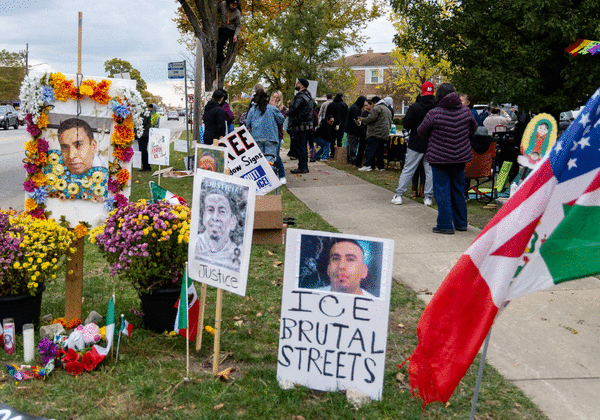
Of course, we all witnessed through videos federal agents fatally shoot Renee Good and Alex Pretti in Minneapolis. In Chicagoland, we witnessed the shooting death of Silverio Villegas González in Franklin Park and the serious wounding of Marimar Martinez in the Brighton Park neighborhood. We saw federal officers aggressively raid an apartment building, point deadly weapons at people and routinely use projectiles and chemical agents on protesters and bystanders. Federal officers also used excessive force to detain people, including chokeholds and restraints that are not permissible under Illinois or federal law.
Chicago’s experience underscores the crucial importance of federal agent accountability. While evidence quickly emerged that raised questions about the Department of Homeland Security’s account of Villegas González’s shooting, no independent investigation has been launched into that tragedy. The officer who rammed Martinez’s car and shot her multiple times — and bragged about it in his text messages — was allowed to leave the state and repair the car involved in the incident.
As we have seen, the Trump administration eschewed any independent investigation of the Good and Pretti killings, pushing state and local experts out and quickly moving to smear both Good and Pretti. In response to events like these, senior administration officials have repeated the claim that federal officers have “total immunity” and can act in any fashion they please — even at the cost of our neighbors’ lives.
Faced with an administration that has no interest in holding agents accountable, many state and local leaders are working on ways to bring federal officers to justice for violating the law during the surges into cities around the country. The Hennepin County, Minnesota, prosecutor recently announced charges against an Immigration and Customs Enforcement officer who allegedly pulled a gun on unarmed motorists in Minneapolis. But these are difficult pathways, raising legal and constitutional questions that may delay or derail the search for accountability and justice.
There is a sure way to ensure that accountability applies to everyone — including federal officers. A string of recent Supreme Court decisions has severely limited individuals’ ability to sue federal officers for constitutional violations. This includes the evisceration of so-called Bivens actions, named after a Supreme Court case that authorized damages lawsuits against federal officers when they violate the Constitution. The Bivens Act, now pending before the United States House of Representatives, restores the people’s right to get meaningful relief in court when federal agents violate peoples’ constitutional rights. It reaffirms the fundamental principle that no one — including officers sent into our streets by Trump — is above the law. The American Civil Liberties Union of Illinois will join others on Capitol Hill during Community Safety Week in May to advocate for the Bivens Act.
In Chicago, we know that public safety is a complex issue that cannot be solved by fantastical quick fixes or by reckless late-night social media posts from officials more interested in burnishing their “tough on crime” bona fides than finding actual solutions. The hard work of improving public safety is a mixture of working in our communities and neighborhoods, investing in public programs that offer hope to residents and holding everyone — including law enforcement — accountable for their actions. This accountability is critical to establish trust between law enforcement and the public they serve, a trust that further enhances public safety.
Trump does not understand that need for trust. He believes that force and power are the solutions to every problem. Congress should act to restore the American people’s confidence that federal law enforcement officials will face consequences for their illegal actions — before Trump’s recklessness further breaks the public’s trust.
____
Edwin C. Yohnka is director of communications and public policy at the American Civil Liberties Union of Illinois.
___
©2026 Chicago Tribune. Visit at chicagotribune.com. Distributed by Tribune Content Agency, LLC.
















































Comments