Allison Schrager: Yale is the least of US higher education's problems
Published in Op Eds
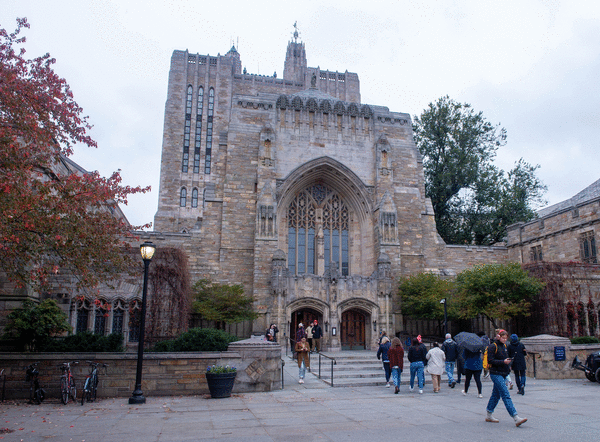
Last week Yale University took the first step on the road to recovery: It admitted it had a problem. That problem is a lack of trust — and the damage that Yale and other top schools have done isn’t to themselves, it is to the entire system of U.S. higher education.
America’s elite universities, which produce world-class research and attract top scholars from around the globe, should be a source of pride. But most Americans mistrust the U.S. higher education system, and last year Yale’s president assigned a committee to study the reasons why. The resulting report identifies several culprits: high tuition costs, opaque admissions practices, a politically monolithic culture, and a weak commitment to academic rigor and open debate.
These perceptions, the report concedes, are not entirely wrong. The irony here is that even if Yale does nothing to change, it will probably be fine. Elite students and scholars will still want to go there. Donors will still give them money. The consequences will redound for people who go to schools not named Yale or Harvard.
Anyone who would consider a top school like Yale won’t decide against college altogether because of the flaws and excesses detailed in this report. I worry more about the first-generation students who are ambivalent about going to college in the first place, uncertain about whether the investment is worth it and whether they can stick with it.
In the last 60 years, getting a college degree became part of the American Dream. Technology and the economy changed in ways that rewarded graduates with higher earnings. The result was that many more people — not just the children of the elite but first-generation students too — went to college.
In the last few years, however, this trend has started to reverse. Now about 62% of high school graduates enroll in college or university, down from 70% several years ago.
There is no single reason Americans have turned on higher education, although one big one is that a degree does not pay off like it used to. If you graduate from a four-year degree program at most schools, the odds are still very good that your degree will confer higher earnings over your lifetime. But it is no longer a sure thing. And as tuition got more expensive after 2000, the college wage premium also stagnated. It seems like college is no longer such a good deal.
Still, given the positive expected value, economics alone can’t explain falling enrollments. One reason could be that the mission of many elite universities is muddled. Back when only a small fraction of the population went to college, it could be just a place to read great books, have fun, and stay up late in your dorm room debating Marxism. When it was over, you got a job in banking or law. Elite universities were especially good at providing that experience, and graduates were rewarded with higher pay.
But once more people started going to college, the experience had to provide more transparent economic value. In theory, less elite schools could have become more like trade schools, but this didn’t happen (perhaps because the less elite schools are largely staffed by graduates of elite schools). Also the incentives were never there to change because the U.S. subsidizes all college degrees, even if some pay off more than others.
What if the mission was just academic excellence? In that case, almost all universities — and especially elite ones — failed. Most students don’t go to elite universities, but these schools get outsized attention. So it’s hard not to notice how the supposedly best and brightest students don’t care about their classes, don’t get real grades, and often seem comically immature when trying to be taken seriously. Then students had the nerve to demand the government forgive their loans, an unpopular stance with many Americans.
If these elite schools can’t deliver on their most basic mission, what does that say about the system as a whole? The financial returns to a degree have been falling for years, but the decline in enrollments and erosion of trust is relatively recent, and coincides with many of the controversies that have erupted on elite campuses.
America’s higher education system is already shrinking and will probably shrink further, especially if it continues to be hard for graduates to find jobs. Some colleges are closing, and universities are focused on degrees that offer a higher earning potential and are cutting departments that are less popular.
These falling enrollments may well be justified. At the same time, for all its problems, college remains an important contributor to economic mobility. It still usually produces higher earnings, and it brings together people from different economic backgrounds.
If the U.S. values economic mobility, the whole system of higher education needs to regain the trust of the public. If more marginal schools want to survive, they will need to be less academic and provide more training in skills that translate into jobs. More elite schools can restore trust by returning to a focus on academic excellence rather than trying to solve all of society’s problems.
Yale’s report does have some good ideas that other universities are also trying, such as curbing grade inflation, making admissions more transparent, reforming university governance and cutting administrative bloat. Fixing the perception of political bias will be harder, especially since most academics lean left.
But if universities want to offer a truly rigorous education that is open to good-natured debate, students and faculty of different political backgrounds will need to feel more welcome. Without substantial change, U.S. universities may squander what little trust they have — and the country will be worse off.
_____
This column reflects the personal views of the author and does not necessarily reflect the opinion of the editorial board or Bloomberg LP and its owners.
Allison Schrager is a Bloomberg Opinion columnist covering economics. A senior fellow at the Manhattan Institute, she is author of “An Economist Walks Into a Brothel: And Other Unexpected Places to Understand Risk.”
_____
©2026 Bloomberg L.P. Visit bloomberg.com/opinion. Distributed by Tribune Content Agency, LLC.




















































Comments