Commentary: Will King Charles' visit help soften the animus between the US and the UK?
Published in Op Eds
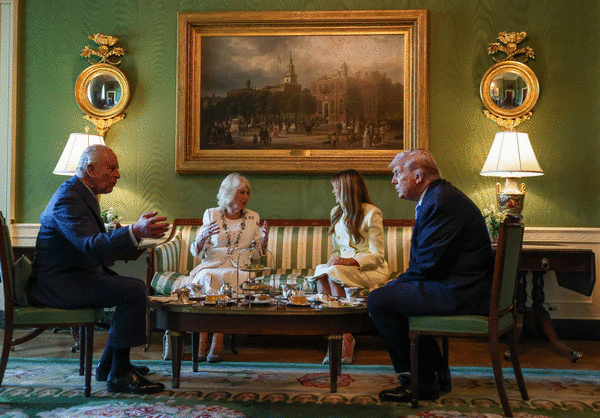
King Charles III is Donald Trump’s opposite in every way. The former is a master of protocol: Everything he does daily is scripted to a T. The latter despises a script, hates giving formal speeches and prefers to ad-lib in front of his supporters. Due to his bloodline and the role of the monarchy in British life, Charles rises above the fray of Britain’s increasingly bitter politics. Trump, meanwhile, relishes partisanship and uses it to his advantage.
This week, the unlikely pair are meeting for a second time in less than a year while Charles is in Washington for a multiday state visit. His itinerary includes the usual goings-on for a head of state — a symbolic speech to Congress one day and a visit to chat with 9/11 families in New York the next. Pomp and circumstance will be on full display as one might expect. Even so, the monarch will have some work to do on this side of the pond. Job No. 1: Use the gravitas of the British royal family to chip away at the animus that has bedeviled the U.S.-United Kingdom relationship since the beginning of the year.
Although it would be an exaggeration to say that the so-called special relationship is falling apart, ties between the kingdom and its former colony are certainly at a low ebb. The U.S. and U.K. have clashed over everything from energy policy and trade to NATO and the status of Greenland, the large ice-covered Danish territory that Trump at one point threatened to seize by force. Trump, who has immense respect for the royals but very little for the British politicians actually running the country, has taken a liking to lumping the U.K. in with “woke” European states that have, in his view, turned a once-great continent into a hellscape overrun by migrants, crime and windmills.
It didn’t start out this way. During Trump’s first year, British Prime Minister Keir Starmer emerged as one of the few government heads on his side of the Atlantic who could manage the mercurial American president, particularly on Ukraine, where Trump has long wanted to cut a deal with Russian President Vladimir Putin. Trump constantly referred to Starmer as a leader who was doing a good job in a tough position. The two reached a trade agreement last May, a relatively short negotiation that was far less painful than the trade talks the White House had with the European Union.
But the 2-month-old war in Iran has driven the relationship into lower depths. Wedged in between a war in the Persian Gulf that he chose to fight but which he’s having trouble extricating from and oil prices 50% higher than they were earlier in the year, Trump has taken to bashing the U.K. for being no better than those hapless Europeans. Trump expected the British to make their air bases in the region available for U.S. bombers, but Starmer’s government rejected those requests. London’s decision to change tack and allow U.S. military aircraft to use British bases for defensive strikes against Iran along the Strait of Hormuz didn’t satisfy Trump; he apparently believed that Starmer would keep his concerns to himself and follow Washington’s lead like then-Prime Minister Tony Blair did in Iraq two decades before.
Things have further devolved. Trump repeatedly has implied that Starmer is a modern-day Neville Chamberlain who really has nothing to offer the United States.
Starmer, now one of the most unpopular politicians in the U.K., has used Trump’s bellicosity to his advantage. Standing up to Trump is a surefire way to earn decent ratings from members of the British public, who have a highly negative view of the American leader. Starmer is no longer acting as the amiable pushover; he’s now the bold-faced Brit sticking up for U.K.’s national interest. During successive interviews and sessions in the House of Commons, Starmer consistently has argued that he won’t bow to Trump’s pressure tactics by sending the U.K. armed forces to do battle with the Iranians.
He’s also getting louder in his criticisms of U.S. policy. “I’m fed up with the fact that families across the country see their bills go up and down on energy, businesses’ bills go up and down on energy because of the actions of Putin or Trump across the world,” Starmer told British television earlier this month. It’s not an unsubstantiated complaint; the International Monetary Fund has assessed that the U.K. is more exposed to energy supply disruptions in the Middle East in relation to other advanced economies, and it cut its growth forecast for the British economy as a result. For Starmer, whose future as leader of a progressively rudderless Labour Party is now at risk, these projections are about as helpful as a hole in the head.
The negativity surrounding Trump’s war of choice in Iran can’t be chalked up to simple ideological divides between left and right either. Kemi Badenoch, leader of the right-wing Conservative Party, at first applauded the U.S. and Israeli bombing campaign against the Iranian regime. But as the economic costs have gotten more pronounced, she has come to criticize the Trump administration for the lack of a coherent plan and for leaving the region in a mess. Even Nigel Farage, who considers Trump a personal friend and whose Reform U.K. Party is the closest Britain has to Trump’s MAGA movement, has given Starmer credit for refusing to become an active belligerent in the conflict.
King Charles, therefore, has his work cut out for him. It’s a thought that will no doubt linger in his mind as he dines at the White House and poses for pictures with lawmakers at the Capitol.
____
Daniel DePetris is a fellow at Defense Priorities and a foreign affairs columnist for the Chicago Tribune.
___
©2026 Chicago Tribune. Visit at chicagotribune.com. Distributed by Tribune Content Agency, LLC.


















































Comments