Andreas Kluth: The Iran war may become a 'phoney Sitzkrieg'
Published in Op Eds
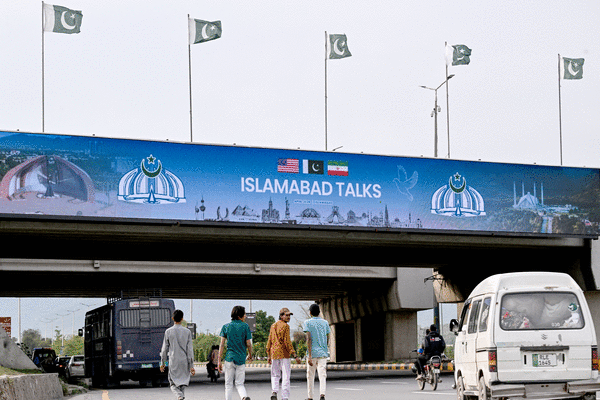
The war that the United States and Israel launched against Iran, and by extension Lebanon, seems to have entered a new phase, which might be called a Sitzkrieg, a “Bore War,” drole de guerre or a “phoney” (sic) war.
Those terms come from one of the strange early phases of World War II. After the Nazis invaded Poland, Britain and France declared war on the Third Reich. For eight months, however, nothing much happened. The Allies blockaded Germany, a bit as the U.S. and Iran now maintain dueling blockades of the Strait of Hormuz. But a few other skirmishes aside, the belligerents conserved their resources. The real carnage commenced only in early 1940.
The Germans called that phase Sitzkrieg, a “sitting war,” in a pun on Blitzkrieg. The Brits referred to it as the Bore War, a play on “Boer War,” and the French named it the drole de guerre, meaning strange rather than funny. Eventually, a U.S. senator from Idaho came up with the label that stuck, when he observed that “there is something phoney about this war.”
The circumstances in the Iran war are different, of course, but the limbo feels similar: “No peace, no war — the new U.S.-Iran normal.” That’s how my colleagues at Bloomberg Intelligence — Dina Esfandiary, Ziad Daoud and Becca Wasser — put it.
Because a deal to end the war seems elusive, the Americans and Israelis on one side and the Iranians on the other are instead abiding, more or less, by fragile ceasefires, which they may extend a few more times. But the bombing, killing and dying could start again at any moment, and could even escalate.
This development is “not the worst,” Esfandiary, Daoud and Wasser conclude. It’s better than continued hot or “kinetic” war, with additional thousands of Iranian and Lebanese deaths and many more American casualties than the 13 killed and 400 injured so far. And a leaky quasi-blockade of the strait that keeps the price of oil near $100 definitely beats a total closure of the waterway that sends oil in the direction of $200.
And yet even phony wars have costs and risks. The inability of Washington and Tehran to reach a deal highlights how far — and possibly even how much farther than before Feb. 28 — Washington and Tehran remain apart.
For a start, they appear unlikely ever to agree on what should happen to Iran’s enriched uranium, which the American president keeps calling “dust.” It’s easy to forget (because President Donald Trump has changed or amended the stated objectives of his war so many times), but stopping Iran’s nuclear program was the original impetus for the American bombing last June (after which POTUS claimed to have “obliterated” the facilities) and again for the current war.
Iran’s leadership — more decentralized but in parts also more radicalized after the many decapitation strikes — is now likely to be even more determined to build nukes. After all, they’ve had American bombs falling on them, whereas North Korea’s Kim Jong Un, who already has his atomic arsenal, has not.
Tehran has also picked up a new weapon that is more versatile and deployable than an atomic warhead: the means to throttle the strait, and thereby much of the world’s oil and chemical supplies, and by extension the global economy. The regime now wants to turn the passage into a lucrative toll booth. Karim Sadjadpour at the Carnegie Endowment for International Peace puns that Tehran has discovered “over the last five weeks that Hormuz enrichment is a far more potent tool than uranium enrichment.”
Aside from this stalemate between Washington and Tehran, the downstream costs for the United States are becoming clearer. In terms of geopolitical prioritization, the war has been a disaster. Having promised in its National Security Strategy to shift resources from the Middle East to the Western Hemisphere and the Indo-Pacific, the Trump administration has just spent two months doing the exact opposite.
It has moved ammo and troops from East Asia to the Middle East. And it has depleted its stockpiles of missiles, having used up about half of its Patriot and THAAD systems, for example. These stocks will take years to replenish. The risk, according to the Center for Strategic and International Studies, “lies in future wars” against adversaries, including China or Russia, who could hurt America and its allies much more directly and gravely than Iran. Lithuania and Estonia, which border Russia, have already been informed that, owing to shortages, the U.S. will delay military equipment slated for them.
A clear end to the Iran war would give the U.S. the chance to address these many risks. If America had achieved the “UNCONDITIONAL SURRENDER” that Trump demanded early in the war, it could now set about liberating Iranians, rebuilding the Middle East, replenishing its resources and girding for future crises in other regions. Even if the U.S. conceded defeat and retreated, as it did in Vietnam, it would survive the setback and could harness its might for the contest that matters most, with China.
A phony war prohibits these corrections. It pushes the world closer to economic recession, alienates America’s allies in Europe and Asia and leaves the U.S. more isolated. And it keeps sucking up America’s military resources and limited political attention. At worst, as in 1939, this Sitzkrieg is only a prelude to an even greater conflagration. At best, if that is the word, it will merely tie America down, rendering it less able to manage its own relative decline.
_____
This column reflects the personal views of the author and does not necessarily reflect the opinion of the editorial board or Bloomberg LP and its owners.
Andreas Kluth is a Bloomberg Opinion columnist covering US diplomacy, national security and geopolitics. Previously, he was editor-in-chief of Handelsblatt Global and a writer for the Economist.
_____
©2026 Bloomberg L.P. Visit bloomberg.com/opinion. Distributed by Tribune Content Agency, LLC.



















































Comments