Noah Feldman: Thou shalt not overturn Supreme Court precedent
Published in Op Eds
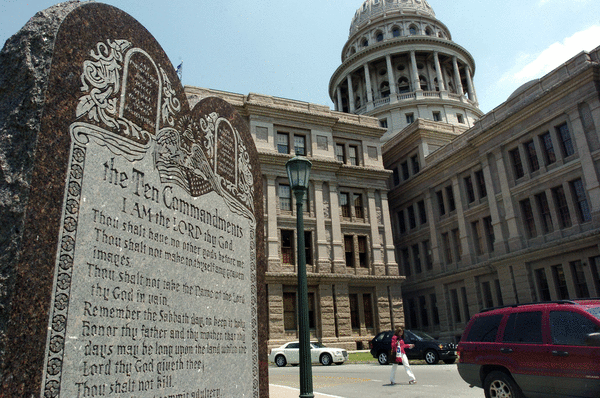
In an outrageous decision issued yesterday, a federal court has upheld a Texas law requiring the display of the Ten Commandments in public school classrooms. The U.S. Court of Appeals for the Fifth Circuit held that the displays would not have counted as an establishment of religion in 1791, when the First Amendment was ratified.
This is terrible originalism. The establishment clause of the First Amendment was written and intended to prohibit two things: religious coercion and government expenditure to support religion. The Texas law coerces school children to be in classrooms where the explicitly religious messages of the Ten Commandments are held up as models. And while posting the Ten Commandments signs may not be expensive, it does cost something — and properly understood, the First Amendment prohibits any expenditure for religious purposes.
In 1980, in a case called Stone v. Graham, the Supreme Court held that requiring displays of the Ten Commandments in classrooms violates the constitutional prohibition against any “law respecting an establishment of religion.” At the time, prevailing Supreme Court doctrine said that if a law didn’t have a secular purpose, it violated the establishment clause. The court thought it was plain that the “Ten Commandments in the classroom rule” did not have a secular purpose.
Texas passed its Ten Commandments law in 2025 hoping that the Supreme Court would overturn its 1980 decision. That hope came from a landmark 2022 Supreme Court decision, Kennedy v. Bremerton.
In the Bremerton decision, the court repudiated the old secular-purpose test. (That test was part of what is often called the Lemon test, because it was laid out in a 1971 case called Lemon v. Kurtzman.) Instead of looking at secular purpose, the Supreme Court said that the meaning of the establishment clause should now be measured by “reference to historical practices and understandings.”
Since the Bremerton decision overturned the secular-purpose test, and the 1980 Stone decision relied on the secular-purpose test, the Fifth Circuit reasoned that Stone had also been overruled.
That isn’t necessarily right. The Supreme Court is the only body that can overturn its own precedent, and it hasn’t yet overturned the no-Ten-Commandments-in-class rule.
Yet the technical issue of whether the Fifth Circuit should have waited for the Supreme Court is much less significant than the appeals court’s bad reasoning when it purported to apply the historical test.
In reaching its conclusion that the class display wouldn’t have counted as an establishment of religion, the court neglected to mention (much less consider) the underlying reason for the establishment clause — to protect citizens’ liberty of conscience from the government. The protection of liberty of conscience resulted in the two components of the establishment clause’s meaning, which are to protect people from being religiously coerced, and to spare them from having to pay taxes that would go to support religion in violation of their own conscience. In my own book on the subject, I summed up the original meaning of the establishment clause with a simple slogan: no coercion and no money.
The Texas law violates both parts of the establishment clause’s original meaning. As the Supreme Court has held with respect to prayer in schools, requiring students to be present when religious words are spoken amounts to unconstitutional coercion. The same is true of words that are prominently displayed in every classroom, which serve the same purpose of requiring students to be exposed to religious truths. It’s not an accident that classrooms in religious schools display various religious messages. (Mine certainly did.) It’s part of the pedagogy.
The Fifth Circuit attempted to distinguish the Ten Commandments display from mandatory “scripted” prayer or “corporate worship,” which it conceded would count as coercion. (Note the word “scripted,” which seems to imply that mandatory unscripted prayer would somehow not violate the establishment clause.) But the coercive purpose of the display is precisely the point: The state wants every student to be exposed to the Ten Commandments all day every day, with the goal that the teachings will rub off on them.
The Fifth Circuit also seriously flubbed the no-money portion of the establishment clause test. The Texas law allows the use of public funds to buy the Ten Commandments displays. But the court claimed that this didn’t count as an impermissible expenditure because the law “neither requires such funding nor compels anyone to pay for the displays.” The use of state funds means the use of tax dollars that are in fact coerced and mandatory — precisely the concern of the no-money part of the establishment clause test.
Finally, the Fifth Circuit avoided what may well be a crucial part of the Supreme Court’s analysis when this case reaches the court: namely, the absence of any historical tradition in the U.S. of mandatory religious displays in public school classrooms. The reason for that tradition is America’s national religious diversity, as well as the collective recognition that putting religion in the classroom is an invitation to a permanent fight over what version of religion should be there.
To allow the Ten Commandments in classrooms is to open the door for other religious messages, such as “Jesus Saves” or “There is no God but God, and Muhammad is his prophet.” The justices understand the controversy that will follow as different jurisdictions adopt different messages.
I’m optimistic that the Supreme Court will do a better job of capturing the original meaning of the establishment clause and take into account the important tradition of respecting religious diversity.
The risks associated with religious displays in classrooms today are the same ones that drove the adoption of the establishment clause more than two centuries ago: The majority will always be tempted to coerce the minority to adopt its religious beliefs and pay for its preferred religious expression. That violates the fundamental liberties the Framers worked so hard to protect.
_____
This column reflects the personal views of the author and does not necessarily reflect the opinion of the editorial board or Bloomberg LP and its owners.
Noah Feldman is a Bloomberg Opinion columnist. A professor of law at Harvard University, he is author, most recently, of “To Be a Jew Today: A New Guide to God, Israel, and the Jewish People."
_____
©2026 Bloomberg L.P. Visit bloomberg.com/opinion. Distributed by Tribune Content Agency, LLC.




















































Comments