David M. Drucker: Why what worked for Newsom isn't working for Spanberger
Published in Op Eds
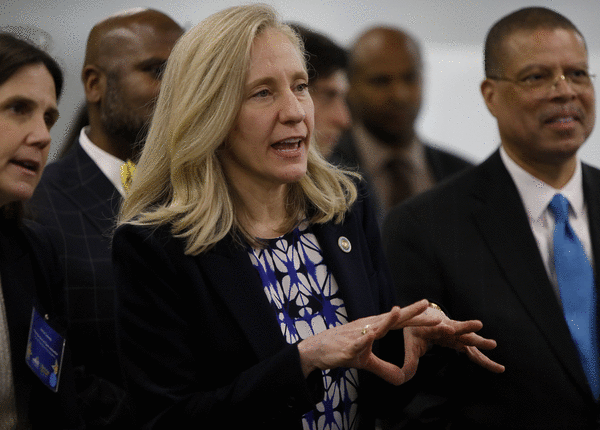
Governor Abigail Spanberger won a sweeping victory in Virginia in no small part because she focused on affordability and prioritized political pragmatism over polarization. Five months later, a public opinion poll shows the Democrat has lost considerable support.
Why? Likely because of her party’s push to enact a partisan gerrymander.
Spanberger’s job approval rating clocks in at 47%, according to a Washington Post-Schar School survey. That’s more than 10 percentage points below the impressive 57.6% vote share she earned in last fall’s key off-year gubernatorial contest. The drop is even more pronounced among crucial independent voters: 59% backed the governor in November, while just 45% approve of her now. This nosedive comes amid Spanberger’s intense effort to win voters’ support for redistricting in an April 21 special election.
The push is a response to President Donald Trump’s bid to redraw congressional districts in red states in a way that would boost Republican chances of maintaining control of the House of Representatives in the midterm elections. To combat that, Virginia’s ballot initiative seeks to allow a new map that would increase the number of House seats drawn to elect Democrats from six to 10, while reducing districts that favor the GOP from five to one.
Democratic voters may very well approve of the strategy — in Virginia and elsewhere. Generally speaking, they’re convinced the party’s elected leaders aren’t fighting Trump hard enough. So why is Spanberger suffering for her efforts? Because not all blue states are created equal. And Virginia is not as deep blue as California.
Governor Gavin Newsom was hailed as a hero in the Golden State after the passage of a similar redistricting initiative known as Proposition 50. The initiative came after Texas Republicans’ successful redrawing of their map lines at Trump’s behest, and Newsom, a potential 2028 presidential contender, won the fight in California largely because he framed the campaign as a battle to undercut the president.
But Spanberger has positioned herself as a centrist ever since I covered her first campaign for office in 2018; a state like Virginia is a lighter shade of blue and still swings right from time to time. Many voters — whatever their frustrations with Trump — appear more interested in the economic pragmatist she campaigned as, rather than the partisan warrior they believe she’s become.
“Some amount of polarization is baked in, but this (the redistricting initiative) is unusual at this early stage of her administration and given that she had long cultivated a centrist image,” Mark Rozell, dean of George Mason University’s Schar School of Policy and Government, which conducted the poll, told the Washington Post.
Here’s what’s not unusual: Spanberger wouldn’t be the first freshly elected leader to misinterpret her mandate — or seemingly forget why voters supported her over the competition. She wouldn’t be the first politician who presumed an impressive victory equaled a blank check to pursue whatever political project struck her fancy. (Trump is exhibit A.) And she’s hardly the first to suffer the consequences.
“Why is Spanberger not popular; voters elected her (because) she said she’d focus on affordability,” Amy Walter, a veteran nonpartisan political analyst in Washington, wrote in an X post.
“Thus far, she’s most tied (to) a thing she didn’t campaign on, and one that is definitely not about controlling cost of living: a very partisan 10-1 map,” added Walter, the publisher of The Cook Political Report.
This polling on Spanberger may be an outlier, however, according to Larry Sabato, founder and director of the Center for Politics at the University of Virginia. He told me in an email exchange that he’d like to see more data before drawing ironclad conclusions. But the political handicapper didn’t dismiss the numbers and said they could be a sign of real voter discontent with a governor whose appeal was built on a commitment to address the high cost of living and avoid excessive partisanship.
“You turn on TV or your computer, and you’re bombarded by ads about redistricting,” Sabato said. “I’m not sure most people could name more than one or two bills that Spanberger and the Democrats passed and signed, even though there were many affecting affordability.”
Spanberger has sought to preserve her image with social media posts promoting the work she claims her administration is doing to make Virginia more affordable. She also disputes accusations that her gaze shifted to redistricting since assuming office in January.
But more voters “strongly disapprove” of her job performance (38%) than “strongly approve” (29%), according to the survey. And the governor’s pushback suggests she and her political team believe the numbers may have merit. At the very least, they appear to believe it’s possible that her administration has allowed this damaging misperception to take hold. Indeed, some of the accusations leveled against Spanberger — that she has embraced an agenda leftwing enough to make a communist blush — are flatly untrue.
In an op-ed the governor published Sunday in the Richmond Times-Dispatch, she ticked through a list of issues in her administration’s “Affordable Virginia Agenda”: health care, housing, energy and public safety.
“At a moment when clickbait headlines and partisan outrage dominate our politics, this is exactly the kind of unglamorous, practical work that matters most to me. It doesn’t always get fanfare, but it gets done,” Spanberger wrote.
Left unaddressed in the op-ed? Redistricting.
Spanberger’s predicament, deserved or not, is a reminder: Voters often pull the lever for challenger candidates primarily because they’re dissatisfied with the incumbent’s handling of issues important to them — not because they’ve bought into the new agenda. Democrats, who are poised to recapture the House majority in November, would do well to realize that.
_____
This column reflects the personal views of the author and does not necessarily reflect the opinion of the editorial board or Bloomberg LP and its owners.
David M. Drucker is a columnist covering politics and policy. He is also a senior writer for The Dispatch and the author of "In Trump's Shadow: The Battle for 2024 and the Future of the GOP."
_____
©2026 Bloomberg L.P. Visit bloomberg.com/opinion. Distributed by Tribune Content Agency, LLC.


















































Comments