Commentary: The results are in, and same-sex marriage was a win for children and society
Published in Op Eds
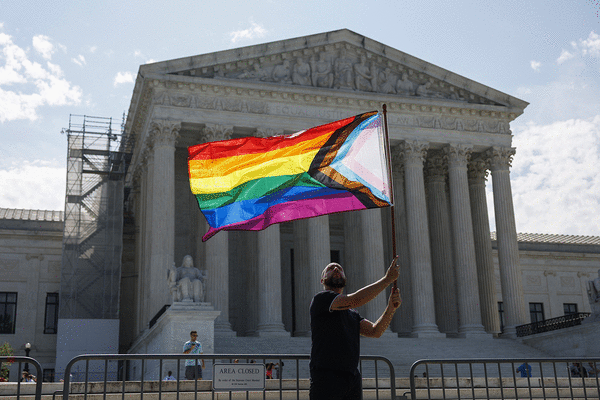
Prior to the Supreme Court’s 2015 Obergefell decision, opponents raised alarms about the severe and immediate harms that would surely occur if marriages between same-sex couples were recognized nationally. Afterward, when those harms failed to materialize, those voices grew quieter, but some have been returning with renewed vigor, in hopes that the current Supreme Court, after overturning Roe v. Wade, may be willing to overturn the Obergefell decision as well — though the justices declined to do so in November.
To build public support for rolling back marriage rights, new campaigns have been repeating the claims that legal recognition of same-sex marriages may harm children or even the stability of different-sex marriages. These are some of the same concerns that were raised in the years prior to the Obergefell decision. They were groundless then, and, more than 10 years later, the data confirm these fears to be unfounded.
In 2024, for the 20th anniversary of the first legal marriages of same-sex couples (in Massachusetts), my lab at UCLA joined with a team of researchers at Rand Corp. to review what social scientists learned over those two decades about the consequences of legalizing same-sex marriage.
We addressed this question in two ways. First, we searched through the research literature to find every published study that had examined the consequences of legalizing same-sex marriage. Prior to 2015, states legalized and prohibited same-sex marriage at different times, and social scientists tracked a wide range of outcomes, including the well-being of children, national trends in marriage and divorce, and the physical and mental health of same-sex couples. Opponents of legalizing same-sex marriage predicted, in the strongest terms, that people would suffer after same-sex couples were granted the right to marry.
After 20 years of legalized marriage for same-sex couples, 96 independent studies confirm there is no evidence for the harms critics predicted. Our review identified not a single study that observed significant negative consequences of legalizing same-sex marriage. Instead, the research literature identified many significant positive consequences.
For same-sex couples, legal recognition of their marriages was followed by more stable relationships, increased mental and physical health, greater financial stability, and stronger connections to family. For the children of those couples, our review found no documented negative outcomes, but legal recognition of their parents’ marriages did result in more children obtaining access to health insurance. And what about the rest of the country? States that recognized same-sex marriages prior to Obergefell experienced economic gains and considerable savings in healthcare costs relative to states that did not.
One of the most striking predictions of the opponents of same-sex marriage was that recognizing marriage among same-sex couples would weaken commitment to the institution of marriage among different-sex couples. That did not happen either.
To address this question, our report conducted new analyses, drawing on census data and other sources to determine whether state-level rates of marriage, cohabitation and divorce changed in the states that recognized same-sex marriage, compared with states that did not. No matter how we conducted the analyses, we could find no effects of recognizing same-sex marriage on any of these outcomes. It makes sense: When different-sex couples are making personal decisions about their own relationships, they are not paying much attention to what same-sex couples are doing.
If any harm resulted from allowing same-sex couples to marry, it ought to be well documented by now. The fact that there has been no evidence of harms despite considerable effort to find some suggests that the predictions made by opponents of legalizing same-sex marriage were unwarranted at the time. Now that we have 20 years of research and experience, those predictions remain unwarranted now.
____
Benjamin Karney is a professor of social psychology at UCLA.
©2026 Los Angeles Times. Visit at latimes.com. Distributed by Tribune Content Agency, LLC.




















































Comments