Commentary: Privatizing security at our nation's airports is useful and necessary
Published in Op Eds
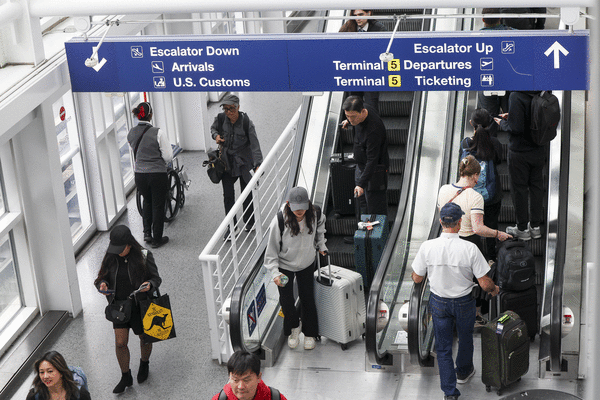
President Donald Trump has called for the privatization of airport security at smaller airports, a recommendation outlined in Project 2025. Though the president has a record of making specious statements and wild recommendations, in this case, he is spot-on and perhaps doesn’t go far enough.
The Transportation Security Administration has had a program in place for over two decades that facilitates airport security screening by private contractors. The Screening Partnership Program, or SPP, permits airports to apply for private companies to provide airport security screening at their checkpoints.
The contractors are vetted by the TSA, and once approved, the contractor’s employees involved in airport screening go through the same training that TSA officers go through, including time at the TSA academy. The airport federal security director provides oversight for security screening operations. The only difference is that contractors, not government workers, are responsible for delivering the last mile of airport screening services.
From the perspective of air travel passengers, they will see nothing different. At airports, the screeners will perform the same tasks, use the same protocols and technologies, and meet the same standards of airport security screening by TSA officers. Their uniforms will be similar to those of TSA officers.
So what are the criticisms of privatizing airport security screening and why do they miss the mark?
The union that represents TSA officers, the American Federation of Government Employees, is unsurprisingly against this. It argues that private contractors were staffing airport security checkpoints on Sept. 11 and returning to such an environment would pose security risks. It also notes the high turnover rates of airport security screeners and how such rates have dropped precipitously in recent years. Yet all such arguments ring hollow today.
Contrary to the common perception, what failed on Sept. 11 was not airport security screening but aviation security policies. The airport screeners on Sept. 11 were following the accepted standards for what was considered benign items permitted to pass through an airport security checkpoint. If 3-inch box cutters had been considered a banned item that day, then the screeners would have been in a position to detect and prevent such items from getting onto the airplanes.
As for turnover rates, contractors will be subject to supply-and-demand pressures like any company. The drop in TSA officer turnover rates can best be attributed to higher wages and a better work environment. The contractors understand this, and given how long it takes to train airport security screening personnel, they have a vested interest to retain their screeners.
Raising the issue of placing profits over security is also ill conceived and misguided. The TSA standards for airport security screening are set by the TSA, not by the contractors. If these standards cannot be met, the contractors risk losing their contract. Given that there are 20 airports that participate in the SPP, including large airports such as San Francisco International and Kansas City International, they provide a case study in airport security efficiency and effectiveness, and any concerns about a compromise in security are unfounded.
Calls for airport screening privatization may appear to be a knee-jerk reaction to the Department of Homeland Security funding impasse in Congress. Yet moving airport security screening to private contractors does not mean that aviation security should be privatized. On the contrary, airport security is just one element of the many layers that constitute aviation security. A decision-making entity is needed that uses research and analysis to determine which technologies to purchase and deploy and which procedures to use at airport security checkpoints. A government entity such as the TSA is well suited for this.
The TSA’s role as the overseer of aviation security is critical to keeping national airspace safe. On the other hand, pushing the last mile of delivery of airport screening to the private sector is reasonable. Estimated savings on the order of $50 million annually at smaller airports is inconsequential, given that the cost of TSA officers is around $120 million per week.
The president does not go far enough, however, in pushing for privatization at only smaller airports. If security at San Francisco International can be overseen by private contractors, then every other airport in the U.S. should be on the table for privatization. Such a radical shift would certainly draw scrutiny and criticism. Yet as long as the TSA continues to set the standards and oversee the training, there is no reason why such moves should not be put forward for discussion.
_____
Sheldon H. Jacobson is a professor of computer science at the University of Illinois Urbana-Champaign. He has researched risk-based aviation security for over 25 years, which provided the technical justification for TSA PreCheck.
_____
©2026 Chicago Tribune. Visit at chicagotribune.com. Distributed by Tribune Content Agency, LLC.


















































Comments