Andreas Kluth: America's amateur diplomats are set up to fail
Published in Op Eds
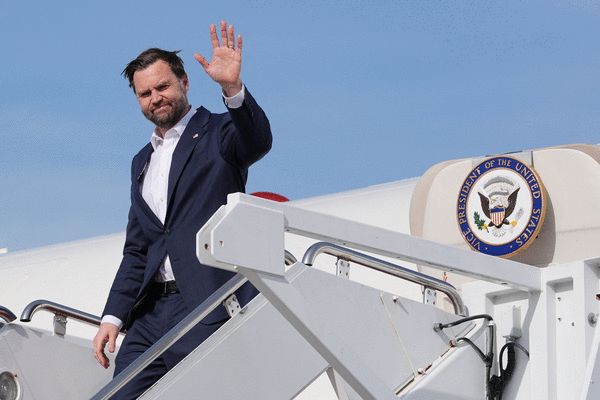
The negotiations between the United States and Iran in Islamabad had to fail. That doesn’t mean future rounds, perhaps already starting this week, are futile. But the American approach to diplomacy has doomed the talks so far for the same two reasons that it has hampered efforts to broker a ceasefire between Russia and Ukraine, say, or to turn the fragile truce in the Gaza Strip into a lasting denouement between Israelis and Palestinians.
The first reason is that the U.S. in the second term of Donald Trump relies not on professional diplomats and experts but on amateurs who may have the trust of the president but are otherwise out of their depth.
The second is that Trump, as strategist-in-chief, keeps giving his negotiators objectives so implausible, confused or contradictory that even the wiliest diplomats in history — a Klemens von Metternich in the 19th century, say, or a Henry Kissinger in the 20th — would come up empty. In some cases, he even seems intent on setting up specific underlings to fail. That would explain why he suddenly put his vice president, JD Vance, in charge of the talks with Iran.
The amateurism is a problem all by itself, and is part of Trump’s full-bore assault against professionalism across government. From the start of his second term, those officials who would in a normal administration play leading roles in diplomacy have been relegated to bit parts, while the president’s friends and family members have taken the leads.
Marco Rubio, who was not in Islamabad, is a notable example. He’s the secretary of state as well as the national security adviser (only Kissinger has ever combined both functions simultaneously). But while Rubio has displayed impressive talents of political survival and has the president’s ear on matters such as Venezuela and Cuba, he has been on the sidelines in dealing with the three big conflicts in Ukraine, Gaza and Iran.
On those, the unofficial title of top diplomat instead belongs to “special envoy” Steve Witkoff. He’s a real-estate tycoon from New York who has been friends with Trump for decades (he was golfing with the president during the second assassination attempt) but had no experience or credentials in diplomacy before the second Trump administration.
It shows. For example, Witkoff spent much of last year shuttling to Moscow to speak to his Russian contacts and President Vladimir Putin, while somehow neglecting ever to visit Kyiv. When in Russia, he generally sidestepped the U.S. embassy and its experts, at times not even using American translators, and relied on the Kremlin’s interpretation instead. He became notorious for an interview with Tucker Carlson in which he regurgitated Putin’s talking points and propaganda almost word for word and didn’t seem to understand that Russia was the aggressor and Ukraine the victim.
The president has paired Witkoff with Trump’s son-in-law, Jared Kushner. He had helped broker the Abraham Accords in Trump’s first term but had been planning during the second to focus on his vast investment funds (with much of the money coming from the Middle East). Trump had different ideas, and Kushner and Witkoff have been hopscotching between negotiations on Ukraine, Gaza and Iran.
They were still engaged in talks with Tehran’s envoys last June, when Trump abruptly started bombing, and again in February, when he launched the war. At various points, Witkoff and Kushner didn’t seem to understand what the Iranian side was offering to them, because they lacked expertise on the arcana of nuclear physics and the like.
They’ve been more successful in Gaza, where they secured a tenuous ceasefire between Israel and Hamas. But then they overhyped that baby step as the beginning of a renaissance for Gaza and the region, as though they were selling a glitzy real-estate project. Somehow, the Board of Peace that was supposed to manage the rebuilding of Gaza and point toward a long-term solution — albeit without including any Palestinians — has become distracted with other matters, not least the aggrandizement of Trump.
Veterans of traditional diplomacy such as Aaron David Miller and Daniel Kurtzer give Witkoff and Kushner an F and consider the administration’s diplomatic process a “hot mess.” (1)
Only so much blame can be assigned to those tasked to execute strategy, however. The bigger question has to be whether that strategy is realistic and coherent. It is not, and that is the president’s fault.
How could anybody, even a modern-day Metternich, negotiate an end to the war in Ukraine, when the American commander-in-chief keeps applying more pressure on the invaded country and less, if any, on the invader? And what could even a Kissinger, say, do in the Israeli-Palestinian conflict when Trump keeps deferring to Israeli Prime Minister Benjamin Netanyahu, instead of reining in Israeli settler violence in the West Bank and the like?
In launching his “military operation” against Iran (ominously echoing Putin’s “special military operation” in Ukraine), Trump appears to have been unduly swayed by Netanyahu, while ignoring whatever timid objections his own advisers expressed. The most explicit objector was Vance, who has been consistently opposed to foreign adventurism, and to this Iran war in particular. If it turns into disaster (and it’s well on the way), Vance could look prescient. That doesn’t sit well with the boss.
And so Witkoff and Kushner were dispatched to Islamabad as part of a delegation that was now led by the vice president. Holed up for 21 exhausting hours with their Iranian counterparts, the American amateur trio had to hold multiple opposed ideas in their minds at the same time while retaining the ability to function.
They had to hew to Trump’s line that the U.S. was already victorious, even as the Iranians clearly believe that they are now stronger than they had been before Feb. 28. They had to haggle about suspensions on Iran’s nuclear program — 20 years, or perhaps only five? — while avoiding any impression that they were negotiating anything resembling the Obama-era agreement that Trump derided and unilaterally quit in his first term.
At a luncheon before the talks, Trump had made a joke to an audience that included Vance. He wants a deal, the president said, but “if it doesn’t happen, I’m blaming JD Vance. If it does happen, I’m taking full credit.”
Trump may be a masterful tactician in the game of me-first-politics. But he’s a woeful strategist in the immeasurably greater game of America First geopolitics.
____
(1) Below the top positions, the White House has also hollowed out the National Security Council and State Department. Of America’s 195 ambassadorial posts, 115 are currently vacant. The professional association for the Foreign Service says that 98% of its members report low morale; one in three has changed career plans.
____
This column reflects the personal views of the author and does not necessarily reflect the opinion of the editorial board or Bloomberg LP and its owners.
Andreas Kluth is a Bloomberg Opinion columnist covering U.S. diplomacy, national security and geopolitics. Previously, he was editor-in-chief of Handelsblatt Global and a writer for the Economist.
©2026 Bloomberg L.P. Visit bloomberg.com/opinion. Distributed by Tribune Content Agency, LLC.



















































Comments