Editorial: Battle Creek, a Rust Belt icon, battles back as American manufacturing jobs decline
Published in Op Eds
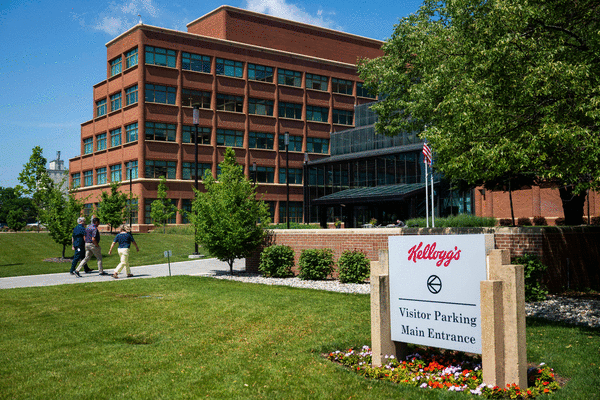
For generations, the Kellogg food company and Battle Creek, Michigan, went together like corn flakes and milk. Then came 2023.
After decades as an independent public company, Kellogg split in two, later selling its storied cereal business to Italy’s Ferrero Group and its valuable snack business to Mars Inc., which has extensive operations in Chicago.
When Illinois Gov. JB Pritzker bragged in March about hundreds of jobs being transferred to the Windy City in the wake of the deals, that sounded like a tough blow in the offing for Michigan’s “Cereal City.”
As it turned out, not so much.
Many of those jobs being consolidated in Chicago come from Mars’ operations elsewhere. And while Kellogg was indeed busted up and sold off, it remains one of the biggest employers in its old hometown, maintaining a global research and development facility and a local headquarters at One Kellogg Square.
The Kellogg Foundation still supports education, housing and revitalization in Battle Creek. A local student can still attend Ann J. Kellogg Elementary, Kellogg Prep High School and Kellogg Community College. The Kellogg Arena, Kellogg Community Credit Union and Kellogg Bird Sanctuary just outside town are still notable landmarks.
Like many other small industrial cities across the Midwest, Battle Creek is diversifying beyond its roots. A community built on blue-collar union jobs and paternalistic corporate leadership has had to evolve as those one-time pillars of prosperity weakened.
Battle Creek today is much different than it was, but it is not circling the drain. Its resilience in the face of change shows that, under pressure, the Rust Belt’s factory towns can carve out a future based on their long-time strengths.
American manufacturing shed an estimated 100,000 jobs last year amid tariff chaos and persistent inflation. Sustained downward pressure could herald an even worse performance this year.
Battle Creek would be in big trouble had it depended only on Kellogg as its economic engine. Instead, over the years, the city’s economic development brain trust got creative.
Back in the 1980s, Battle Creek courted Japanese companies, overcoming skepticism and occasional hostility from some locals. Today, Denso Manufacturing is considered the area’s No. 1 employer. Other Japanese companies took note as Denso grew and prospered in this unlikely spot midway between Chicago and Detroit.
The Fort Custer Industrial Park, launched in the 1970s at a time when such ventures were hit-or-miss propositions, now hosts dozens of companies. Some of the big ones are Japanese manufacturers turning out auto parts, Denso included.
Like so much of Battle Creek, the industrial park was something else before its current incarnation. The sprawling Fort Custer helped train generations of soldiers throughout the 20th century, and part of it still serves the Michigan National Guard.
The Milton is another example of a white elephant that became a unicorn. At 19 stories, the former Heritage Tower is one of the city’s tallest buildings. Built in 1931 for a long-gone bank, it fell into disrepair until the Michigan Economic Development Corp. undertook a high-stakes renovation, supported by local patrons.
The result is an office, retail and residential property anchoring downtown, its art deco mezzanine beautifully restored. On a recent visit, the leasing office reported that just two of its 85 apartments were available.
Battle Creek’s people needed to reinvent themselves, too. Consider Michael “Mac” McCullough, former editor of the Battle Creek Enquirer, a once-robust local newspaper that operates today with a stretched-thin staff. McCullough is now a librarian and archivist at the public library downtown, and a walking encyclopedia of local knowledge.
McCullough is clear-eyed about the ongoing challenges — the empty buildings, silent churches and all-too-conspicuous poverty that followed the loss of good-paying union jobs. Battle Creek long benefited from talented executives serving on civic boards, organizing charity drives and coaching youth sports. They’re scarce these days, and much of Battle Creek’s workforce commutes to the city while living outside it. “There was more of a mindset that their jobs were to be stewards of the community,” he recalled.
As he spoke, not far from the library’s Japanese-language section, McCullough was setting up a local-history archive with 7,000 historical books and other items. “Tales of Battle Creek” tells of the connection with the Seventh-day Adventist Church, established in the city more than a century ago and instrumental in promoting healthier corn flakes over the pork-heavy diet of the era. “Small Town: Giant Corporation” describes the origins of Denso’s ongoing, transformative investment in Battle Creek.
McCullough misses the city that moved to the rhythm of a three-shift workday when he arrived to join the newspaper in 1998. But he says he’s not going anywhere. “Battle Creek is a town you can fight for, care for,” he said. “I love it here.”
____
©2026 Chicago Tribune. Visit chicagotribune.com. Distributed by Tribune Content Agency, LLC.





















































Comments