Commentary: Artemis II does for our era what Apollo 8 did for 1968
Published in Op Eds
Millions in the streets. An unpopular war. Violence. And in the middle of all that: a moonshot.
The parallels between today and 1968 are eerie.
Nearly 60 years ago, civil rights marches and anti-Vietnam-war rallies burst across the country. Martin Luther King Jr. and Robert F. Kennedy were assassinated. Police beat protesters outside the Democratic National Convention in Chicago. A congressional committee stated that “the mental picture that many foreigners have of our nation is increasingly that of a violent, lawless, overbearing, even sick society.”
At year’s end, fearing that the rival Soviet Union would launch a cosmonaut to the moon, the U.S. sent its first crew there. The daring Apollo 8 mission was only the second time humans had flown the spacecraft and the first time they had journeyed to another object in our solar system. Orbiting the moon on Christmas Eve, the astronauts read from the opening of Genesis on live television. One woman wrote NASA that the mission had “saved” 1968.
That message was underscored by the iconic color “Earthrise” photo. The poet Archibald MacLeish also wrote a front-page New York Times essay, saying we are all “brothers who know now they are truly brothers.”
Today, “No Kings” protests draw huge crowds to oppose President Donald Trump, standing up against masked federal agents abducting people; the illegal surprise attack on Iran; corruption; and inflation. Americans have been killed by ICE in full view of cameras, and twice in the last two years would-be assassins have gone after Trump himself.
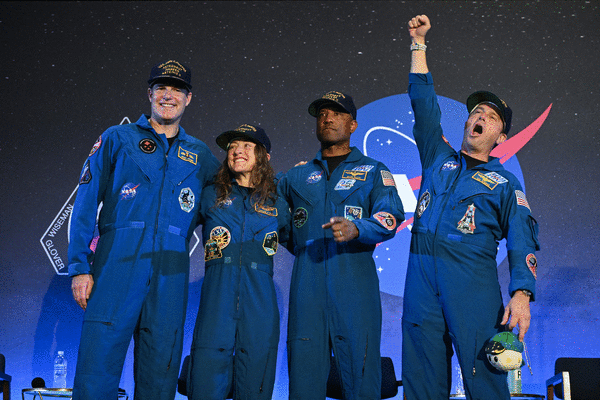
And then came our era’s moonshot, Artemis II, whose four astronauts have returned safely to Earth after a lunar flyby, the first time humans have been in the vicinity of the moon since 1972. Last week commander Reid Wiseman, pilot Victor Glover (a Southern California native), mission specialist Christina Koch and Canadian mission specialist Jeremy Hansen traveled 252,756 miles from Earth — the farthest any humans have ever been.
A cynic might say, given the state of Earth, perhaps they should have stayed up there. But astronauts are anything but cynical.
A nearly flawless test mission of the Orion capsule — well, there were toilet problems — unfolded from a literally brilliant launch to the stately splashdown.
Last week, more than 600,000 people watched the NASA YouTube channel as the crew saw the moon as it truly is, a sublime, wild, awesome place — as Koch put it, “not just a poster in the sky.” She offered metaphor after metaphor, bringing the moon into focus, noting that bright, small craters dotted the surface like “a lampshade with tiny pinprick holes and the light shining through.” Wiseman compared huge gorges to how water looks draining off a Grand Canyon cliff. Glover saw darkness so intense he imagined falling through “to the middle of the moon.” More domestically, Hansen saw a brownish area and compared it to “a piece of pie.”
This is not breathlessness or frivolity. As Koch said, the moon is “a real place.” We need to know it as such, and as a human symbol, while we aim for future flights.
Compare this eloquent, science-based and culturally respectful enthusiasm to Apollo 8’s negative reactions. The moon was not, in the words of commander Frank Borman, “a very inviting place to live or work.”
The astronauts who just came back from there would disagree — though their love of Earth shone through too.
I was also moved by the kinship of the Artemis II fliers. I’ve never seen astronauts smile and laugh as much as this crew did. I’ve never seen astronauts cry in space. When Hansen proposed naming a crater Carroll, after Wiseman’s late wife, he choked up. So did I. All four hugged and wiped tears from their eyes.
This may have been Artemis II’s Apollo 8 moment: In 1968, the crew read an origin story from an ancient text. In 2026, the crew used the name of a loved one to mark the moon. Both gestures captured human hearts.
“We love you from the moon,” Glover said. Koch added, “We will always choose each other.”
Artemis II sets the stage for a new era of lunar exploration, science and possible commerce. With the discovery of water ice at the lunar poles, humans can tap that material to understand the history of our solar system and the development of conditions that led to life — like us — and project that understanding to exoplanets around other stars.
Back on Earth, the chaos of the antiscience Trump administration led to the release — during Artemis! — of a proposed nearly 50% cut to NASA science. A similar cut was defeated last year and will again galvanize strong opposition.
We are these days quite present with doom. There is so much to be done, to be set against and to work for. We need to embrace the wonder and care embodied in Artemis II, remembering what backup astronaut Jenni Gibbons said of her own work. She didn’t fly but was still on a “shared mission.” So are we: We’re all crewmates on a shared mission.
____
Christopher Cokinos is author of “Still as Bright: An Illuminating History of the Moon From Antiquity to Tomorrow.” He writes for Scientific American, Astronomy, Orion and others.
©2026 Los Angeles Times. Visit at latimes.com. Distributed by Tribune Content Agency, LLC.





















































Comments