Commentary: In Iran negotiations, the White House's military options are dwindling
Published in Op Eds
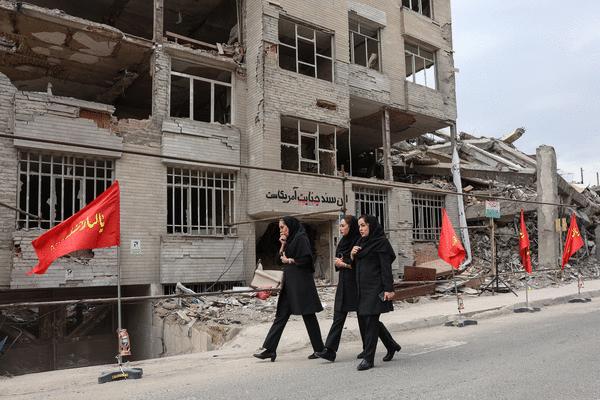
With no breakthrough between the U.S. and Iran in Islamabad this past weekend, President Donald Trump is reverting to his preferred tool: the U.S. military. Last week he vowed to keep American forces in the region at an elevated level and to restart shooting (“bigger, and better, and stronger than anyone has ever seen before”).
Last Wednesday, at the Pentagon’s post-ceasefire conference, Gen. Dan Caine, the chairman of the Joint Chiefs of Staff, issued a similar threat: “A ceasefire is a pause, and the joint force remains ready, if ordered or called upon, to resume combat operations with the same speed and precision as we’ve demonstrated over the last 38 days.” As of 10 a.m. Monday, the U.S. military is implementing a “naval blockade” of ships traveling to or from Iranian ports. This is a step short of returning to full war; Iran has the next move.
But the U.S. domestic appetite for more war is low, and the costs very high. Iran’s surviving leaders know this, and they’ve learned how to outlast American military might. Trump should not have expected the ceasefire talks to deliver much beyond a halt to hostilities in the short run. Iranian negotiators predictably are inclined to string out the talks, recognizing that the longer the respite of U.S.-Israeli strikes and Iranian retaliation from the daily cycle, the harder it will be to restart the fighting.
Meanwhile, the U.S. will wrestle with the cost of maintaining two aircraft carriers in the Middle East, two Marine Expeditionary Units, hundreds of fighter jets, the headquarters element of the 82nd Army Airborne Division and countless forward-deployed logistics capabilities — all of which force difficult budgetary and military trade-offs. The U.S. temptation to pull back some of these forces will only grow, especially as Congress grapples with the cost of the war, military planners account for the wear and tear on critical platforms, and high energy prices add to defense budgetary pains.
For the U.S., there are diminishing strategic gains to be made from more strikes, despite the impressive U.S. and Israeli military achievements inside Iran. Trump faces deep public distaste for the war, midterm elections looming in November, spiraling financial costs domestically and globally, wearing down of U.S. warfighting capabilities, depleted munitions stockpiles, and strains on regional air defense assets. His military options are grim.
Iran sees its bargaining position very differently. The surviving members of its regime will use the ceasefire to reset. Without fear of Israeli decapitation strikes, they will meet in person, move about the country, reestablish control and regroup militarily. The U.S. and Israel will not be able to simply resume the war where it paused. The enemy will adapt.
Trump may hope that as Iran takes stock of the damage done to its conventional capabilities — and as the economic costs of the naval blockade mount — it will realize its internal vulnerability and weakness and seek a quick resolution at the negotiating table. But Trump has already implicitly endorsed Iran’s ultimate asymmetric leverage: Iranian control over the Strait of Hormuz. The regime has been coordinating transit through the strait, issued its own map to navigate around mines and plans to take toll payments in cryptocurrency. Worse, Trump floated a U.S.-Iranian joint venture to manage traffic through the strait, and he may stand to personally benefit from toll fees collected in crypto.
Fast or broad progress in the talks is unrealistic. In previous rounds of negotiations with Iran, both Republican and Democratic administrations declined to pursue a comprehensive agreement that included the Iranian nuclear capabilities, missile arsenal and threat of terrorism. After years of talks, the Obama administration secured the 2015 Iran nuclear agreement, and pursued the missile and terrorism issues separately through sanctions and other nonmilitary means.
Some in Trump’s orbit now argue that, given the extensive damage the U.S. and Israel have done to all three of these aspects of Iran’s regional threats, this is precisely the time to compel Tehran to make verifiable, comprehensive commitments on all files. But Iran’s hold on the Strait of Hormuz adds a fourth pillar that has emboldened Iran’s leaders. Securing worthwhile commitments on all these problems — not to mention the regime’s abhorrent repression of the Iranian people — is simply not in the cards in the time remaining on the ceasefire clock.
Global leaders understand this glum picture and are not counting on the United States for a quick fix. Iran’s theocracy will survive, for now. Even as Iranian missiles and drones continued to target civilian energy infrastructure after the ceasefire, Saudi Crown Prince Mohammed bin Salman accepted a call from the Iranian president, as did Japanese Prime Minister Sanae Takaichi. Other U.S. allies and partners were already working directly with Tehran for safe passage through the strait, including India, Pakistan and the Philippines.
Rather than launching Truth Social tirades against NATO and other U.S. allies, Trump should work through America’s longstanding allied network to strengthen his hand. Most of our allies do not want a return to war, but they also do not want to see an empowered, vengeful regime in Iran rebuild its nuclear and missile arsenal while menacing the global economy.
American allies are now critical, as is a more flexible timeline. Trump needs their help to steer a path that builds on the military campaign with civilian tools and multilateral pressure, and resists the urge to cut self-interested bilateral agreements with Tehran.
U.S. and Israeli warfighters teed up this weekend’s political opening, but the next phase should not only fall back on them as a last resort. The president who prides himself on deal-making should give this process more than two weeks.
____
Dana L. Stroul is director of research at the Washington Institute and served as deputy assistant secretary of D efense for the Middle East in 2021-23.
©2026 Los Angeles Times. Visit at latimes.com. Distributed by Tribune Content Agency, LLC.




















































Comments