Andreas Kluth: It's the worst time to be an American ally
Published in Op Eds
The Iran war, which is now likely to flare up again after talks in Islamabad between Washington and Tehran have failed, has been a humanitarian, economic and geopolitical disaster. One heuristic for grasping the scale of the strategic catastrophe is to look at America’s allies and adversaries worldwide and ask: Cui bono, who benefits? Cui malo, who loses?
The balance sheet is disturbing, because the main winners have been America’s adversaries, while the losers are its traditional allies in Europe, Asia and the Gulf. Israel is a special case.
On the side of the adversaries, the Iranian regime is battered, of course. But it has survived an onslaught by the superpower and remains ensconced. And it is suddenly staking an entirely new claim to controlling the Strait of Hormuz, which was open before Feb. 28 and which the U.S. now plans to contest with a selective blockade.
Most paradoxically, Iran won sanctions relief from the Trump administration during the war that it couldn’t get before. Eventually, Tehran may yet negotiate some sort of deal that trades oversight of its enriched uranium for a permanent drop in sanctions; but it was already doing that when the war began. It had even agreed to such an arrangement in 2015, before Donald Trump walked out on it in his first term. On balance, much lost; possibly more gained.
Russia, which has provided intelligence to Iran in its fight, benefits more. Before Feb. 28, it was in economic straits that could have pressed it toward some sort of denouement in its ongoing invasion of Ukraine. But the spike in oil and gas prices caused by Trump’s war has put Moscow back in business. As in Iran’s case, that boon even came with unforeseen sanctions relief from the U.S. Better yet, the Kremlin sees that Trump is angrier than ever at NATO, and can reasonably hope that the Western alliance, meant primarily to deter Moscow, is tearing at the seams.
North Korea, which has been notably restrained in its criticism of the U.S. during the Iran war, must be gloating. It has partnerships with Russia and China and a growing nuclear arsenal pointed at South Korea, Japan and possibly the U.S. Since Feb. 28, it has also had the pleasure of watching U.S. forces in South Korea and Japan transfer ammo and kit to the Middle East. That’s the exact opposite direction of the one outlined as recently as January in the Trump administration’s National Defense Strategy.
China has even more reason to be smug. That same strategy paper also talked a tough game about concentrating American and allied forces in the Indo-Pacific to defend the “first island chain” in a potential war over Taiwan or the South China Sea. Instead, America seems to be exhausting itself and its arsenals in the Middle East.
China already stared down Trump last year when he tried and failed to cow it with tariffs, by matching his economic coercion step by step. As it ponders an invasion of Taiwan, a lesson Beijing could draw from the Iran war is that the U.S. can deliver shock and awe for a few days or weeks but then runs out of steam. Trump has postponed a summit with his counterpart, Xi Jinping, to May. Xi will now be an even stronger host than he would have been without the Iran war.
The losers include America’s allies. Until recently, the monarchies in the Gulf thought they were investing in their own safety by hosting U.S. bases and transacting generously with the Trump clan’s private businesses. With his war of choice, Trump instead threw them under the Shahed. It remains to be seen whether they can ever regain their glitter as international hubs for aviation, business and fun — or whether they’ll team up with China for that purpose.
The European NATO allies are in turmoil. Trump has always held them in contempt and already mused about quitting the alliance in his first term, a threat he brought up again last week during a visit by Mark Rutte, the permanently groveling secretary general. (1) He may also “punish” the alliance in other ways, by withdrawing some U.S. troops, for example. And he again menaced Greenland (“THAT BIG, POORLY RUN, PIECE OF ICE!!!”), which belongs to NATO ally Denmark.
Trump has no leg to stand on in his criticism of NATO over the Iran war. He never notified the allies that it was imminent, then toggled between bragging that America doesn’t need their help and sulking that it’s not getting any. For the record, NATO is a purely defensive alliance. It’s not meant to help members wage wars of choice, but to deter and repel aggressors by stipulating that an attack on one ally is an attack on all. Its mutual-defense clause has only been invoked once, after America was attacked on Sep. 11, 2001.
European reactions vary depending on how vulnerable a country feels to Russia. Spain, which is far from Moscow, has barred American forces from using its bases to wage the Iran war. But even people in France, Germany and other nations increasingly feel that the U.S. is not a reliable ally, and possibly even a rival, adversary or enemy.
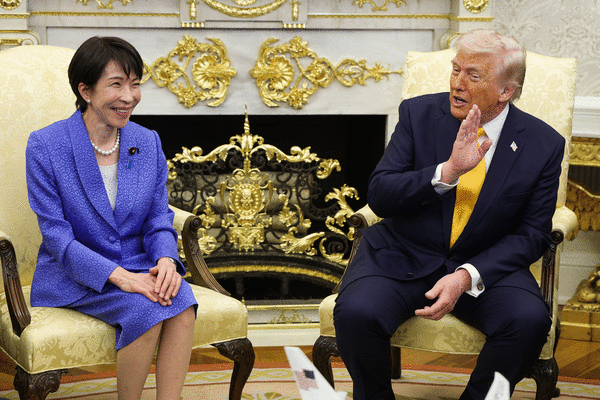
Trump is pouring similar disdain on America’s treaty allies in Asia. While hosting the Japanese prime minister, Trump was again asked why he didn’t notify America’s partners (except for Israel) about the war. “We didn’t tell anybody about it because we wanted surprise,” the president replied; “who knows better about surprise than Japan, OK? Why didn’t you tell me about Pearl Harbor, OK?” His Japanese guest, usually a paragon of diplomatic cool, visibly squirmed.
The one American ally whose role has been upgraded is Israel. That isn’t necessarily a good thing. Reporting by the New York Times has revealed the outsized role played by Benjamin Netanyahu, the Israeli prime minister, in going to war. Uniquely among allies, he even got to present in the White House Situation Room and clearly impressed the president (even though Trump’s advisers thought that parts of Netanyahu’s analysis were “farcical” or “bulls**t”).
The upshot is that it isn’t clear whether Trump has been leading or following Israel in prosecuting his war against Iran. And that is the worst indictment that can be made against an American commander-in-chief. The proper use of alliances is as a deterrent to prevent wars and a force multiplier once they occur. The wrong approach (called “moral hazard”) is to encourage smaller partners to take excessive risks, drawing America into wars that are not in its interest.
Several historians already consider the Iran war of 2026 an American “Suez moment,” in an analogy to an international crisis in 1956 that marked — psychologically and for the world to see — the beginning of the end of the British and French empires.
Now it is American might that has been revealed as limited and waning. One accelerant of America’s decline as a superpower will be that former allies will look elsewhere for their safety, while adversaries will recalculate the right time to challenge Washington head-on.
____
(1) Trump couldn’t withdraw from NATO without Congressional approval, however, thanks to a law co-sponsored by his own national security advisor when Marco Rubio was still in the Senate.
____
This column reflects the personal views of the author and does not necessarily reflect the opinion of the editorial board or Bloomberg LP and its owners.
Andreas Kluth is a Bloomberg Opinion columnist covering U.S. diplomacy, national security and geopolitics. Previously, he was editor-in-chief of Handelsblatt Global and a writer for the Economist.
©2026 Bloomberg L.P. Visit bloomberg.com/opinion. Distributed by Tribune Content Agency, LLC.
















































Comments