Abby McCloskey: Can RFK Jr. save Republicans' midterms hopes?
Published in Op Eds
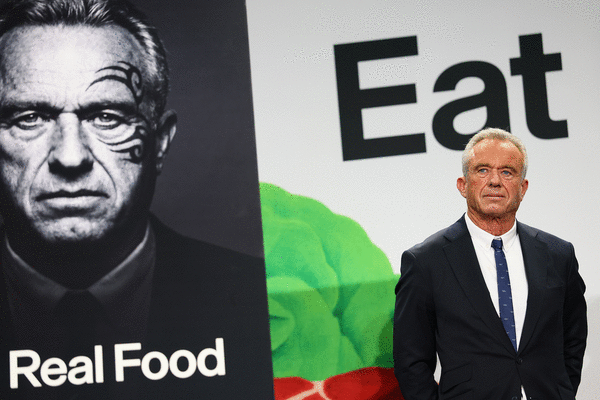
Robert F. Kennedy Jr., the health and human services secretary, is once again out in front. This week, he launched his new podcast, which promises “fearless conversations” because “the government lies to us.”
He’s scheduled to testify before the House Ways and Means Committee on Thursday. And he’ll be going out on the campaign trail alongside vulnerable members of Congress in advance of the midterms. This has pros and cons for Republicans.
Let’s start with the pros. According to recent Pew Research polling, Kennedy is the most popular member of President Donald Trump’s Cabinet, and these days, he’s more popular than the president himself: 44% of U.S. adults have a favorable opinion of Kennedy, compared to just 40% who see the president favorably.
And he’s famous. In our age of celebrity politicians, few can compete with Kennedy’s celebrity status. Only 6% of American adults have not heard of him. Compare that to other prominent folks in the administration: Nearly a third of voters haven’t heard of Defense Secretary Pete Hegseth and a fifth haven’t heard of Secretary of State Marco Rubio.
Many of the health-related causes Kennedy has championed are popular. Most Americans are (understandably) deeply concerned about children’s health. Parents of both parties worry about the rise of chronic conditions and allergies in children, the decline in kids’ mental health and the additives in America’s food system.
Because Make America Healthy Again is a giant hodgepodge of health-related things — ranging from screentime to pesticides to vaccines to food dyes to breastfeeding — different folks can emphasize different parts of it. That broadens its appeal. According to new Politico polling, one out of five MAHA supporters voted for Kamala Harris in 2024.
Even a federal judge’s recent decision to block changes sought by Kennedy to the vaccine schedule could end up working in the secretary’s favor. Raising suspicion around vaccines remains the most controversial part of the MAHA agenda. Among MAHA supporters, concerns about ultra-processed foods, food additives, chemical exposure and lack of physical activity outpace concerns about vaccines. Kennedy’s views on vaccines have long been a liability that threatens to cast suspicion over the whole MAHA movement. He would be wise to accept the court’s ruling and let the vaccine issue drop.
But he may not. Which brings us to the cons for Republicans of using him as a midterm surrogate.
In and of itself, his deployment shows the administration realizes that it needs to change the script — and that it has a limited number of people who can do so.
Kennedy may be famous and the least-unpopular member of an unpopular administration. But he is also an inherently risky choice for reaching swing voters. His unfavorables are high, with half of voters (48%) viewing him poorly, according to Pew. That rises to 78% among Democrats and those who lean Democratic. These aren’t the numbers you want to see in someone headed to contested districts.
The list of MAHA accomplishments leaves much to be desired. They are there, but they are nipping on the edges, not taking big bites — getting companies to limit food dyes, changing the food pyramid, persuading Coke to offer a version made with real sugar, criticizing the use of Tylenol during pregnancy. Missing are any concrete policy targets for improving children’s health or efforts to assemble a broader political coalition in Washington.
Even supporters believe that the movement hasn’t done enough. According to a Politico poll, 52% of Americans — including 41% of Trump’s 2024 voters — say the administration has not done enough to Make America Healthy Again. This suggests a substance problem, not a messaging or awareness problem.
If anything, the administration’s substantive actions on health care have run counter to the MAHA cause. The White House demanded cuts to Medicaid funding in last year’s reconciliation package. It also proposed new HHS cuts in its most recent budget and recently issued an executive order to protect pesticides, despite the latter being a MAHA sticking point. Drawing attention to health care in advance of the midterms draws attention to these unpopular efforts too.
But given where the administration finds itself six months out from midterms, no wonder it’s willing to take the risk and deploy RFK Jr. Republicans need all the energy they can get, given Democrats’ overperformance in 2025 and 2026 elections and dwindling GOP enthusiasm.
Kennedy’s crosscutting brand of health-focused populism could motivate some demoralized Republicans to go to the polls, despite their disappointments. He’s divisive, but the former Democrat might be the best surrogate Republicans have.
_____
This column reflects the personal views of the author and does not necessarily reflect the opinion of the editorial board or Bloomberg LP and its owners.
Abby McCloskey is a columnist, podcast host, and consultant. She directed domestic policy on two presidential campaigns and was director of economic policy at the American Enterprise Institute.
©2026 Bloomberg L.P. Visit bloomberg.com/opinion. Distributed by Tribune Content Agency, LLC.

















































Comments