Editorial: Why reviving the WTO would serve US interests
Published in Op Eds
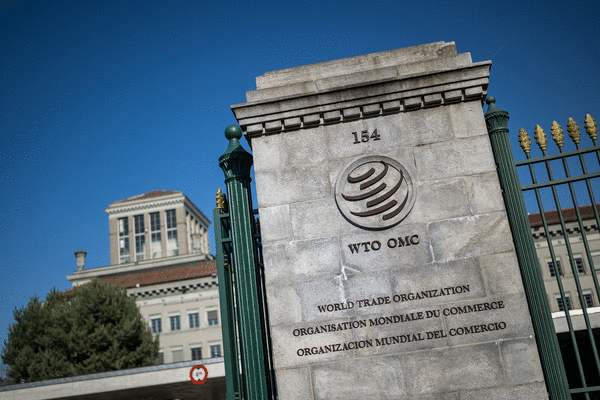
The World Trade Organization moved another step closer to irrelevance at its 14th biennial conference last month, with the assembled ministers failing to reach an agreement on e-commerce rules. The U.S. position was worth noting: The new global champion of tariffs was eager to extend an earlier deal on digital free trade.
Since its introduction in 1998, the WTO’s ban on e-commerce tariffs has been extended every two years. This time, the U.S. advocated a permanent extension, but resistance from Brazil, India and Turkey blocked it. Discussions continue. In the meantime, Jamieson Greer, the U.S. trade representative, was dismayed by the impasse — calling the zero-tariff pact “the lowest of low-hanging fruit.”
One second: Liberal trade is fruitful? Tariffs are a bad thing?
So the U.S. used to believe. In an earlier era, it saw agreements overseen by the WTO as a kind of disarmament treaty for mercantilists. All countries gain from trade, but maintaining liberal commerce involves give and take; if governments cheat by imposing tariffs, others retaliate, the system breaks down and everybody loses. Lower barriers and the principle of “most favored nation” — that is, the requirement to treat all trade partners alike — formed the basis of multilateralism.
The U.S. once championed this concept. Unfortunately, it has wavered in recent years and 12 months ago discarded the notion altogether. But the White House’s position on digital commerce suggests it still sees there are gains from trade. And taking that argument to the WTO seems to recognize that talks based on mutual advantage can be worth pursuing. Maybe the cause of liberal trade isn’t dead yet.
The e-commerce talks failed, to be sure, and the decline of the WTO is undeniable. Multilateralism can succeed only with a strong U.S.-led consensus that tariff disarmament is desirable, which these days is nowhere in evidence. The failure also highlighted a problem with the WTO’s design that critics have long emphasized: One or two dissenters can sink a deal supported by the vast majority of members.
For the moment, the U.S. turn to protectionism means the way forward will be plurilateral, not multilateral. Preferential free-trade agreements, ranging from the original European Economic Community to the Comprehensive and Progressive Agreement for Trans-Pacific Partnership and beyond, were long allowed as exceptions to MFN, mainly because they cut rather than raised overall tariffs.
Even as the U.S. tries its hand at mercantilism, such pacts are becoming deeper and broader. (Who knew “Trans-Pacific” might encompass the UK?) If this trend continues, the WTO can stay useful by helping with technical assistance, dispute-settlement services and more.
In fact, the most encouraging thing about the administration’s erratic efforts to disrupt trade is how little difference they’ve made — so far. Countries slapped with “reciprocal” tariffs a year ago could’ve retaliated, and the losses might have been much bigger. Understanding the benefits of open commerce, they mostly chose not to.
The White House has also dialed back many of its initial threats, responding to faster inflation, higher producer costs and alarm in financial markets. A Supreme Court ruling invalidating the legal basis for many of the new tariffs will most likely push the same way, despite the administration’s plan to seek other authorities. The net effect, while damaging, has been much less dramatic than feared.
Lack of retaliation gives the president the option of declaring victory while rolling his new tariffs all the way back down. Who knows — to secure the potential benefits of more trade and competition, the U.S. could even try to revive the WTO, impaired but not yet dead, as a forum for trade liberalization. You know: in line with the understanding that zero tariffs are low-hanging fruit.
_____
The Editorial Board publishes the views of the editors across a range of national and global affairs.
_____
©2026 Bloomberg L.P. Visit bloomberg.com/opinion. Distributed by Tribune Content Agency, LLC.

















































Comments