Commentary: Industrial fish farms could break US fisheries
Published in Op Eds
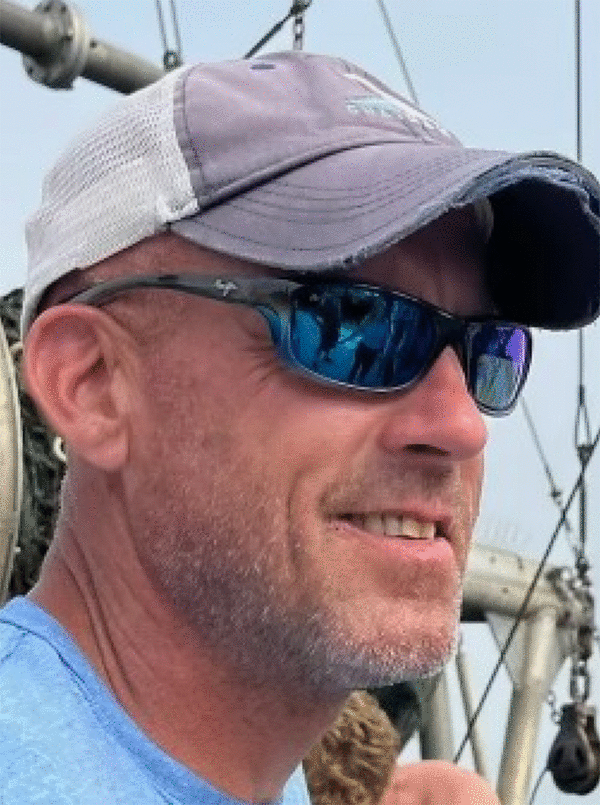
For years, coastal communities like mine in New England have been rebuilding what corporate seafood systems ruined by exploiting our marine resources. Now, some lawmakers are trying to hand our ocean commons over to the same types of industries that emptied out our fisheries in the first place.
It’s been more than 25 years since I got my start as a fisherman in the infamous groundfish industry— a business model built on the slogan “high volume, low value.” It was extraction on overdrive.
Back then, the seafood buyers told us to bring in as much cod as we could, and not ask questions. They paid us nickels and shipped most of our catch overseas, leaving our towns financially strapped and our cod depleted. I’ve spent the past decade trying to undo that damage.
I rebuilt my boat and started fishing differently, focusing on a more diverse, responsibly-caught harvest and local markets. I began educating the public about under-loved species, like dogfish and monkfish. That led to co-founding the award-winning Chatham Harvesters Cooperative, where we distribute our diverse catch to local and regional programs, schools and gatherings. This is what food sovereignty looks like.
But now, Congress is debating whether to open our public waters to industrial fish farms, even after years of similar proposals have failed to pass. The Marine Aquaculture Research for America (MARA) Act would make it easy for the federal government to dole out permits to these farms, allowing corporations that already have a grip on land-based food systems to extend their reach into open waters. You already know some of the biggest players in the industrial food system: Sysco, JBS and Cargill, along with pharmaceutical companies that make fish drugs to keep stressed, diseased farmed fish from dying.
America does not need these fish factories. We already catch enough wild fish to feed our nation and still have a surplus. In 2023, for instance, U.S. fishermen landed 8.4 billion pounds of seafood compared to the 6.4 billion pounds that Americans ate that year.
The problem is not our supply but our twisted system, which ships most of our wild-caught seafood overseas, then re-imports a portion after it has changed hands countless times through an untraceable global supply chain.
Much of the imported 70% to 85% of fish that Americans eat is also farmed abroad in ways that destroy marine ecosystems. But Big Aquaculture wants to take the dysfunction further by bringing these polluted fish feedlots to U.S. federal waters.
Democratic Sen. Ed Markey of Massachusetts has a track record of protecting our oceans, coastal communities and public health. We need him to continue that commitment by rejecting the MARA Act and instead co-sponsoring the Keep Finfish Free Act (KFFA), which would prevent federal agencies from issuing operating permits to offshore fish farms without approval from Congress.
This is an opportunity for Markey to reaffirm that Massachusetts stands with its fishing communities. Supporting the KFFA would ensure that working coastal towns like mine remain part of our nation’s seafood future.
What’s at stake isn’t just fishermen making a living. Scientists warn that pathogens from ocean-based fish farming pose a serious threat, not only to marine ecosystems, but also to human health by breeding drug-resistant bacteria. Just a few sea lice can cause open wounds and deadly infections in finfish. In crowded net pens, these parasites spread fast and lay thousands of eggs. From there, the lice larvae can travel up to 50 miles, capable of triggering catastrophe across entire fish populations.
These operations also burn through huge amounts of wild forage fish to feed farm-raised fish, leading to overfishing. Sometimes the ratio can be as high as 5:1, meaning five pounds of wild forage fish are needed to produce one pound of farmed fish. That’s robbing Peter to feed Paul. It’s decimation in disguise, wiping out food access and livelihoods in coastal communities around the world.
Congress should approach our fisheries with two goals in mind: defend what’s working and build up what’s been neglected. So, in addition to passing the Keep Finfish Free Act, lawmakers should introduce legislation that invests directly in building up waterside seafood infrastructure and bringing in the next generation of fishing families.
____
Doug Feeney is a commercial fisherman and captain based in Chatham, Massachusetts. He is a co-founder and the president of the Chatham Harvesters Cooperative, a fishermen-owned collective dedicated to sustainable fishing practices and supplying fresh, locally caught seafood to the community. This column was produced for Progressive Perspectives, a project of The Progressive magazine, and distributed by Tribune News Service.
_____
©2026 Tribune Content Agency, LLC.




















































Comments