Commentary: Pediatrician perspective: Impacts of armed conflict on children
Published in Op Eds
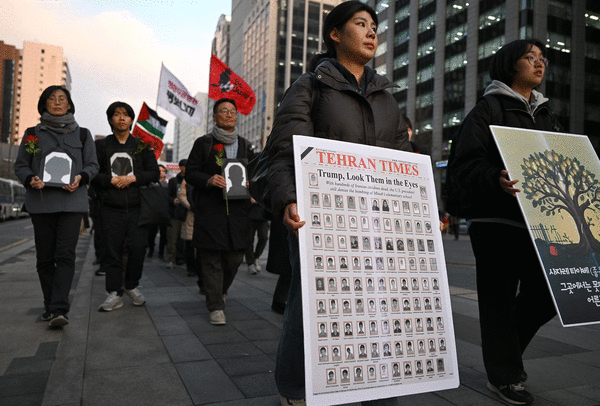
The children from the Shajareh Tayebeh primary school, a girls’ school in Minab, Iran, should have been sitting in classrooms, giggling with their friends, and dreaming about recess — not wondering if they would survive that day. Their parents should have been looking forward to picking them up that afternoon, hearing the day’s stories, and helping with homework — not frantically digging through rubble to find them.
On Feb. 28, an airstrike killed around 170 people at the school, mostly children between 7 and 12 years old. This tragic loss of life is a devastating reminder that when conflict erupts, children inevitably pay the price.
We are pediatricians, specifically humanitarian pediatricians who have worked in conflict settings. Our job, wherever we are, is to protect children’s health, advocate for their needs, and help them grow into adulthood. Most days, that means treating infections, stabilizing injuries or reassuring worried parents that their children are going to be OK. But at moments like this, it also means speaking a simple truth that unfortunately has become necessary to emphasize: Children must be protected from the harms of armed conflict.
Recognizing the growing number of children affected by increasingly protracted armed conflicts, the American Academy of Pediatrics recently published a policy statement that calls on pediatricians to advocate for the protection of children in armed conflict settings; the safeguarding of schools, hospitals, and health care workers; access to health and mental health services both during and after conflicts; and humanitarian support for families affected by war. Within one month of its publication, we find ourselves heartbroken and compelled once again, in the wake of the tragedy in Iran, to demand that the spaces children depend on to survive and thrive must not be a target, that children must not be collateral damage.
More than 520 million children, or roughly one in five globally, currently live in areas affected by armed conflict. When conflict erupts, children face immediate dangers, such as traumatic injuries, the loss of their caretakers, and possibly death. Risks to children linger as conflicts progress, including trafficking, sexual violence, recruitment, and abduction, and both the physical and mental impacts of conflict can last a lifetime and affect generations.
But the harm does not stop there. Armed conflict disrupts nearly every system that a child depends on to survive and develop. Hospitals are damaged or overwhelmed. Vaccination programs collapse. Food supplies become unreliable. Clean water systems fail. Families are separated as parents search for safety. And schools — which are places of stability and opportunity — are closed, destroyed, or as we saw recently, bombed.
Education is not simply a social good; it is a critical protective factor for children’s health and well-being. Schools provide structure, safety, and developmental support. When schools are attacked or shuttered, children lose far more than lessons. They lose stability. They lose routine. Sometimes, they lose their lives. They lose the simple, sacred things childhood is supposed to hold: going to school, playing with friends, and living without fear. These are not privileges, nor are they extraordinary demands. They are basic rights, outlined in the United Nations Convention on the Rights of the Child, a treaty that every nation in the world has ratified except the United States.
After the school bombing in Minab, Iran, the question should not be whose side the children were on. The question should be why children were ever in harm’s way. No matter where a child lives, no matter which nation is fighting, the principles should remain the same. Children deserve protection. They deserve safety. And they deserve the chance to grow up in a world that believes their lives are worth protecting.
____
Anik Patel, MD, FAAP, and Lisa Umphrey, MD, FAAP, are two of the authors of the AAP policy statement "The Effects of Armed Conflict on Children and Adolescents"
©2026 Tribune Content Agency, LLC.


















































Comments