Commentary: Chicago appeals court picks the wrong constitutional emergency by coming to DHS' rescue
Published in Op Eds
The 7th Circuit Court of Appeals decision last week to vacate an order, from an already dismissed lawsuit limiting the Department of Homeland Security’s tactics against journalists and protesters, is a misuse of judicial power.
If the appellate court insists on granting relief no one asks for, it has far better targets than an injunction aimed at stopping well‑documented constitutional abuses by out-of-control immigration authorities.
Judges are often willing to bend procedure and stretch doctrine when doing so benefits the powerful, but their imagination fails them when the shoe is on the other foot. Suddenly, they become sticklers for dotting i’s. The majority opinion by Chief Judge Michael Brennan and Judge Michael Scudder shows they are more concerned with presenting contrarian procedural arguments than with serving the interests of justice.
That’s the generous explanation. The other is that they went out of their way to reward President Donald Trump, who appointed them to the appellate court during his first term. Either way, no one seriously concerned with the Constitution — let alone the greater good — could look at DHS’ rampage across the country and think the real threat to the rule of law lies in a dismissed order restraining them.
U.S. District Judge Sara Ellis did not casually elect to second-guess the conduct of federal immigration agents in Chicago. She issued her preliminary injunction along with a 200‑plus‑page opinion that sifted through body camera footage, conflicting government reports and sworn testimony about the events of Operation Midway Blitz, finding that DHS’ conduct“ shocks the conscience.”
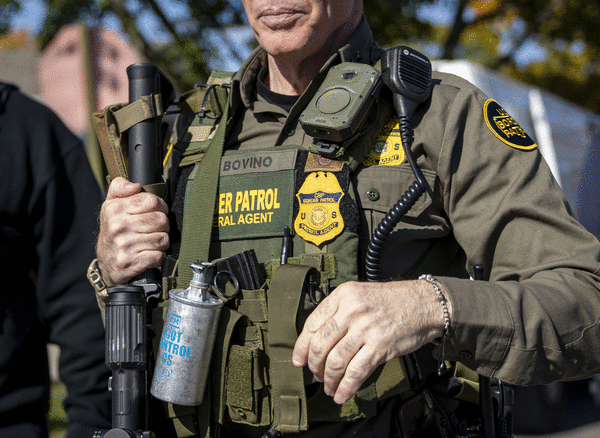
She detailed how DHS agents repeatedly used force against journalists, peaceful protesters, clergy and local officials, then provided official accounts that did not match what footage showed. At the Broadview immigration facility and elsewhere, they deployed dangerous chemicals and weapons into crowds that posed no imminent threat. Ellis also detailed that agents including then-Border Patrol boss Gregory Bovino came to her courtroom and lied.
The U.S. Press Freedom Tracker, a project of Freedom of the Press Foundation, documented dozens of freedom violations by law enforcement responding to immigration protests in Chicago last year. The attacks included everything from rubber bullets shot at close range to arrests of journalists. There was also plenty of indiscriminate tear-gassing of journalists and everyone else, continuing even after Ellis ordered it to stop.
Local reporter Steve Held was shot in the groin with a pepper ball on Sept. 19 and arrested for doing his job about a week later. He’s still dealing with the fallout from the Sept. 27 arrest — he posted last week that his Transportation Security Administration clearance for expedited security screening at airports was revoked because of an alleged assault against law enforcement in Terrace, Illinois, on that date. He was never charged with anything, let alone assault.
Terrace sounds lovely, except that it doesn’t exist, just like the violent terrorist invasion of Chicago that government lawyers told Ellis justified their crackdown on constitutional rights.
Ellis’ injunction imposed basic guardrails that most people would assume already exist, such as limits on chemical agents and dangerous munitions, obligations for agents to give clear warnings before resorting to using such weapons and requirements -– consistent with Department of Justice guidance— to distinguish press from unlawful actors so that journalists aren’t taken off the scene and restrained from reporting. It did not bar DHS from enforcing immigration laws and did not immunize unlawful conduct.
That’s not to say that good intentions place Ellis’ order above appellate scrutiny, although in my opinion, her sole (but significant) misstep was failing to give her orders teeth by sanctioning government lawyers and holding DHS agents in contempt of court. But by the time the 7th Circuit acted, the plaintiffs’ lawsuit had been dismissed pursuant to an agreement of the parties.
As dissenting Judge Frank Easterbrook noted, there was no live controversy over the continued application of Ellis’ order. Yet the 7th Circuit took the extraordinary step of swooping in anyway, treating constraints on DHS — which has only become more violent in the months since Ellis’ order — as a lurking constitutional problem that had to be scrubbed from the books lest plaintiffs seek similar relief in the future.
There is no shortage of judicial orders affecting constitutional rights actually worth vacating, such as rulings allowing politicians to banish news outlets they dislike, gag orders that prevent journalists from publishing news, orders permitting seizure of journalists’ equipment containing their sources and stories, immunity decisions that make it nearly impossible to hold officers accountable for First Amendment violations, and deportation cases based on immigrants’ protected speech.
If appellate courts want to spend their time looking for rulings to vacate, they should focus on those that facilitate censorship and impunity, rather than those that restrain tear gas and rubber bullets.
____
Seth Stern is the advocacy director at the Freedom of the Press Foundation.
___
©2026 Chicago Tribune. Visit at chicagotribune.com. Distributed by Tribune Content Agency, LLC.


















































Comments