Commentary: Artemis was a state failure and a human triumph
Published in Op Eds
“If the great brain of NASA were attached to any particular sense, it was the eye,” wrote Norman Mailer in his psychedelic history of the Apollo program. Whatever else one may say of the agency, its ability to produce evocative images remains unrivaled.
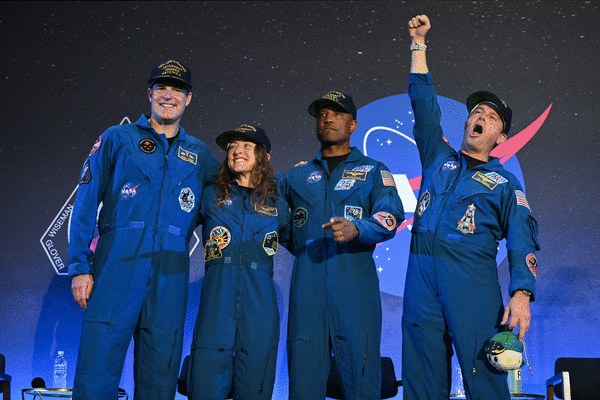
Artemis II, NASA’s just-concluded lunar mission, will be remembered for many things, but the photos it captured were inarguably bangers: of a crescent “earthset,” wildly polychromatic against the void of space; of a lunar eclipse of the sun; of the moon’s mottled surface, vivid and strangely inviting. And then of the all-too-dramatic splashdown last week, with four astronauts plonking safely into the Pacific, having traveled further than any humans in history.
I was reminded of a press tour I took in 2015 of NASA’s famed Vehicle Assembly Building (what Mailer called the “first cathedral in the age of technology”). It was being renovated to accommodate what would become the 322-foot tall, 5.7-million-pound Space Launch System, the rocket that would — all these years later — propel the Artemis II astronauts through their lunar flyby. Even then, the whole undertaking struck me as completely unreasonable: vertiginous, out of earthly proportion, defying common sense. It was awesome.
This mission, too, was unreasonable. Against the odds, it emerged from a program beset by incoherent goals and spiraling complexity. It was by many accounts unsafe. It was monumentally over budget. It accomplished little of scientific interest. And yet, by a certain way of looking at things, it was a sublime success.
Mailer conceded that he “hardly knew whether the Space Program was the noblest expression of the Twentieth Century or the quintessential statement of our fundamental insanity.” Six decades on, it’s quite possibly both.
For all the well-earned acclaim, this mission was uncomfortably close to tragedy. In fact, its risks were more pronounced than the public was generally aware, and out of all proportion to the limited goals it was pursuing.
In an uncrewed test flight in 2022, the heat shield on the astronauts’ Orion capsule — what protects them as they reenter the atmosphere at 25,000 miles per hour — had chipped off in dozens of places, leaving an alarming trail of debris. The full scale of the problem wasn’t revealed until an inspector general report more than a year later. “Should the same issue occur on future Artemis missions,” the report warned, “it could lead to the loss of the vehicle or crew.”
Test flights are meant to find such flaws, and NASA spent many months reviewing the data and conducting further tests. An independent team reviewed the probe and agreed with the agency’s conclusions. And yet.
“They should not have let that crew fly,” Charles Camarda, a former astronaut and heat-shield expert, told me last week. At a meeting at NASA headquarters in January, Camarda, along with a few other outside experts, was given access to confidential technical data about the heat shield. “What I heard that day absolutely shocked me,” he said. He told the gathered officials that Orion’s reentry would be riskier than they expected, in part because they didn’t understand exactly why the shield had failed as it did. Rather than conducting another test flight or redesigning the capsule — already severely behind schedule and over budget — NASA decided to revise Orion’s reentry path, relying on simulations to conclude that it could still land safely.
After the meeting, NASA administrator Jared Isaacman said: “We have full confidence in the Orion spacecraft and its heat shield, grounded in rigorous analysis and the work of exceptional engineers who followed the data throughout the process.”
Camarda was not convinced. “This isn’t even like playing Russian roulette,” he said, “because in Russian roulette, you know, there's one bullet in the chamber. And you know what the odds are. This is playing Russian roulette without knowing how many bullets are in the chamber.” When I raised what Camarda told me with Joshua Finch, a NASA spokesman, he referred me to Isaacman’s statement and declined to comment further.
Artemis III, scheduled for 2027, will adopt a different design — meaning that the defective shield and the modified reentry in this go-around amounted to a one-off experiment, with essentially no benefit for the broader mission. In the end, mercifully, everyone was fine. But as with Russian roulette, avoiding the worst outcome doesn’t mean you’ve learned the appropriate lesson.
One reason this mission was so risky was that it was so expensive, and it was so expensive because Congress designed it that way, and Congress designed it that way mainly to please aerospace contractors, and the contractors were pleased because they had learned — like macaques grown accustomed to being fed by tourists — how best to exploit the concept of “cost-plus contracting,” which enabled them to charge program overruns to the government in effective perpetuity and with little regard for quality or productivity.
This was not the only problem afflicting Artemis, the lunar-exploration program that began (in its current iteration) nearly a decade ago, now consists of at least five successive missions and aims for a moon landing in two years or so. Evolving program requirements, complex and interdependent systems, technical and safety challenges, the statutorily mandated use of archaic components, and a tendency to distribute suppliers and facilities according to the logic of congressional politicking — “Senate Launch System” was the sardonic nickname for the SLS — all played a role.
So no one was much surprised when Artemis managed to ring up a $100 billion tab without getting off the ground. Or that Orion came to cost more than $20 billion over 20 years yet was still so flawed that its heat shield required an untested operational workaround. Or that each launch of the SLS had somehow come to exceed $4 billion. Costs rose so fast, in fact, that NASA effectively stopped tracking them.
All these factors — politics, cost inflation, ever-changing goals — resulted in a rocket that was overweight, underpowered, ill-suited to reaching the moon and, in an age of reusable rocketry, inexplicably expendable. That combination made the entire program increasingly hard to justify. More worrying, the baroque expense of each launch made further test flights all but impossible.
In a sense, these are all problems of long standing; Pete Worden coined the phrase “self-licking ice cream cone” to describe the circular logic of NASA’s budget process in 1992. (“Since NASA effectively works for the most porkish part of Congress, it is not surprising that their programs are designed to maximize and perpetuate jobs programs in key Congressional districts.”) The oddity this time, though, was that these problems persisted — indeed worsened — even as private-sector alternatives from SpaceX and others were rendering the SLS-Orion combo obsolete.
What are we doing here?
“It's political,” said Phil Metzger, a NASA veteran and now a professor at the University of Central Florida. “The U.S. has invested so much in building the SLS that it's a political embarrassment if they don't use it. And so, in order to go forward, they have to use it a few times and then at some point declare that it served its purpose and we're not going to use it again.”
In 1976, the physicist Gerard K. O’Neill published a strange and oracular book called The High Frontier: Human Colonies in Space. It imagined, in exacting detail, whole communities inhabiting the nearby cosmos, floating in rotating, cylindrical “islands,” sustained by resources from the moon and asteroids, vivified by commerce and industry and untethered by earthly limitations.
“For me, the age-old dreams of improvement, of change, of greater human freedom are the most poignant of all,” he wrote, “and the most chilling prospect that I see for a planet-bound human race is that many of those dreams would be forever cut off for us.” He figured space colonization would happen, using then-available technology, within 30 years.
In March, as the blast-off date neared, NASA announced a revised architecture for its lunar objectives. It paused plans for a money-burning “lunar gateway,” pledged to accelerate rocket launches and laid out a string of material goals: a moon base, communications networks, lunar GPS, rovers, landers, surface reactors. “America will never again give up the moon,” Jared Isaacman said.
A cynic may see the self-licking ice cream cone with even more scoops. But to a certain kind of enthusiast, this mockup suggested real progress toward the O’Neillian vision, coming to life only 20 years late. And seen in that light, Isaacman — omni-competent billionaire, private space cadet, gambler by nature — looks like the right man for the job. He has vowed to embrace space commerce and rationalize the agency’s priorities. He brings ambition and management skills not always in evidence at NASA. He wants to embark on “the next golden age of space exploration.” Casey Handmer, formerly of NASA’s Jet Propulsion Laboratory and a frequent critic of the agency, told me: “Jared has exceeded expectations across the board. I advocate to ‘let him cook.’”
Space, in fact, has rarely looked more interesting. Advances in rocketry have enabled cheaper launches and faster cadences. Competition is robust. Industries are devising new uses for satellites. AI companies are pondering orbital data centers. More ideas will require more launches, drive down costs yet further, and open yet more commercial possibilities. Rivalry with China remains a congressional priority, with the space dollars flowing to match.
Surveying that landscape, one can almost imagine Artemis as the last boondoggle of its kind — and its Space Age excesses giving way to something much cooler and weirder.
If that happens, in the end, I suspect the arresting images captured by Artemis II will have played no small part in the transition. “It is absolutely spectacular, surreal, there’s no adjectives. I’m going to need to invent some new ones.” So said Reid Wiseman, the mission commander, on witnessing an eclipse from space.
You can still find people who think all this is a waste of time. There will always be reasons not to explore, to focus on terrestrial problems, to spend limited tax dollars in prosaic ways in strategic congressional districts. “Let’s stop going into space,” was the headline of one recent column. “There’s nothing to see and no one to talk to.”
To which I’d offer Wiseman’s words as the fullest rejoinder. He and his colleagues in fact witnessed an ineffable moment, flying toward a place no human had ever ventured, to accomplish things no one has ever done, transcending the malfunctions and limitations of the politics that sent them there. Wiseman, a single father, said of his daughters: “They understand the risk, but they also understand the value of human exploration, human ingenuity, that drive of humanity to go see what is on the other side of that mountain.” He added: “No one can say no to that.”
I expect that this impulse can’t be eradicated from the American soul — and, really, we shouldn’t want it to be. It’s the element that induces invention, restlessness, exploration, that produces the kind of oddballs who take unreasonable risks and traverse terrible frontiers and manage to make money from the whole radical show, despite their country’s manifest dysfunctions. It’s what the historian Frederick Jackson Turner was talking about, in 1893:
To the frontier, the American intellect owes its striking characteristics. That coarseness and strength combined with acuteness and inquisitiveness, that practical, inventive turn of mind, quick to find expedients, that masterful grasp of material things, lacking in the artistic but powerful to effect great ends, that restless, nervous energy, that dominant individualism, working for good and for evil, and withal that buoyancy and exuberance which comes with freedom — these are traits of the frontier, or traits called out elsewhere because of the existence of the frontier.
I thought of those words on the evening of the Artemis launch, a full moon overhead, illuminating the clouds of a frigid April night. I confess I was nervous for the astronauts, barreling through untraveled space, their fates indelibly tied to a potentially defective chunk of Lockheed Martin’s space-metal. But they betrayed not a hint of doubt themselves. “We have a beautiful moonrise,” said Wiseman, serene and imperturbable, a few minutes into the flight. “We’re headed right at it.”
_____
This column reflects the personal views of the author and does not necessarily reflect the opinion of the editorial board or Bloomberg LP and its owners.
Timothy Lavin is a member of the editorial board covering technology and politics. Previously, he was a senior editor at the Atlantic.
_____
©2026 Bloomberg L.P. Visit bloomberg.com/opinion. Distributed by Tribune Content Agency, LLC.





















































Comments