Adriana E. Ramírez: The war on Iran and the battle at your local bookstore
Published in Op Eds
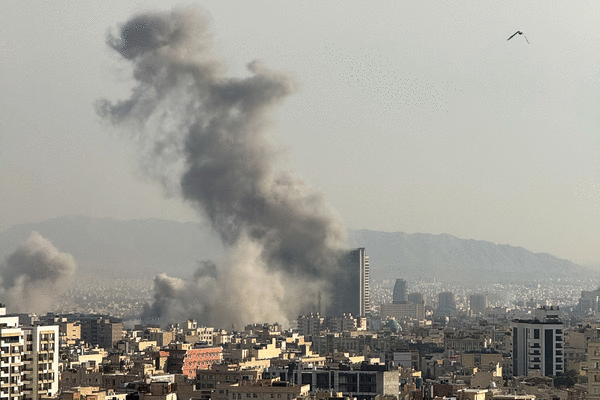
As a U.S. and Israeli-driven war in the Middle East that may change the world ramps up, it seems strange to care about books. But we have been telling stories as long as we have been conquering and defending civilizations, trying to make sense of the world that surrounds us, to understand how many have survived and made lives in the middle of extraordinary violence.
There is a natural relationship between literature and bloodshed, I suppose. Both are deeply invested in conflict. On the economic side of it all, books, and the bookstores that carry them, are cultural battle sites.
Bookstores are places of resistance, of banishment, with sections devoted to women, children, ethnic and affinity groups. Bookstores are woke, or decidedly unwoke, by nature, inherently concerned with the possibilities contained in human expression and taxonomy.
Bookstores host authors, book clubs and other gatherings intended to discuss literature, militant in their devotion to new ideas. I know of a bookseller from Seattle who hosts workshops on avoiding arrests while protesting.
Another from Brooklyn works with nonprofits to subsidize books for children. A bookseller here in Pittsburgh owns a mobile bookstore that caters to often-neglected neighborhoods.
Anytime booksellers are together, the conversations cannot help but be political, even at an industry conference, a location that normally exists to discuss topics like “eCommerce trends” and “Building Your Bookstore’s Media Presence.” But bookstores being bookstores, the political cannot be helped — bookstores are sites of inherent opposition, containing too many opinions to be neutral on anything.
All my books are on loan
Last week, the American Booksellers Association held their Winter Institute Conference at the David L. Lawrence Convention Center in Pittsburgh.
While the Winter Institute is an industry conference with standard industry panels and discussions (even on eCommerce), it also features several dozen authors, all selected by their publishers, prepared to highlight their work and autograph their manuscripts.
As one can imagine, a booksellers conference is full of books. The galley room alone was a thrill, with special-edition covers for the conference itself and hundreds of titles available to take home for free.
I ran into the co-owner of White Whale Bookstore in Bloomfield, Adlai Yeomans. We took a minute to geek out about the titles on display. There were books about war, about gender, about love, about battles internal and external, conflicts won and lost.
“So,” I asked him, “this feels like it’s an industry conference, a publisher’s showcase, a fan event for big-deal authors, and a staging ground for the revolution all at once?”
“You’re not wrong,” Yeomans replied.
The reference section
In between panels on how to partner with Instagram influencers and how to design spaces for young readers, booksellers mingled in the hallways of the convention center. Everyone I spoke to seemed energized about the work their shops were doing or worried about the future, but all of them referenced national politics.
I spoke to a bookseller from Minnesota, who mentioned keeping whistles in their shop. I spoke to a bookseller from Arizona, who keeps masks and a sign informing shoppers that COVID-19 infections have not ended. I spoke to a bookseller from Texas, who talked about the risks in displaying banned books.
All declined to speak on the record, perhaps aware more than anyone, as purveyors of words that have landed plenty of good people around the world in hot water, including prison or expulsion, that speech is both a right and carries tremendous risk. As I often say, Freedom of Speech is not freedom from consequences.
Even innocent speech. One of the banned books displayed in that Texas bookstore is “And Tango Makes Three,” the true story of two male penguins who incubate an egg together.
“I couldn’t imagine a more wholesome story,” the bookseller told me. “But it’s the title we get the most angry messages about keeping prominently displayed – over 20 years after publication.”
“They’re just penguins.”
The attendant’s eye
But it’s never just penguins. Books have agendas, because they are written by authors, who have agendas. I know this, because as I wrote my book, I wanted to make sure the reader understood the absurdity of state-sanctioned violence. It’s a book about war that’s decidedly anti-war.
And right now, the United States is a nation at war. We’re at war in the Middle East, we’re at war against undocumented civilians living in our country, we’re at war against the truth. And one of the best and most dangerous places to get information on all these topics, outside of a local library, is a bookstore.
I know this, because I was indoctrinated in my local bookstore, indoctrinated to read voraciously, to inform myself and fact check, to understand good sources and bad actors. Bookstores are where I’ve met authors, where I’ve gone on first dates, where I’ve found refuge after a breakup.
Bookstores are where I’ve attended poetry slams, found invaluable sources for my work, and once heard a song that still makes me weep in memory of the girl I was when I first heard it. If I ever find myself in the revolution, it will because I first heard about it at my local bookstore.
_____
©2026 PG Publishing Co. Visit at post-gazette.com. Distributed by Tribune Content Agency, LLC.

















































Comments