Editorial: America's choice -- The way of hatred versus the way of grace
Published in Op Eds
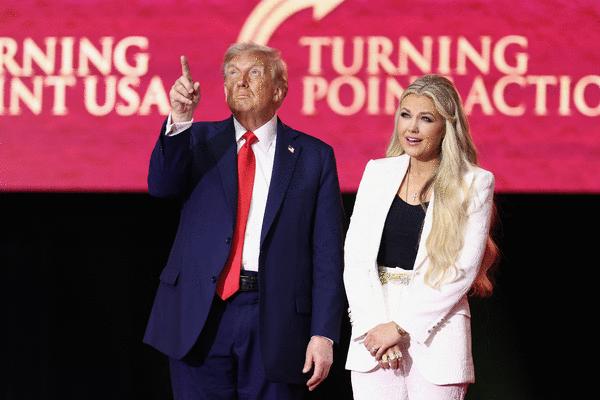
"That man — that young man — I forgive him. I forgive him because it was what Christ did and is what Charlie would do. The answer to hate is not hate. The answer, we know from the gospel, is love and always love."
"He did not hate his opponents; he wanted the best for them. That's where I disagreed with Charlie. I hate my opponent, and I don't want the best for them — I'm sorry."
These two sentiments — the first expressed by Erika Kirk, widow of the murdered conservative activist Charlie Kirk, and the second expressed by President Donald Trump — represent two possibilities for the future of American politics.
One offers nothing but repeated cycles of recrimination and revenge until there is nothing of America left to save. The other offers the only available off-ramp to a renewed, if uneasy, civil peace.
The norm of violence
For the vast majority of human history, political violence has been the norm. It has been expected. More than that: it has been too easily tolerated and too often celebrated.
Periods relatively free from the overt use of violence for political ends tend to be brief and fragile. Most famously, the Roman Republic established norms of power sharing and transfer that endured for nearly four centuries, until the violence the republic deployed to grow its size and wealth came home, became normalized and ultimately led (among other factors) to the creation of an autocratic imperial system.
But this relative freedom from political violence was the exception, not the rule. Even moments remembered as antecedents to modern liberal republicanism, such as the city-states of Renaissance Italy, were almost unbelievably violent. Political cultures that developed under the influence of the Enlightenment, most notably revolutionary France, often believed political violence necessary and even purifying.
The United States is regarded, rightly, as the standard-bearer for liberal (in the classical sense) perseverance and civil peace in the modern age. But from this county's own revolution to the Civil War to the westward expansion to Jim Crow to the crises of the 1960s and 1970s, political violence has consistently marked, and at times defined, American history.
Political societies face a choice when violence and cycles of legal (or extralegal) retribution take hold: Either all sides to the struggle continue to respond in kind, creating a cycle of violence that will not end, or they agree to stop fighting, and begin the difficult process of reconciliation.
The virtue of forgiveness
The idea of forgiveness as a public and private virtue is relatively new in human civilization. In the Roman Republic, for instance, honor was the paramount virtue. This may have made it particularly vulnerable to the cycles of violence that began in the second century B.C.: The only "honorable" thing was to respond to violence in kind.
In the intellectual traditions of the West, the concept of forgiveness as we understand it today essentially begins with Jesus of Nazareth, who developed existing Jewish thought into a radical new teaching: that to lack forgiveness excludes oneself from holiness, and therefore salvation.
The requirement appears in the prayer many Christians say often: "forgive us our trespasses, as we forgive those who trespass against us." It also appears later in Islam as a saying of Mohammad: "Forgive others, and Allah will forgive you."
This has proven for two millennia to be one of the most attractive yet most challenging religious teachings.
Forgiveness is attractive because true forgiveness after deep suffering appears to transcend the limits of human frailty, and can actually stop the violence and bring peace.
Jimmy Kimmel, the late-night host who became embroiled in controversy after the assassination, wept during his monologue when describing Ms. Kirk's forgiveness, saying that it represented the teachings of Jesus that he tries to follow, as well. And this Thursday, the comedian Tim Allen wrote on X that Ms. Kirk's words inspired him to forgive the drunk driver who killed his father over 60 years ago.
Forgiveness is challenging, because it involves emptying oneself of pride and giving up the perceived right to the satisfaction of retribution. It can also appear to leave necessary work undone.
While most of the crowd cheered Ms. Kirk's statement of forgiveness, and tens of thousands shed tears, one camera angle showed a young man shaking his head and mouthing, "no." Forgiveness, when it is no longer understood as a paramount virtue and moral necessity, quickly comes to be seen as weakness and surrender — as allowing evil, or at least the "other side," to have the last word.
Choosing peace
This is clearly what Trump thinks. The day after the Kirk memorial service, a reporter asked White House press secretary Karoline Leavitt about the president's remark about hatred, and she replied that Trump is "authentically himself."
Trump — as demonstrated in his pressure to indict former FBI director James Comey, which came to fruition this week — sees no reason not to respond to perceived wrongs in kind. This is also, it must be said, part of the president's political appeal: He campaigned on pursuing an indictment against Comey and others who have taken action against him.
In his explicit denial of the value of forgiveness, and indeed his explicit endorsement of the necessity of hatred, Trump represents both new and old strains of politics: new, in directly contradicting an ideal that, even if practiced only infrequently, has been central to Western self-understanding for two millennia; old, in bringing back honor and revenge as paramount political virtues.
There is, however, no endpoint to cycles of retribution, other than total victory. In a country where each party can only cobble together at any given time a slim majority based on a fractious coalition, such an outcome is nearly impossible to imagine, and what it would require to bring it about is unthinkable.
The only humane endpoint is found by following the way of Kirk: the way of forgiveness.
After the Butler County assassination attempt on Trump last July, the Editorial Board wrote that "our choices are only two: reconciliation or further bloodshed." More blood has been shed. Is America ready, yet, to try another way?
_____
©2025 PG Publishing Co. Visit at post-gazette.com. Distributed by Tribune Content Agency, LLC.





















































Comments