2 trying to challenge US Rep. Jesus 'Chuy' Garcia's handpicked successor ordered off the ballot
Published in Political News
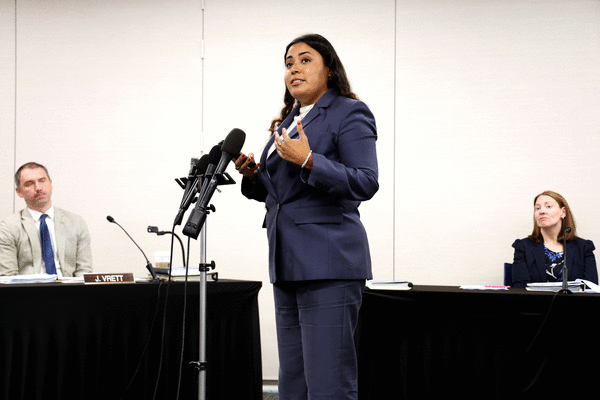
CHICAGO — Two progressive, independent candidates for the 4th Congressional District should not appear on the General Election ballot in November, the Illinois State Board of Elections voted Tuesday.
The board voted without opposition that Mayra Macías and the other hopeful, Alderman Byron Sigcho-Lopez, 25th, should not be on the ballot for the Southwest Side and west suburban district because they didn’t collect the requisite number of valid signatures. The decision came after challenges from people with ties to U.S. Rep. Jesus “Chuy” Garcia, who is retiring, and Patty Garcia, his handpicked successor.
“It is a sad day for democracy when the two Latino candidates, that are running as independents because we were not allowed to run as Democrats, are kicked off the ballot,” Macías said.
The decision keeps the path to victory clear for Patty Garcia, of no relation to the congressman, pending a potential court fight.
Sigcho-Lopez and his attorney, Andrew Finko, both said litigation on the issue could continue, though neither outlined a specific plan. Options include a constitutional challenge in federal court, Finko said. The candidates could also request review in circuit court.
“Today, in the 4th Congressional District, democracy died at the hands of Patty and Chuy Garcia,” Sigcho-Lopez said to reporters after leaving the board meeting. “What a terrible legacy to leave behind.”
Supporters of Sigcho-Lopez and Macías have said the process to get on the ballot is unfair to independent candidates, and have lamented the lack of a competitive primary ever since the outgoing congressman announced he planned to retire at the last minute, clearing the Democratic field for Patty Garcia, his former chief of staff.
“The spirit of the law is being completely broken in this race,” Macías said, speaking before the board.
A handful of speakers during the meeting’s public comment period expressed deep disappointment at what they said was Illinois Democratic political insiders getting to decide who runs rather than the thousands of people who signed petitions to get Macías and Sigcho-Lopez on the ballot.
Patty Garcia’s campaign in response to a request for comment called petition review “a normal part of the democratic process.”
“Patty earned her spot on the ballot the same way every candidate is supposed to: going door to door, talking to voters in this district,” campaign spokesperson Kait Sweeney said.
Patty Garcia’s campaign also referred a reporter to Democratic state Rep. Norma Hernandez of Melrose Park, who said she felt for the candidates who worked hard to gather signatures but called the criticisms of the congressman’s legacy “disgusting” and rejected any comparisons to “machine politics.”
“This is nowhere near that,” Hernandez said.
A spokesperson for the congressman declined comment.
The elections board’s job is to administer the law, not make it, Chair Laura Donahue said.
“We very definitely err on the side of putting people on the ballot. We try very hard to make that happen, and I think you have been given every opportunity, and you have just come up short,” Donahue said, speaking to Macías at Tuesday’s hearing.
The congressman’s move this fall already set off an avalanche of criticism and independent bids by Macías, Sigcho-Lopez and a third independent candidate, Lyons Mayor Chris Getty. Then those denunciations intensified after the petition signature challenges, which Macías and Sigcho-Lopez, have argued that, while legal, amounted to strong-arm tactics that disenfranchise voters and destroy the outgoing congressman’s progressive reputation.
Macías said she’s keeping her options open but didn’t commit Tuesday morning to any specific legal actions. She said she would consider using her resources to open a service-oriented organization or political action committee.
Sigcho-Lopez on Tuesday declined to commit to whether he’d pursue another run for City Council next year, given the vote to keep him off the ballot in November.
Finko, Sigcho-Lopez’s attorney, acknowledged the board’s “hands were tied.” But he called for supporters to advocate for the General Assembly to update the state’s elections code, which he said was outdated, citing issues from the high number of supporters required for independent candidates to the process’s reliance on distinct handwritten signatures.
Even after each of the candidates submitted the maximum number of signatures, hearing officers previously determined after challenges that Macías and Sigcho-Lopez did not have the 10,816 valid signatures required by state law for independent candidates.
Macias filed 9,758 valid signatures, and Sigcho-Lopez filed 9,594, elections board general counsel Marni Malowitz said Tuesday.
Recent federal campaign finance records showed Patty García was in a tough fundraising competition with Macías, Sigcho-Lopez and Getty. Macías and Sigcho-Lopez have also said their focus on the ballot challenges pulled attention away from fundraising.
The congressman has defended his last-minute decision that spurred the ballot fight, saying he had a change of heart after considering his own health, his wife’s multiple sclerosis and their recent decision to adopt one of their grandchildren after the death of his daughter.
____
©2026 Chicago Tribune. Visit at chicagotribune.com. Distributed by Tribune Content Agency, LLC.




















































Comments