Maryland campaign mailers may mislead voters -- and still be legal
Published in Political News
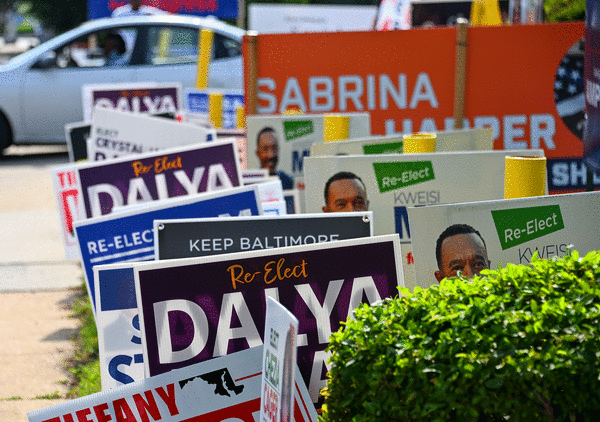
BALTIMORE — When Maryland voters in northwest Baltimore opened campaign mailers from outgoing state Sen. Dalya Attar ahead of last month’s Democratic primary, they saw a smiling photo with Gov. Wes Moore and language emphasizing that he appointed her to the Senate.
Although Moore appointed Attar to the vacant Senate seat in District 41, the mailers omitted a key piece of context: Moore had endorsed her opponent, Delegate Malcolm Ruff.
Ruff said he believes the mailers were designed to leave voters believing Attar still had the governor’s support, even though Moore had endorsed him, donated $6,000 to his campaign and appeared with him at campaign events after appointing Attar.
“People don’t necessarily pay close attention. They look at the pictures (and) don’t really scrutinize it,” Ruff told The Baltimore Sun. “That’s the reason why my opponent and maybe others were willing to do that, because they’re just saying, ‘OK, if I can just get the image out there, some people will buy it.’”
Attar did not respond to multiple requests for comment.
During Maryland’s primary elections, several campaigns distributed mailers that appeared to suggest endorsements or official backing they did not actually receive. Election law experts told the Sun that those tactics are generally protected political speech under the First Amendment.
Donald Tobin, a professor at the University of Maryland’s Carey School of Law, said the Supreme Court in recent years cited free speech protections when it ruled in favor of protecting deceptive political speech, and campaigns negatively affected by an opponent’s misrepresentations can only claim defamation — which has a high bar for proof — in a legal challenge.
The U.S. Supreme Court in 2012 struck down the Stolen Valor Act, which criminalized making false claims about one’s military record, and judges emphasized that spouting false statements alone isn’t enough to strip an individual of their free speech rights.
“The core concern is who gets to determine what is, in fact, the truth?” Tobin said of the Supreme Court judges’ past opinions. “I bet you the candidates (presenting misleading information) have some argument about why they’re not inaccurate.”
The mailers illustrate a gray area in campaign advertising: Candidates can use technically accurate statements, photographs and familiar designs to create impressions that election law experts say are generally protected political speech — even if some voters draw conclusions the campaigns never explicitly state. Campaign strategists say the practice raises ethical concerns because many voters never verify those impressions before casting ballots.
A similar incident occurred in June in Montgomery County. State Sen. Will Smith and several colleagues distributed mailers designed to resemble an official Democratic sample ballot, using party-style branding even though the Maryland Democratic Party had not approved the slate.
But the Maryland Democratic Party did not authorize the mailer.
Smith did not respond to multiple requests for comment.
Robbie Leonard, a Maryland lawyer with experience in election law and campaign finance, said as long as a campaign’s statements are factual, they can’t be legally disputed.
“In Dalya Attar’s case, if she doesn’t say Wes Moore endorsed me (and) says Wes Moore appointed me to fill the Senate vacancy, that’s totally legitimate. That’s a true factual statement,” Leonard said. “If the recipient of that mail assumes Wes Moore endorsed her, that’s not Dalya’s fault. Dalya Attar is just expressing fact and providing that information to the voters.”
Why campaigns test the legal limits
Campaign strategists noted that candidates often send mailers to create the impression of broad support to sway voters to their side.
Joe Francaviglia, a former Maryland Democratic Party leader, said this tactic works closer to Election Day, when candidates can capitalize on the short time frame — between when a mailer is received and when ballots are cast — that voters have to scrutinize claims.
“The closer to the election deadline, the less options you have,” Francaviglia said.
This is a risky strategy, he added, because “it also has the tendency to blow back on campaigns if there’s enough time for the public to understand that people are trying to trick them.”
What voters can do
Leonard, the election law and campaign finance attorney, said the onus of vetting campaign messages ultimately rests on voters, especially because outside groups often pay for campaign materials to influence elections in their favor.
“We should all be going online and researching the candidates. Read the League of Women Voters’ endorsement questionnaires. Look up people’s voting records,” he said. “We should make our own conclusions.”
But, Ruff noted, voters should beware of how motivated some candidates are to win elections that they’ll do “anything necessary, even if it ain’t ethical.”
_____
©2026 Baltimore Sun. Visit baltimoresun.com. Distributed by Tribune Content Agency, LLC.
















































Comments