Even without birthright citizenship, Supreme Court co-signs much of Trump's immigration agenda
Published in Political News
WASHINGTON — Over the past year and a half, the Trump administration has turned repeatedly to the Supreme Court for clearance on its sweeping immigration enforcement plans. While the administration lost its bid this week to do away with birthright citizenship by executive order, its strategy has, in large part, been a success.
In a White House news release listing 60 actions the administration has taken as part of its America First agenda to restrict immigration, the first four actions were decisions by the Supreme Court.
After the court ruled in June that President Trump can, without judicial review, end temporary legal protections for hundreds of thousands of immigrants, his administration celebrated the ruling as a "major victory for American sovereignty."
The list of accomplishments also noted that the high court had granted immigration officers greater leeway to remove green card holders who are accused but not convicted of crimes; allowed the administration to limit how many people can apply for asylum; and gave it the green light to continue deporting immigrants to third-party countries where they have no connection.
The decisions raise significant consequences for immigrants who have made their lives in the U.S., and stand to reshape public views over the country's historic position as a place of refuge. The administration has not only tried to restrict illegal immigration, it has also targeted people residing in the country legally and stepped up efforts to drive them out.
The court's term that ended last week is the most robust judicial affirmation of executive power over immigration in the court's history, said Muzaffar Chishti, a senior fellow at the Migration Policy Institute, a nonpartisan think tank. Chishti said the rulings signify that future presidents could continue to change immigration policies at their discretion.
"The biggest impact is that we have now fully understood the power of the presidency, especially in immigration matters," Chishti said. "Where there is any discretion left to the president or the executive, this Supreme Court has widened the limits of that authority."
One of Trump's earliest wins since returning to the White House came last September, when the Supreme Court affirmed that immigration agents can stop anyone they suspect of being in the country illegally on the basis of their perceived race and ethnicity, job or the language they speak.
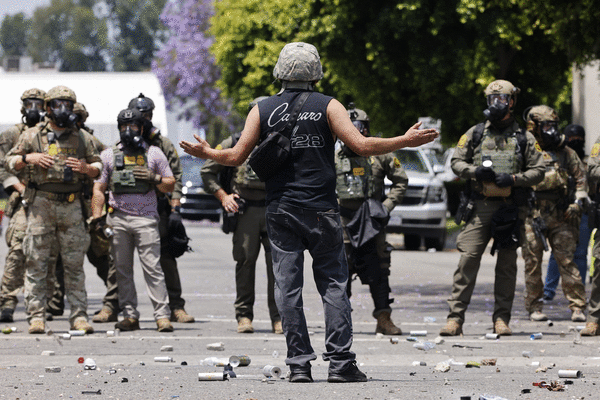
Afterward, federal officials launched enforcement operations in Chicago, North Carolina and Minneapolis, using increasingly aggressive tactics until two U.S. citizens were shot and killed by immigration agents in January and the administration shifted course.
The Supreme Court's rulings have landed with particular force in South Florida, which is home to the largest share of Venezuelan immigrants in the country.
The end of Temporary Protected Status — a program intended to protect people in the event of a natural disaster — heightened concerns about deportation to a country that is reeling after twin earthquakes from June 24. More than 100 Venezuelans deported from the U.S. hours before the disaster are among those missing.
Some Florida Republicans called on the administration to renew the legal protections for Venezuelans in the U.S.
"Congress specifically included earthquakes in the TPS statute for moments exactly like this," said Rep. Maria Elvira Salazar (R-Fla.). "I urge the Administration to redesignate TPS for Venezuelans already in the United States because sending them back after this catastrophe is simply not the right thing to do."
The White House did not respond to a request seeking comment on whether Trump would authorize humanitarian relief for Venezuelan immigrants.
Immigrants from El Salvador are now holding their breath for an upcoming decision on their TPS designation, which is set to expire Sept. 9.
About 1.3 million people from 17 countries were enrolled in the program when Trump took office last year. The administration has already terminated TPS for many of them, and the Supreme Court's decision last week, which concerned Haitians and Syrians, clears the way for federal officials to continue.
"The implication of this is that at least most of the claims that have been litigated to challenge this administration's illegal war on TPS are now foreclosed," said Ahilan Arulanantham, co-director of the Center for Immigration Law and Policy at UCLA, who presented arguments for the Syria case.
The concern among advocates took on greater urgency after The New York Times and other outlets reported on Thursdaythat immigration officials, seeking to reach a goal of 2,000 arrests per day, had detained more than 10,000 people in less than a week.
Arnulfo De La Cruz, who leads a California union representing thousands of home care workers with temporary protected status, said he is alarmed by the Supreme Court's many immigration rulings.
"We're getting into really dangerous territory with, in some ways, the Supreme Court almost legislating the priorities of the administration," said De La Cruz, who is president of SEIU California and SEIU Local 2015. "That's the responsibility of Congress."
In a blow to a centerpiece of the administration's immigration agenda, the divided Supreme Court upheld birthright citizenship — that, with few exceptions, a person born in U.S. soil is citizen.
Stephen Yale-Loehr, a retired Cornell University immigration law professor, called the ruling one setback among Trump's largely successful restructuring of how the U.S. treats immigrants. He pointed to a tracker led by a Stanford University law professor that lists more than 700 immigration policy actions by the Trump administration so far.
"Despite this seemingly historic loss, the Trump administration is winning its war on immigrants," Yale-Loehr said.
And now some Republicans, including Trump, are saying Congress should lead the attack on birthright citizenship.
"You can't have the kinds of immigration programs other countries have when you can just have a baby here, and now that child is an American citizen," said Stephen Miller, a Trump aide who is behind much of his immigration agenda.
But Chishti, of the Migration Policy Institute, said in reality, "Congress can't do anything — it was left powerless by the Supreme Court."
Other conservatives called on the administration to lean on the considerable authority it already has.
Dale Wilcox, executive director of the Federation for American Immigration Reform, a hard-line restrictionist group, said the birthright decision "makes it all the more urgent to step up enforcement to the maximum possible extent."
Democrats, meanwhile, cheered the win while acknowledging that their fight against the administration's immigration policies continues.
"We cannot rest," said California Sen. Alex Padilla. "Because this is certainly not the end of Trump's attacks on our Constitution, our democracy, and the notion of what it means to be American."
More immigration-related cases are among those in the Supreme Court's docket starting in October and could offer further expansions of executive power.
One case concerns more than 50,000 petitions filed in federal courts in hopes of obtaining the release of detained immigrants. Those petitions ballooned after the administration began limiting the ability of many immigrants to seek release through bond hearings in immigration court.
The administration is expected to put up a fierce defense.
©2026 Los Angeles Times. Visit at latimes.com. Distributed by Tribune Content Agency, LLC.



















































Comments