In first face-to-face forum, opponents slam Wasserman Schultz for seeking reelection in Florida's 20th District
Published in Political News
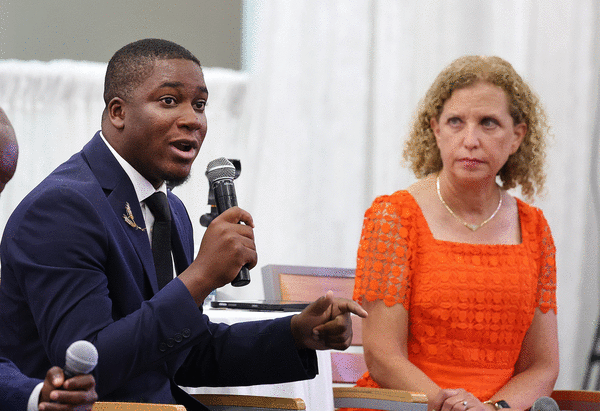
FORT LAUDERDALE, Fla. — Brushing aside criticism that she shouldn’t even be running for reelection in a new Broward County district, U.S. Rep. Debbie Wasserman Schultz sought to portray herself Wednesday night as the best choice for voters wanting experience and clout to deliver — and the guts to stand up to President Donald Trump and MAGA Republicans.
Primary opponent Elijah Manley offered a decidedly different assessment.
Manley assailed Wasserman Schultz for accepting campaign contributions from interests disfavored by many progressives — insurance and private prison industries and the pro-Israel organization AIPAC — and as someone who can’t adequately represent many of the residents of Congressional District 20 because she doesn’t have their lived experience.
Wasserman Schultz said she’s been able to pass legislation and secure significant funding for Broward County.
The contrast between Wasserman Schultz, 59, the senior Democrat in the Florida Congressional Delegation, and Manley, 27, who has never held elected office despite several attempts, was the most vivid — and recurring — difference among candidates at a lengthy, wide-ranging candidate forum Wednesday night in Fort Lauderdale.
Two other contenders for the Democratic congressional primary, Sheila Cherfilus-McCormick and Dale Holness, were more subdued than Manley when it came to interactions with Wasserman Schultz. They focused more on their own backgrounds and touting accomplishments from their past time in elected office.
Race
Race was a central theme, sometimes addressed directly, sometimes more subtly.
For weeks, Broward Democrats have been divided over whether Wasserman Schultz, who is white, should be running in the 20th District, where an estimated 42% of the population is Black. The four other candidates in the Aug. 18 Democratic primary are Black.
Wasserman Schultz opted to run for reelection in the 20th District after the Republicans who control state government changed the boundaries of South Florida congressional districts to make them more likely to elect Republicans and less likely to elect Democrats.
Wasserman Schultz’s district was chopped up, with its territory split among five other districts, including the 20th, which is now the only one entirely in Broward and the only one all-but-guaranteed to elect a Democrat.
Holness said “lived experience is critical.” Someone who wants to represent the 20th District needs to fully understand daily experiences influenced by race. He cited, for example, evidence showing that Black motorists who aren’t wearing seatbelts are far more likely to be pulled over by police.
Holness, a former Broward County commissioner and Lauderhill city commissioner, who has unsuccessfully run for Congress previously, also has the political experience to get things done.
Cherfilus-McCormick said it is imperative to “speak up when Black voices are being diluted and when Black voices are trying to be gentrified. … We see that going on right now, in this district.”
Not using Wasserman Schultz’s name, but in a comment clearly directed at her, Cherfilus-McCormick said, “Everybody must talk about what is wrong at this time. Having someone come into our district, that is forum shopping.”
Manley, too, took aim at Wasserman Schultz. “While the Republicans are trying their hardest to silence Black voices I don’t expect someone in our own party, a white Democrat, to do the same.”
Wasserman Schultz said she can represent residents of the district.
“To address the accusation here. I have spoken with hundreds of people now in District 20. And it is absolutely certain that representation matters. And lived experience matters. But experience and making sure that you have someone who has the seniority and the seasoning to deliver for a district, it matters as well,” she said, promising to “enhance the lived experience” of its residents if she is elected.
Wasserman Schultz repeatedly said her actions in office show what she’d do in the future in a range of ways. She said she secured federal money to pay for body cameras for law enforcement officers.
After the 2014 killing of a Black man, Michael Brown, by a white police officer in Ferguson, Mo., Wasserman Schultz said she and the late U.S. Rep. Alcee Hastings developed a program for young people to tell police chiefs about their experiences. (She described Hastings, who was a pioneering civil rights lawyer early in his career, as a mentor to her.)
Barbara Effman, president of the West Broward Democratic Club and a longtime Wasserman Schultz supporter, said after the forum that she “really connected then because she showed how she has helped this community throughout the years … she has the experience that’s needed in this district.”
Corey Shearer, president of the Broward Black Democratic Caucus, has been one of the voices arguing that the district should have a Black representative. “When you just see the wealth of knowledge and experience that our candidates have, we have no need for a candidate (Wasserman Schultz) to come over from the west part of the county,” he said after the forum.
Cherfilus-McCormick
Cherfilus-McCormick was elected to Congress in a 2022 special election after two unsuccessful congressional campaigns.
She resigned in April minutes before the House Ethics Committee was set to decide on what sanction to recommend to the full House after its adjudicatory subcommittee found she had committed 25 ethics violations, including breaking campaign finance laws.
The former congresswoman has consistently denied any wrongdoing and has entered a not guilty plea to federal criminal charges, some of which overlap with the House ethics case.
None of the candidates went after Cherfilus-McCormick’s issues, which came up only through a moderator’s question.
Cherfilus-McCormick focused on, and minimized, one of the central issues in the long investigation of her. The family-owned health care company she used to run received a $5.8 million overpayment of federal money processed by the state for services during the COVID-19 pandemic. It kept the money, and agreed to repay it over time to settle a state lawsuit years later.
Cherfilus-McCormick said it was a “mistake” and a “contractual issue” that happened after she stepped away as CEO to campaign full time for Congress.
Congressional investigators said some of that money improperly went to support her campaign. As she has in the past, she said the circumstances “made me feel this was actually politically motivated.”
Policy
There were relatively few policy surprises, and few differences among the candidates on issues.
Most offered similar prescriptions from the Democratic policy playbook, including reining in ICE.
Some advocated for free or discounted college tuition and vocational training.
Several said they wanted regional or national catastrophic insurance pools, to share risk from major events as a way to reduce homeowners insurance premiums.
Holness and Manley said they supported a government-funded “Medicare for All” system, but didn’t suggest how it could get passed or paid for; Wasserman Schultz said she wanted to undo Trump-era cuts to the Obamacare health program.
Holness, Manley and Wasserman Schultz raised their hands to show support for repealing the doctrine of qualified immunity, which shields police officers from civil liability unless their conduct is so bad a reasonable person would have known it violated someone’s rights under the constitution or statutes.
Wasserman Schultz said she voted for legislation to eliminate it. Manley went further, suggesting that settlements in police misconduct cases involving an act of violence against the community, the money should come out of law enforcement officers’ pensions.
Holness said he saw a young person having a mental health issue get shot by police. At another point, Manley said he lost a family member to “police violence.”
Cherfilus-McCormick, who said she had relatives who are police officers, said it wasn’t a simple yes-or-no question.
Israel
There were significant differences over U.S. support for Israel, something that has become a flashpoint in American politics since the war in Gaza that began with the Oct. 7, 2023, Hamas terrorist attacks on Israel.
Many on the progressive left and some in the Democratic center have split with Israel over its conduct of the war, which has included the deaths of many Palestinian civilians.
Cherfilus-McCormick said she supported Israel having the money to defend itself. But as a House Foreign Affairs Committee member until she resigned, she said she told Israeli Prime Minister Benjamin Netanyahu that people in Gaza had to have access to food.
Holness said Israel and the Israeli people “have a right to exist,” but emphasized that Palestinians also “have a right to resist.”
Manley condemned Israel’s conduct of the war, and its effect on Palestinians, explaining that “I strongly believe there is a genocide happening.” Far too many have died in Gaza, Manley said, adding it is unacceptable that Israel’s conduct is being fueled by U.S. support. “We cannot accept that as Americans,” he said. “Our money needs to go to rebuilding Sistrunk.”
(Sistrunk Boulevard is the historic main street of the African American community in northwest Fort Lauderdale.)
Wasserman Schultz, who is the first Jewish woman elected to Congress from Florida and co-chair of the Congressional Caucus on Black-Jewish Relations, said she supports the U.S.-Israel relationship.
“Israel is the only democracy in the Middle East,” she said, adding it is “an absolute necessity that we work toward a two-state solution” with security guarantees for a Palestinian state and Israel. “We need to make sure that we free Gaza from Hamas.”
Candidate forum
The event, which lasted about an hour and 40 minutes, was the first joint appearance of all the Democratic candidates since the primary field in the 20th District was finalized on June 12.
There were some nods in the direction of a more old-fashioned political civility Wednesday night. Afterward, Manley and Wasserman Schultz — who organizers sat next to each other — shook hands. And each of the Democrats present said they would support whoever the party’s voters nominate.
The partisan voting index from the nonpartisan Cook Political Report rates the district as D plus 20, which means it performed 20 points more Democratic than the nation during the last two presidential contests.
With the district so overwhelmingly Democratic, the primary winner is all-but-certain to win in November.
Germaine Smith-Baugh, president and CEO of the Urban League of Broward County, which co-sponsored the forum with WDFL-TV, said the organization invited all candidates, including Republicans.
Rod Joseph was the Republican participant, and urged the audience to support his campaign. “If you can, donate a dollar before you leave so we can retire Miss Debbie.”
One Democrat was missing. Organizers announced that Luther Campbell, famous from his time as leader of the rap group 2 Live Crew and more recently a civic activist, had said he would be there. A chair was set for him, his picture was projected on a big screen with the other candidates, but he wasn’t there.
Later Wednesday night, Campbell posted a video on social media in which he said neither he nor his staff had received a formal invitation. “Under no circumstances did I confirm anything,” he said, adding, “I don’t run from a fight.”
----------
©2026 South Florida Sun Sentinel. Visit at sun-sentinel.com. Distributed by Tribune Content Agency, LLC.





















































Comments