Idaho doctor's abortion case reached trial this week. Here's what's happened so far
Published in Political News
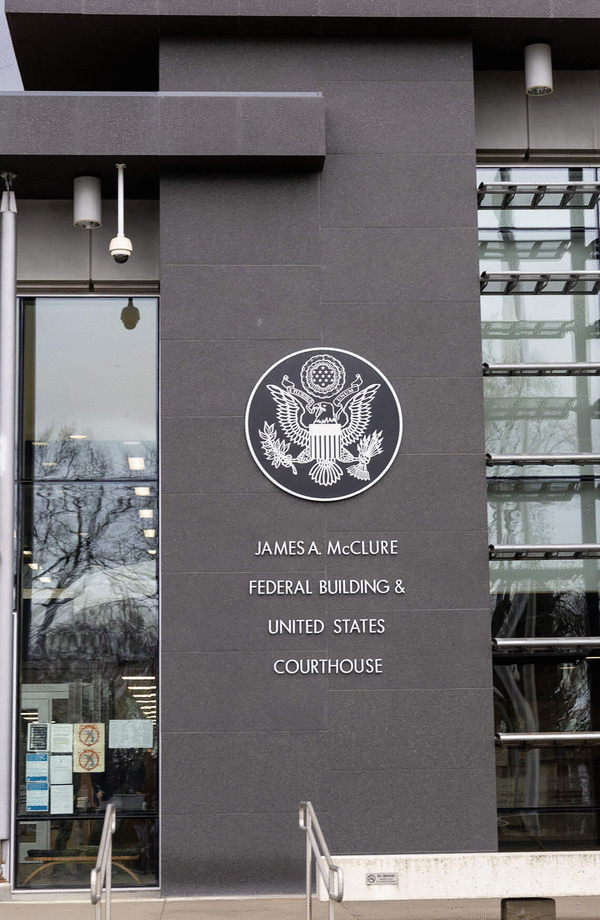
BOISE, Idaho — A trial whose outcome could impact Idaho’s abortion laws is underway in federal court in Boise, and the first two days have included expert witness testimony from the high-risk pregnancy specialist suing government officials and from several other specialists who detailed myriad potential pregnancy complications they said could necessitate abortion care.
Dr. Stacy Seyb, a maternal-fetal medicine specialist at St. Luke’s Health System in Boise, filed the lawsuit against the Ada County prosecutor’s office and members of the Idaho Board of Medicine in May 2024. Seyb claimed Idaho’s strict abortion restrictions interfered with his ability to provide medically necessary abortions to his patients, who are typically experiencing high-risk pregnancies.
U.S. District Judge B. Lynn Winmill is presiding over a bench trial — which has no jury — to decide the case, which addresses potential exceptions to the state’s abortion ban to protect the health of a pregnant woman. The trial is scheduled to continue into next week.
Seyb’s attorneys with the Lawyering Project, a nonprofit that aims to expand abortion access, argued the state ban violates the U.S. Constitution by denying pregnant Idahoans the rights to due process and equal protection under the law, both guaranteed by the 14th Amendment.
Abortion is illegal in Idaho in nearly all cases, except to save the life of the mother, for ectopic or molar pregnancies or in cases of rape or incest that have been reported to police. Last year, an Ada County judge ruled partially in favor of four Idaho women who said they were denied abortions for health risks and fatal fetal anomalies. The judge’s ruling did not declare the laws a violation of pregnant Idahoans’ rights as requested by the plaintiffs.
Seyb’s case takes a new tack against the law known as Idaho’s Defense of Life Act, which has also been the subject of lawsuits from the U.S. Department of Justice and St. Luke’s Health System.
Idaho Attorney General’s Office Division Chief for Civil Litigation and Constitutional Defense Jim Craig led the defense. Craig read a graphic description of an abortion procedure during a cross-examination on Tuesday as part of what he called the state’s assertion of its interest in limiting “gruesome and barbaric medical procedures,” an argument he made in defense of Idaho’s abortion laws in a previous court challenge.
The state questioned witnesses Monday and Tuesday about their credibility and prior support for abortion access, including asking some who had worked to overturn other states’ bans if they were “bringing that assault” to Idaho.
The Attorney General’s Office previously moved to dismiss the lawsuit on the grounds that Seyb admitted during deposition that he does not understand the law, a motion Winmill denied.
Idaho doctor, experts say abortion law poses serious risks
Craig pursued that same thread as he cross-examined Seyb on Monday after the maternal-fetal medicine specialist testified that Idaho’s abortion bans have changed how he is able to practice medicine, forced patients out of state for care and pushed practice partners to leave the state.
“It’s impacted us a lot,” Seyb said. “It’s been very, very difficult to try to figure out what types of procedures, what situations would not put you into harm’s way.”
Craig asked the Boise physician about a description of Idaho abortion law in a medical journal and prompted Seyb to confirm that he now knows the description is inaccurate.
“I’m not sure that I do,” Seyb replied.
Attorneys with the Lawyering Project generally focused on a particular topic with each health expert they called to establish their case, which argues that pregnant Idahoans face discrimination under the state’s bans. In the lawsuit, they said pregnant women face “governmental interference” if they have pregnancy-related complications that jeopardize their health, if pregnancy exacerbates an existing or underlying health condition, if pregnancy puts them at risk for death from self-harm or if they have a pregnancy with fatal fetal conditions.
Seyb’s attorneys called maternal-fetal medicine specialists to the witness stand in the first two days of trial to speak to pregnancy’s risks to a woman’s physical and mental health, as well as possible fatal or “life-limiting” fetal conditions. Witnesses spent hours describing pregnancy’s impacts on the body and influence on chronic conditions, as well as complications and conditions that would lead them to discuss abortion as a potential option for patients.
The plaintiffs at various points during the trial sought to establish the need for abortion access for mental health circumstances. Experts noted that in the U.S. and in Idaho, mental health is the leading cause of maternal mortality, or the death of a woman who is pregnant or recently gave birth. Seyb, who previously served on Idaho’s first Maternal Mortality Review Committee, testified that suicide was considered a pregnancy-related death, meaning it was linked directly to pregnancy.
Carly Dahl, a maternal-fetal medicine specialist at Intermountain Health in Ogden, Utah, testified that since the committee was reestablished in 2023, Idaho no longer considers suicides pregnancy-related, out of step with other states and the Centers for Disease Control and Prevention.
Idaho’s attorneys question expert credibility, call abortion ‘barbaric’
The state’s cross-examinations of witnesses frequently included references to their depositions, publications or past support for abortion rights or organizations like Planned Parenthood. The questions appeared aimed at shaking the credibility of the witnesses, and at times led to terse exchanges or pushback.
In more than one instance, Craig asked witnesses to read excerpts of their publications or depositions that appeared to contradict their testimony in court. Marcela Smid, a maternal-fetal medicine specialist at the University of Utah who focuses on mental health and substance use disorders, appeared frustrated when Craig’s chosen excerpt cut off halfway through a sentence.
“Suicide is less common during pregnancy than at other times in someone’s life,” the excerpt read. Smid insisted on finishing the sentence, which concludes, “but more common within the first year postpartum.” Seyb’s attorneys later asked her to read additional context from the publication. “However, suicidal ideation during pregnancy has increased over the past 10 years, with a more drastic increase among Black individuals.”
Craig also questioned the physician witnesses as to whether they consider both mother and fetus their patients, and whether they believe commitments to treat patients under ethical principles also apply to fetuses.
The state attorney clashed with Winmill when he began to read a description of an abortion procedure to Utah maternal-fetal medicine specialist Alexandra Grosvenor Eller to confirm the veracity of the description. Craig, who ultimately was allowed to continue with his questioning, said the description helped establish abortion as a “gruesome and barbaric” medical procedure.
“It seems to me that what you’re doing is trying to sensationalize the process as opposed to trying to resolve the issues that are really at hand here,” said Winmill.
©2026 Idaho Statesman. Visit at idahostatesman.com. Distributed by Tribune Content Agency, LLC.





















































Comments