South Carolina primary: US Rep. Clyburn wins Democratic primary; US Rep. Wilson's race not called yet
Published in Political News

COLUMBIA, S.C. — South Carolina’s longest-serving members of the U.S. House of Representatives were vying to keep their parties’ nominations during Tuesday night’s primary elections. It came after weeks of debate over whether the state should redraw its congressional map, an effort that would have put them into same district.
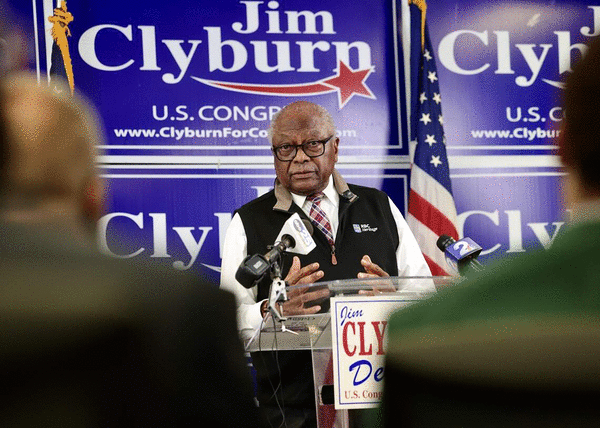
U.S. Rep. Jim Clyburn, an incumbent Democrat representing the 6th District, which includes part of Richland County, won the primary early in the night. The Associated Press called the race just before 8 p.m. with just 12% of the votes counted. By 8:15 p.m., he had received about 93% of votes.
Clyburn’s opponent, Frederick Goodwin, received just over 6% of votes.
“I am humbled and honored to receive the Democratic nomination to continue serving the people of the 6th Congressional District in the United States House of Representatives,” Clyburn wrote on X. “If reelected, I promise to fight against the forces of retrogression, continue standing up for the values and interests that matter most to all South Carolinians, and continue our pursuit towards a more perfect Union.”
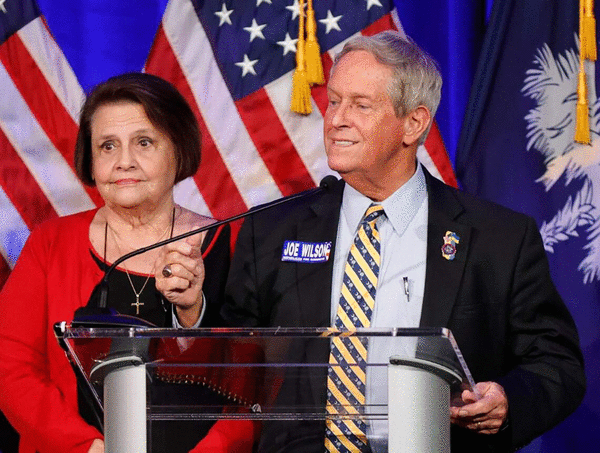
U.S. Rep. Joe Wilson, is an incumbent Republican representing the 2nd District, which includes Lexington County and part of Richland County. His race has yet to be called. However, by 8:15 p.m., he had already garnered more than 76% of votes.
His opponents, Sam Gibbons and Hampton Redmond, received about 13% and 9%, respectively.
Both Clyburn and Wilson are highly favored to win in November’s general election.
It comes at the heels of a last-minute effort to redistrict the state’s congressional seats in May, just as the state’s legislative session was coming to a close, and military oversees and absentee ballots were already being returned.
Of South Carolina’s seven districts, six are drawn to favor Republican candidates, and one for Democratic candidates. With pressure from the White House, the General Assembly was asked to create a map in which all seven districts would turn red, including Clyburn’s seat. It would have essentially ousted him after serving in the role for 17 terms.
That same pressure spurred similar redistricting efforts in red states across the country.
The state Senate voted to “continue” the discussion May 26, after a record number of primary voters cast their ballots when early voting began that day. It effectively ended the effort for the year.
“The White House wanted to draw a new district that would be 7-0. We have someone in the White House that wants Republicans to ignore the Constitutional principles for which this current map was drawn. A critical number of Republicans did not believe in putting a man over the law,” Clyburn said in a May 26 post on X. “Today, members of the South Carolina State Senate stood up for the constitutional principles that they say they believe in.”
Some state lawmakers were disappointed that the effort failed, but Gov. Henry McMaster told reporters in May that he is “confident” that one day, South Carolina’s congressional delegation will be “completely Republican.”
Results of the primary elections are unofficial until certified by the South Carolina Election Commission.
©2026 The State. Visit at thestate.com. Distributed by Tribune Content Agency, LLC.
















































Comments