Mike Pence's new book is a challenge to Trumpism
Published in Political News
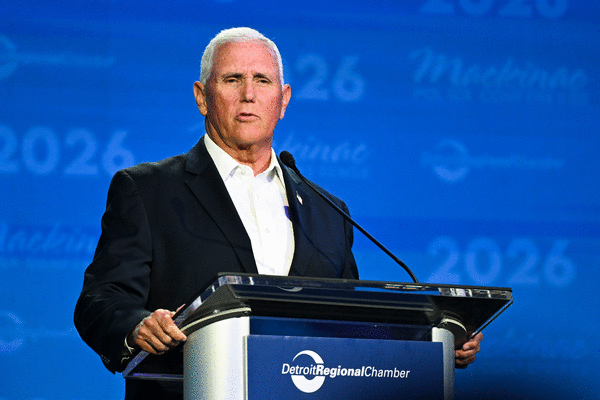
Former Vice President Mike Pence is not merely promoting a new book. He is making a final argument for a vision of conservatism that he believes is slipping away.
In “What Conservatives Believe: Rediscovering the Conservative Conscience,” Pence argues that the Republican Party must choose between enduring conservative principles and what he describes as the growing appeal of populism, grievance politics, isolationism and big-government nationalism. The book is widely viewed as his most direct intellectual challenge yet to President Donald Trump and the movement that now dominates the Republican Party.
Pence’s critique is noteworthy not because he is a political rival — his own presidential ambitions have largely faded — but because he was once Trump’s most loyal lieutenant. For four years, he defended the administration, advanced its agenda and stood beside the president during some of the most consequential moments in modern American politics.
Today, however, Pence is warning that the Republican Party risks losing its philosophical foundation. He argues that conservatism has traditionally been defined by limited government, free markets, a strong national defense, America’s leadership in the world and traditional values. In his view, too much of today’s political energy is focused on grievance rather than governance and personalities rather than principles.
Many Republicans will disagree. Trump’s supporters would argue that the former president transformed the party because the old conservative establishment failed to address concerns about trade, immigration, cultural change and the frustrations of working-class voters. They see Trump not as a departure from conservatism but as its necessary evolution.
That debate is healthy. Political parties must continually adapt or risk irrelevance.
Yet Pence raises a question that deserves consideration beyond partisan politics. What happens when political movements become centered more on individuals than on ideas? American history offers a cautionary lesson. Parties built around a single personality often struggle to endure once that leader leaves the stage. Parties anchored by principles have a greater chance of surviving political cycles and generational change.
Pence’s criticisms of Trump extend beyond policy. He has also continued to defend his decision to certify the 2020 election and has criticized efforts to reward individuals involved in the Jan. 6 Capitol riot.
Whether one agrees with Pence or Trump is ultimately beside the point. The larger value of Pence’s book is that it forces Republicans and perhaps all Americans to confront an uncomfortable question: Are our political loyalties rooted in constitutional principles, or in the leaders who claim to represent them?
As America approaches its 250th anniversary, that question matters. The nation’s founders built a republic around institutions, checks and balances, and the rule of law precisely because they distrusted the concentration of power in any one individual.
Pence may no longer be the future of the Republican Party. But his warning should not be dismissed. Political movements come and go. Personalities rise and fall. The true test of any political philosophy is whether it can endure long after its most famous champions have departed the stage.
_____
©2026 The Baltimore Sun. Visit at baltimoresun.com. Distributed by Tribune Content Agency, LLC.





















































Comments