Prior authorization bill now eligible for House fast track
Published in Political News
WASHINGTON — Legislation aimed at reducing delays when Medicare Advantage plans require preapproval for care could hit the House floor under fast-track rules for bills that have broad support.
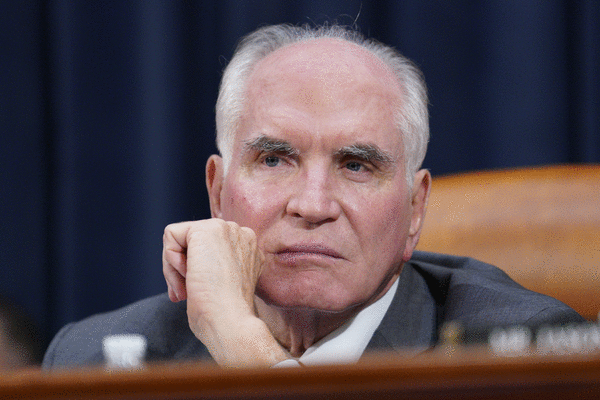
The bill, sponsored by Rep. Mike Kelly, R-Pa., targets use of prior authorization in Medicare Advantage — in which insurers approve or deny services before they can be delivered.
The legislation would require insurers’ plans to adopt electronic systems that use standardized transactions, which proponents say will reduce delays caused when health care providers are forced to navigate through various payer portals or send information by fax. It would also require plans to submit a range of data to the federal government, including which services are subject to prior authorization requirements and the percentage and number of requests approved and denied.
The use of prior authorization has become widely loathed by the public and health care providers, who say it delays access to needed care. Insurers defend the practice as necessary to prevent patients from receiving unnecessary care. Its use has been scrutinized in Medicare Advantage, the private option that now covers more than half of Medicare beneficiaries.
Known as the “Improving Seniors’ Timely Access to Care Act,” the bill has 290 co-sponsors, making it eligible for the consensus calendar, which allows legislation to move outside of the traditional committee process.
A sponsor of the legislation would have to make a motion to the House clerk to place the measure on the calendar.
Bill sponsors are waiting for details on next steps before filing the motion, according to a source familiar with the situation. That could include a markup by the House Ways and Means Committee, a step that’s not strictly necessary but can be done out of deference to the committee with jurisdiction.
A Ways and Means Committee spokesperson said the panel does not comment on specific hearings or markups until they are officially noticed.
The bill reached the 290 co-sponsors threshold Monday with support from Reps. Nancy Mace, R-S.C., and George Whitesides, D-Calif. A companion measure in the Senate, sponsored by Roger Marshall, R-Kan., has 70 co-sponsors.
‘Defining moment’
Despite the bipartisan support, lawmakers, advocates and lobbyists have been frustrated with the slow pace of getting the legislation across the finish line. It was first introduced in 2019 by Rep. Suzan DelBene, D-Wash., who co-sponsors the current bill.
Kelly and DelBene, along with cosponsors Reps. Ami Bera, D-Calif., and John Joyce, R-Pa., said in a joint statement Wednesday that the bill has now reached a “defining moment,” and that passage would “make it much easier for seniors to receive the care they’re entitled to while also alleviating unnecessary burdens on physicians and hospitals.”
For several sessions of Congress, the measure has been one of the most popular in the House and Senate. It has no public opposition and, according to scores from the Congressional Budget Office, would come at no cost to the government.
The reason behind the holdup is unclear even to the bill’s sponsors and supporters, other than a Congress perennially distracted by other priorities like government funding, reconciliation bills and other fights.
The legislation is publicly supported by a coalition of Medicare Advantage insurers called the Better Medicare Alliance, as well as by insurer Humana, patient groups and provider groups.
“There’s no good reason, there’s no weird political opposition or anybody trying to hold this back, it’s just finding the path to do it,” said Peggy Tighe, lead legislative counsel for the Regulatory Relief Coalition, a group of national physician specialty organizations formed to advocate on this issue.
After the measure reached the threshold for the consensus calendar in 2022, the Ways and Means Committee moved quickly to advance it. The House ultimately passed the legislation by voice vote. But it died in the Senate over concerns about a $16 billion cost estimate.
Efforts to include the bill in previous year-end packages did not pan out amid competing priorities.
The Biden administration then implemented similar policies, and although some provisions haven’t yet taken effect, the CBO has acknowledged them and lowered the cost score to zero dollars in 2024.
“The seniors’ timely act should be a slam dunk,” said Scott Styles, executive director of the newly launched Alliance for Medicare, which is aimed at improving Medicare Advantage. “It’s hard to really understand why that hasn’t moved.”
Pervasive requirements
According to health policy research organization KFF, 99 percent of Medicare Advantage enrollees are subject to prior authorization for some services, mostly higher-cost ones like inpatient hospital stays.
In 2024, 53 million prior authorization requests were submitted to Medicare Advantage insurers, according to the KFF analysis. That year, 7.7 percent of requests were denied. Of the 11 percent of denials that were appealed, 81 percent were partially or fully overturned.
Advocates say the high overturn rate points to flaws in the process and note that the data required under the bill could help shed light on the problem.
The Trump administration is also proposing action on prior authorization.
The Centers for Medicare and Medicaid Services recently proposed rules that would require Medicare Advantage use electronic prior authorization for prescription drugs. It sets deadlines of seven calendar days for “standard” prior authorization requests and 72 hours for expedited ones.
The rules apply to Medicare Advantage, Medicaid, the Children’s Health Insurance Program, and individual and small group insurers on federally facilitated exchanges.
The rule is similar to the Biden administration rule finalized in 2024 that applied to nondrug services.
The Trump administration has also touted “voluntary” agreements it has reached with insurance companies to streamline the process. America’s Health Insurance Plans, a trade group for health insurers, says health plans have eliminated 11 percent of prior authorizations across a range of medical services.
But physicians say they haven’t seen those changes in practice yet.
“Physician trust in voluntary insurer pledges is deeply eroded after years of unfulfilled promises,” American Medical Association President Bobby Mukkamala said in a statement last month.
©2026 CQ-Roll Call, Inc., All Rights Reserved. Visit cqrollcall.com. Distributed by Tribune Content Agency, LLC.




















































Comments