US Chemical Safety Board faces steep cuts during probe of Washington paper mill implosion
Published in Political News
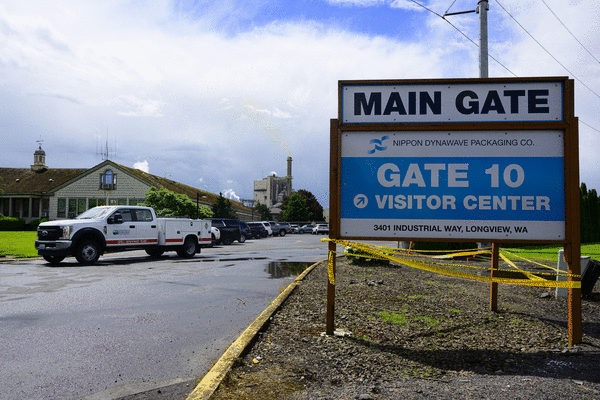
WASHINGTON — As federal investigators descend on Longview, Washington, to make sense of the catastrophic implosion at a pulp and paper mill, Congress is weighing a proposal to cut the investigating agency's budget by more than 40%.
The May 26 disaster at Nippon Dynawave Packaging killed 11, tainted the Columbia River and rocked the tight-knit, industrial Southwest Washington community. Gov. Bob Ferguson called it the deadliest industrial incident in modern state history. Within a day, the U.S. Chemical Safety and Hazard Investigation Board launched an inquiry to determine what went wrong and whether similar tragedies could be prevented elsewhere.
Now, as investigators begin what could be a months- — or years- — long examination of the fatal implosion, Longview is emerging as a critical test for an agency that has spent much of the last decade fighting for its own survival.
The House Appropriations Committee on Wednesday is set to debate a proposal that would reduce the Chemical Safety Board's budget from $14.4 million to about $8.2 million. Former board members, investigators and engineers told The Seattle Times that a drastic cut would impair the board’s ability to conduct a thorough and timely probe of the Longview disaster and future industrial catastrophes. They warn it could cripple the only independent — and already slim — federal agency tasked with answering a critical question after a chemical tragedy: What went wrong and how can it be prevented from happening again?
“This work is incredibly important to protecting workers, communities, the environment and the nation's critical infrastructure,” said Catherine Sandoval, who served as a CSB board member from February 2023 to July 2025. The board, operating with roughly 50 employees at its height, has operated on a flat budget since 2023, she said. A reduction of about 40% would likely force staffing cuts and limit the agency's investigative capacity at a moment when it is undertaking one of the highest-profile investigations in recent years.
The cut “wouldn’t support their current level of staffing — you just lose your ability to do the work, Sandoval said.
It’s the latest in attempts to weaken — or dismantle — the CSB altogether. President Donald Trump has repeatedly sought to eliminate the board, proposing since his first term to reduce its funding to $0. He has argued that the agency duplicates the role of other federal regulators and, in his most recent budget proposal for fiscal 2027, says eliminating the board aligns with broader “plans to streamline functions across government.”
The board was established, however, as an independent, nonregulatory body with a mission of advocating for public safety by holding both regulators and companies accountable when serious chemical incidents occur.
Congress has combated those efforts each time, preserving the board’s funding at $14.4 million as of fiscal 2023 — a budget that former board members say has nevertheless left the agency stretched thin as inflation took a toll.
The proposal before the House Appropriations Committee this week does not eliminate the board’s budget entirely, as the president wishes, but it would reduce it to about $8.2 million beginning in October. Rep. Mike Simpson, R-Idaho, who heads the appropriations subcommittee overseeing the board, has argued the broader bill, which allocates funding to interior, environment and other agencies, “makes fiscally responsible reductions.” It’s unclear why the CSB, already one of the smallest agencies, is being targeted for such a steep cut. Simpson’s office did not respond to The Times’ inquiries.
Meanwhile, Rep. Marie Gluesenkamp Perez, D-Washougal, who represents Longview’s district in Congress and sits on the appropriations committee, said in a social media video over the weekend that she would fight to ensure the CSB has the resources "for a thorough, unbiased investigation." Her office declined to say whether she supports the House proposal that would preserve the board but still significantly diminishes its funding.
The proposed budget, which encompasses a swath of debated funding proposals, must pass the full committee, then pass the House floor. Lawmakers would then have to reconcile the proposal with the Senate’s spending plan, where Sen. Patty Murray, D-Wash., a top appropriator, told The Times she will again push back on attempts to defund the agency.
“Last year, when President Trump fought to defund the Chemical Safety Board entirely — I stopped him,” Murray said. “I have always worked to expand staffing and funding for this agency so they are better equipped to respond to tragedies like the one we are seeing in Longview."
"I hope this will be a wake-up call to my Republican colleagues — funding CSB is about keeping our families safe and ensuring there will be answers and accountability in tragedies like this," she added.
Congress created the agency in the 1990 Clean Air Act Amendments, and it became operational in 1998 with a five-member board.
Like the National Transportation Safety Board — which eclipses the CSB in size and funding — it doesn't issue fines or penalties. It is solely tasked with digging into what caused a catastrophe, and issuing recommendations that may prevent similar ones in the future.
For major incidents, that can involve deploying 20 or so investigators, and it may take more than a year before the board can release a final report, said Johnnie Banks, a former CSB investigator who retired in 2017 after over a decade with the agency.
Investigators conduct field work, scrutinizing physical evidence and interviewing workers, Bank said, sometimes consulting outside experts as well. They review documents and records before preparing a final report that is subject to internal and external review.
After a massive 2013 explosion killed 15 people at a fertilizer storage facility in West, Texas, which Banks helped investigate, the board determined the disaster was preventable, pointing to a lack of personnel training and zoning issues, ultimately issuing myriad recommendations that it said could have saved lives.
"There was just a high degree of rigor in the effort to find out what happened and why and to present that to the people that were undergoing the aftereffects of something that was horrific," Banks said.
The board produced detailed technical reports that became road maps for industrywide safety reforms. Experts say the same could be true in Longview, where investigators must determine why a 900,000-gallon tank containing "white liquor," a caustic chemical used in paper manufacturing, failed so catastrophically.
If funding were cut, critics of the proposal worry that the final report could be delayed, narrowed in scope or, at worst, never completed.
According to the board's website, it is currently conducting eight investigations in addition to Longview, including one at another pulp mill in Maine after a fatal chemical leak in January.
Meanwhile, the board is operating with just two of five board members; three seats remain vacant.
Over the last decade, the Trump administration has at times failed to convene or appoint new members to key federal health and safety advisory boards designed to protect workers, leaving several all but defunct.
Such boards were established decades ago during effort to address the serious injuries, fatalities and workplace violence that have chronically plagued numerous industries. But during both Trump terms many have fallen to the wayside, amid ongoing efforts to reduce regulation and limit the efficacy of federal labor and environmental agencies.
Former CSB board members noted the agency's limitations in sweeping investigations with an already small budget and staff. Even when fully funded, the board has had to prioritize cases involving the highest death tolls or the broadest chemical impact across industry.
"The reality is that there are approximately eight reported chemical safety incidents every month," said Sandoval, the former board member. "The Chemical Safety Board investigates usually a small slice of those. There's just not enough resources to investigate all of the incidents."
And for years, some board members said, the politicization of the work has made it difficult to maintain consistent leadership, at times delaying investigations and recommendations.
"It's already weak and it will just make it weaker," Beth Rosenberg, a CSB board member from January 2013 to May 2014, said of the House proposal. If the bill passes, she said, "there will be fewer investigations, there will be fewer recommendations and policies addressing fatalities that could have been prevented. It just weakens the whole thing."
Najmedin Meshkati, a civil and environmental engineering professor at the University of Southern California, estimates that between 130 million to 150 million Americans live within the vicinity of a chemical plant or refinery.
"If we don't learn from Longview," Meshkati said, "how could we ensure the public that another Longview would not happen in the future?
____
(Anumita Kaur reported from Washington, D.C., and Rebecca Moss reported from Seattle.)
©2026 The Seattle Times. Visit seattletimes.com. Distributed by Tribune Content Agency, LLC.



















































Comments