Supreme Court's redistricting decision hamstrings potential congressional response
Published in Political News
WASHINGTON — The Supreme Court’s decision limiting the Voting Rights Act appears to hamper Congress from passing legislation to restore the law’s protections for minority voters when states draw new congressional districts, legal experts say.
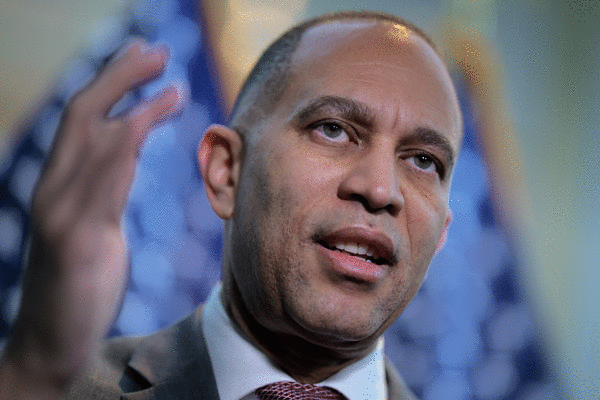
In the hours after Wednesday’s 6-3 decision invalidating Louisiana’s congressional map, House Minority Leader Hakeem Jeffries, D-N.Y., was among Democrats who called for Congress to pass a new version of the law to counter the perceived harms of the majority opinion in Louisiana v. Callais.
At an event with members of the Congressional Black Caucus, Jeffries said the bill would be “one of our first acts” if Democrats win control in the November midterm elections, “so we can end the era of voter suppression in America once and for all.”
But in the majority opinion, Justice Samuel A. Alito Jr. included several passages that seem to limit Congress’ powers under the 15th Amendment to enact “appropriate legislation” to protect voting rights.
In one section, Alito wrote that Section 2 of the Voting Rights Act requires evidence showing that states intentionally drew districts to harm the opportunity of minority voters because of their race.
That interpretation is consistent with the “limited authority” the 15th Amendment confers to Congress, he wrote.
And in another part of the opinion, Alito wrote that the 15th Amendment “does not protect” a right for a state’s minority voters to be provided with enough majority-minority districts, implying that Section 2 or any law that outlaws a map solely for that reason would unconstitutionally exceed Congress’ power.
Nicholas Stephanopoulos, a law professor at Harvard who specializes in election and constitutional law, wrote on the Election Law Blog that Congress likely could have passed laws to reverse prior Supreme Court decisions on the VRA.
“In contrast, I don’t think Congress can directly override Callais,” Stephanopoulos wrote.
If Congress were to try to reverse Wednesday’s decision, which set out a new test for discrimination in election law, Stephanopoulos wrote, “the Court would likely say this approach exceeds congressional authority to enforce the Fifteenth Amendment.”
Dan Vicuña, Common Cause’s senior policy director for voting and fair representation, called the decision an “invitation” for Congress to amend the Voting Rights Act again, but said aspects of the decision would make that difficult.
“Because this is a constitutional ruling, it really narrows the path for people to fight back against discrimination,” Vicuña said. “It basically gives legislatures free rein to claim partisan intent. It basically gives license for them to engage in that, and damn the consequences for people of color.”
Justice Elena Kagan spotlighted the issue in her dissent, arguing that the majority’s reading of the Constitution also limited past decisions that buttressed Congress’ power under the 15th Amendment.
“Today’s majority makes plain its disdain for those views,” Kagan wrote. “But the Fifteenth Amendment gave the power to enforce its guarantees not to this Court but to Congress.”
The existing Democratic legislation, HR 4 in the House and S 2523 in the Senate, would reauthorize preclearance of voting changes and would set new standards for court action to block voting changes and for what constitutes discriminatory voting changes.
The bill includes language to mandate that courts use a “totality of the circumstances” test to see whether minority voters “have less opportunity than other members of the electorate to participate in the political process and to elect representatives of their choice” based on the impact that the map had, without considering the intent of mapmakers.
Alito wrote that the Court “updated” that test with Wednesday’s decision, and Kagan said the majority had weakened it.
Kagan wrote that the majority decision undermined the “totality of the circumstances test” Congress put in the Voting Rights Act in 1982, which was meant to measure whether voting changes had a disparate impact on minority voters.
“It is as if Congress had never amended Section 2,” Kagan wrote.
Rep. Joseph D. Morelle, D-N.Y., ranking member of the House Administration Committee, which has authority over federal election rules, said the decision appeared to limit Congress.
“I mean, what’s clear is the Supreme Court doesn’t appear to care that the 14th and 15th amendments give Congress the authority to carry out efforts to promote racial equity and fair representation,” Morelle said. “So we’re going to go back and do whatever we can.”
Several Democrats are already trying to chart a path forward on that bill after Wednesday’s decision. Rep. Hank Johnson, D-Ga., said Congress may be able to codify other redistricting rules as a way of limiting states from a redistricting free-for-all. Johnson said those changes may be able to help minority communities indirectly.
“Congress could ban political gerrymandering, and it could impose a set of standards on redistricting bodies that did not directly consider race in the analysis, things like communities of interest and keeping political subdivisions together, as opposed to divided. Those kinds of reforms could pass constitutional muster,” Johnson said.
Rep. Deborah K. Ross, D-N.C., a lawyer and former director of her state’s American Civil Liberties Union, said Democrats would pursue whatever avenues remained open to them.
“I am sure that we will craft whatever we do taking into account the legal precedent but maximizing minority participation,” Ross said. “Because the reason why the Voting Rights Act was created is because minorities were disenfranchised.”
©2026 CQ-Roll Call, Inc., All Rights Reserved. Visit cqrollcall.com. Distributed by Tribune Content Agency, LLC.

















































Comments