Senate bans prediction market trading by members, staff
Published in Political News
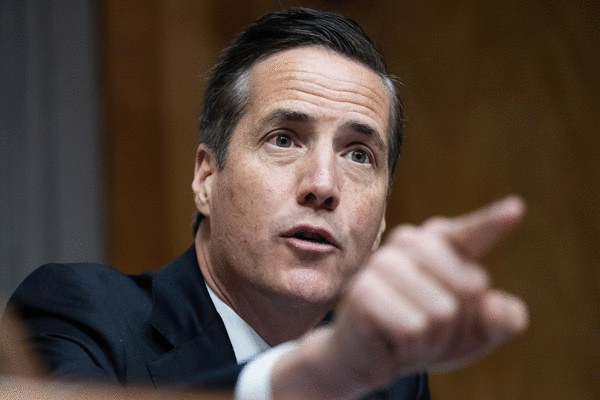
WASHINGTON — Senators will now be barred from trading on prediction markets, after adopting a resolution by unanimous consent Thursday afternoon.
It’s the latest in a flurry of efforts to squash insider trading by government officials as prediction markets grow in popularity. Led by Ohio Republican Sen. Bernie Moreno, the resolution adopted Thursday changes the standing rules of the Senate, adding a ban on buying and selling contracts tied to the outcomes of specific events.
“My issue is, let’s clean up Congress. If there are going to be guardrails in prediction markets, that’s a longer conversation that should have hearings,” Moreno said. “But we don’t want to wait until that ... we just wanted to clean up Congress.”
Lawmakers in both chambers have introduced several bills this year aiming to prohibit trading on prediction markets by government officials, including in the executive branch and beyond.
But Moreno’s resolution applies solely to the Senate and is merely a change to its rules, not the passage of a law regulating the markets. It applies to senators and their staff but does not extend to the House, which has separate rules governing its own members.
“We’re urging the House and the executive branch to do the same,” Sen. Alex Padilla, D-Calif., said.
When senators violate the chamber’s rules, they can, in theory, face penalties imposed by their colleagues, like censure and expulsion — but that rarely happens in practice.
“I think the last thing anybody here who’s serving wants to do is be referred to the Ethics (Committee) for an investigation that would be the end of their political career,” Moreno said.
How to handle prediction markets has become a pain point for lawmakers, especially as users score big payouts from well-timed trades before sensitive events.
A special forces soldier pleaded not guilty this week to allegedly using confidential government information to bet on Polymarket that Venezuelan President Nicolás Maduro would be out of office, raking in more than $400,000. And at least 50 new accounts on Polymarket placed substantial bets on a U.S.-Iran ceasefire in the hours, even minutes, before President Donald Trump announced the action on social media, The Associated Press reported this month.
Sen. Thom Tillis, R-N.C., said, “There’s not a phone here that’s not a casino these days, so maybe we need some rules of the road for predictive markets.”
Tillis pointed to his decision this week to drop his hold on Kevin Warsh’s nomination for Federal Reserve head, noting it was the subject of online betting.
“I mean, one person had control over that outcome,” Tillis said, of himself. He joked he could’ve cashed out: “I was telling my wife, my gosh.”
Tillis, who was considered the make-or-break vote on the Banking Committee, joined his GOP colleagues Wednesday to advance Warsh.
“I’m going, how on Earth, unless you’re just taking a roll of quarters to a slot machine — I don’t gamble, never have — but come on, some of this stuff is silly stuff,” Tillis said.
The resolution adopted Thursday effectively bars senators from any trading on the prediction markets, not just on topics they handle in the course of their work at the Capitol.
“Engaging in any way in a prediction market ... deteriorates the confidence our constituents have in us,” Moreno said on the Senate floor.
FiscalNote, the parent company of CQ and Roll Call, has announced a product expansion into political prediction markets.
©2026 CQ-Roll Call, Inc., All Rights Reserved. Visit cqrollcall.com. Distributed by Tribune Content Agency, LLC.


















































Comments