Supreme Court invalidates Louisiana congressional map over race
Published in Political News
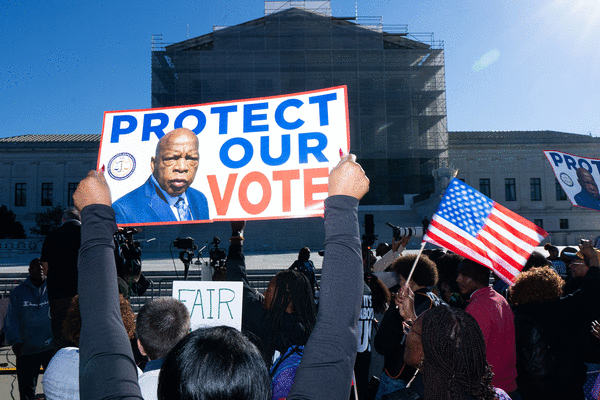
WASHINGTON — The Supreme Court invalidated Louisiana’s congressional map Wednesday ahead of the midterm elections, in a decision that reshaped legal protections for minority voters and could lead to further redistricting nationwide.
The 6-3 decision found that Louisiana should not have been forced to draw a second congressional map with a second Black majority district to comply with the Voting Rights Act, and the map it drew as a result violated the Constitution. The decision upheld a lower-court ruling that the state’s current map was an unconstitutional racial gerrymander.
The decision sent the case back to the lower court to handle the next steps. The outcome means that Louisiana might use for the coming midterm elections the first congressional map it drew after the 2020 census, which aimed for a 5-1 advantage for Republicans in the state’s congressional delegation.
The map invalidated by Wednesday’s decision has four Republican-held seats and two Democrat-held seats. Rep. Cleo Fields, D-La., holds the seat that was drawn pursuant to the VRA. The state’s congressional maps have been in litigation for years.
House Speaker Mike Johnson, R-La., told reporters that Wednesday’s decision was “obviously the right result” after years of arguments opposing the second minority opportunity district in the state, and it is possible the state may end up drawing new maps ahead of its coming congressional primary.
Justice Samuel A. Alito Jr., writing for the court’s six-justice conservative majority, said the Voting Rights Act should be used to guard against intentional racial discrimination, not to guarantee certain districts for minority voters.
Alito wrote that Congress did not have that power under the 15th Amendment to the Constitution, which guarantees voting rights. Interpreting Section 2 of the Voting Rights Act “to outlaw a map solely because it fails to provide a sufficient number of majority-minority districts would create a right that the Amendment does not protect,” Alito wrote.
Alito wrote that challengers to a map under Section 2 should have to show that the only explanation for a current redistricting map should be because voters were discriminated against because of their race. Challengers would have to provide an alternative map that showed the same partisan outcome, Alito wrote.
“In short, §2 imposes liability only when the evidence supports a strong inference that the State intentionally drew its districts to afford minority voters less opportunity because of their race,” Alito wrote.
The decision comes as a wave of partisan mid-decade redistricting has swept the country, with states including Texas, California, Missouri, Virginia and North Carolina drawing new congressional maps.
The decision did not state how it would impact redistricting for the coming midterms, as Florida contemplates redistricting ahead of this fall’s elections.
“This question was pending in several lower-court cases, but in light of the potential impact of those cases on upcoming elections, we concluded that resolution of the question in this suit was appropriate,” Alito wrote.
Justice Clarence Thomas wrote separately in a concurrence that the Supreme Court should never have interpreted Section 2 of the VRA “to effectively give racial groups ‘an entitlement to roughly proportional representation.’”
No Section 2 challenge to redistricting should ever succeed, Thomas wrote. “As I explained more than 30 years ago, I would go further and hold that §2 of the Voting Rights Act does not regulate districting at all,” he wrote.
‘Dead letter’
Justice Elena Kagan took the rare step of reading a portion of her dissent from the bench Wednesday. She was joined in dissent by the court’s other two Democratic appointees, Justices Sonia Sotomayor and Ketanji Brown Jackson. Kagan said the consequences of the majority decision “are likely to be far-reaching and grave” and “renders Section 2 all but a dead letter.”
In states with residential segregation and racially polarized voting that have districts where minorities have a voice in representation, “minority voters can now be cracked out of the electoral process,” Kagan wrote.
“After today, those districts exist only on sufferance, and probably not for long,” Kagan wrote. “If other States follow Louisiana’s lead, the minority citizens residing there will no longer have an equal opportunity to elect candidates of their choice. And minority representation in government institutions will sharply decline.”
The dissent states that the majority opinion changes “eviscerate” Section 2 and made it “impossible” for those seeking to enforce it through the courts.
“Under the Court’s new view of Section 2, a State can, without legal consequence, systematically dilute minority citizens’ voting power,” Kagan wrote. “Of course, the majority does not announce today’s holding that way. Its opinion is understated, even antiseptic.”
While the majority claims it is updating Section 2 through a few technical tweaks, “those ‘updates’ eviscerate the law,” Kagan wrote.
A plaintiff “will have to show — contrary to Section 2’s clear text and design — that the legislators were “motivated by a discriminatory purpose,” Kagan wrote. “And that, as Section 2’s drafters knew, is well-nigh impossible.”
This was the second time the court has considered the legality of the state’s second map.
The legal fight over Louisiana’s congressional map started shortly after the 2020 census when voters challenged the state’s first map, which had one Black opportunity district out of the six in the state. A federal judge later found that map likely violated the Voting Rights Act and ordered the state legislature to draw a new one.
Legislators then drew a new map with two Black opportunity districts, and initially defended the map by arguing that they did so to protect Republican incumbents including Speaker Mike Johnson, Majority Leader Steve Scalise and Appropriations Committee member Julia Letlow.
A group of self-described non-Black voters then challenged the map, arguing that it violated the Constitution by drawing district lines based on race. The state and original map challengers brought the case to the Supreme Court last term.
After an initial set of arguments over the map’s legality, the justices did not issue a decision. Instead, they set it for arguments this term and broadened the legal issues to include whether drawing a second opportunity district under the VRA was permissible under the Constitution.
The case is Louisiana v. Callais.
-----------
—Valerie Yurk contributed to this report.
©2026 CQ-Roll Call, Inc., All Rights Reserved. Visit cqrollcall.com. Distributed by Tribune Content Agency, LLC.

















































Comments