Congress may again curtail 'America First' funding request for State Department
Published in Political News
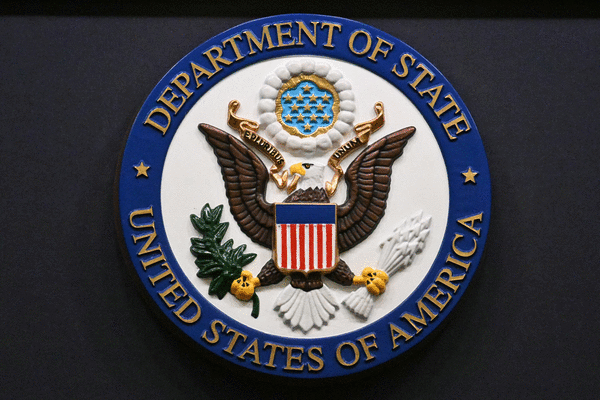
WASHINGTON — The Trump administration is reviving its effort to secure billions of dollars in State Department funding in a wide-ranging account with few guardrails that was met with resistance from Democrats last year, who accused the administration of setting up a foreign policy slush fund.
This week, appropriators will give an initial response to that renewed effort when the House National Security-State Appropriations Subcommittee releases its draft of the State Department’s fiscal 2027 spending bill on Wednesday.
In the president’s fiscal 2027 budget request, the opening salvo of the annual appropriations process in which the White House tells Congress how it would like to fund the government, the administration requested $5 billion for the America First Opportunity Fund.
In its budget justification that accompanied the request, the State Department said the fund would allow the agency to carry out the president’s national security strategy while retaining the ability to “surge resources to take advantage of new opportunities.”
The fund would also “provide targeted investments to enduring partners, such as Jordan and the Philippines, that commit to advancing American interests,” according to a department summary.
The State Department divided the fund into four categories: $810 million for East Asia and Pacific, $1.1 billion for Egypt and Jordan, $650 million for the Western hemisphere and $245 million for countering Chinese influence. Another $2.1 billion was yet to be programmed at the time of the budget’s release.
The fund’s proposed uses are broad, and include priorities ranging from preventing mass migration in Haiti to supporting the South Pacific Tuna Treaty and reconstruction in Ukraine.
But the breadth of the fund, which theoretically could give the administration flexibility to address emerging issues quickly, is the same attribute that lawmakers balked at previously as they debated the department’s fiscal 2026 budget.
During a House National Security-State Appropriations Subcommittee markup last year, Rep. Madeleine Dean, D-Pa., said she could not support a “vague, open-ended fund” that could lead to out-in-the-open corruption.
“All funding accounts are required to align with our national security interests and make America safer, stronger and more prosperous. That is for every single account. Instead what we have here is a slush fund with no established congressional oversight mechanism,” Dean said.
Rep. Debbie Wasserman Schultz, D-Fla., went further, calling the proposed account an “unmonitored billion-dollar slush fund for President Donald Trump and his cronies to buy favors for their rich friends.”
Wasserman Schultz accused Trump of looking to exert direct control over billions of dollars in taxpayer funds because “he believes he knows better than the experts and because his personal interests take precedence over the national interests.”
In the end, appropriators gave the State Department $850 million for the fund in fiscal 2026, and required that the secretary of State consult with the spending panels no less than 30 days prior to the obligation of money within the account. That figure was a far cry from the $2.9 billion the White House sought in its initial fiscal 2026 request.
If past is prologue, appropriators are likely to again set aside the $5 billion figure requested by the administration for fiscal 2027 and replenish the fund with far less money than the White House envisioned, while applying additional restrictions.
At least one outside observer thinks lawmakers may not simply rubber-stamp the White’s House’s request for the fund this time, either.
“I would say that $5 billion is a lot of money in the State Department budget, and I’ll be surprised if Congress supports that amount to be spent at the discretion of the department,” said Kori Schake, director of foreign and defense policy studies at the American Enterprise Institute, a conservative think tank.
©2026 CQ-Roll Call, Inc., All Rights Reserved. Visit cqrollcall.com. Distributed by Tribune Content Agency, LLC.




















































Comments