Becoming a target hits home for Rep. Jared Moskowitz
Published in Political News
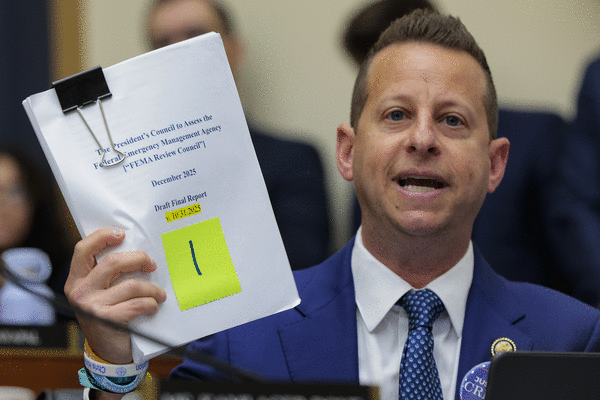
WASHINGTON — Not far from Rep. Jared Moskowitz’s home, police officers found body armor, smoke grenades and firearms inside the house of a convicted felon, along with a handwritten list of “targets” that included the name of the Florida Democrat.
The Justice Department said it was evidence of a would-be active shooter who was “ready for war” and harbored hatred toward the Jewish community, a “ticking time bomb” who had shot at a Jewish woman’s home about two months before the 911 call prompted the officers to search the felon’s home.
“Someone made a call and saved my life,” Moskowitz said in an interview at his Capitol Hill office this month. “We got lucky.”
But life has changed for Moskowitz and his family since the arrest of John Kevin Lapinski Jr., a case that played out as the nation has grappled with a torrent of political threats and a drumbeat of antisemitic attacks.
For the two-term Jewish congressman, what stood out was the man’s proximity and the under-the-radar nature of the threat. It wasn’t someone who called the office to leave menacing voicemails. He wasn’t an identified figure who posted hostile comments from far off in another state.
“No one knew he existed. He was a complete ghost,” Moskowitz said. “And that was the scary part for myself and my family, is to one day get a call out of the blue, randomly, from the Margate Police Department.”
Moskowitz gave his most detailed account of the experience in the interview, along with his assessment of the state of antisemitism in America and the threat landscape now faced by lawmakers in a divisive political environment.
Moskowitz himself was a member of a congressional task force charged with investigating the 2024 assassination attempt against President Donald Trump at a rally in Pennsylvania.
Finding there was a threat to himself that same year, Moskowitz said, was “surreal.”
Shots fired
In October 2024, it was a 911 call, an early morning report of gunfire, that led police to Lapinski’s home in a residential area of Margate, Fla. A group of officers descended on the neighborhood. He eventually emerged from the house after police ordered him out over loudspeaker. With guns drawn, they took him into custody.
Inside the home, prosecutors said authorities discovered an arsenal of weapons and a panoply of tactical gear. Among the findings: body armor, smoke grenades, gun belts, silencers, a camouflage suit and about 3,000 rounds of ammunition. They also found firearms, including at least one rifle and multiple shotguns, according to court documents.
Files found in the home showed Lapinski also harbored hate toward Black people, prosecutors said. Authorities came across a rough-hewn drawing depicting a racist caricature of a Black person holding a watermelon slice. Red targets were drawn on the person. Bullet or pellet holes dotted the drawing.
A black laptop bag on Lapinski’s bed brought out more evidence. Inside, authorities found hand-drawn operational maps with roads and street names. Racist operation names were written on the maps.
Authorities came across a handwritten list of “targets” that included bar mitzvah halls, a synagogue, a Jewish sub shop, a Jewish cemetery, Moskowitz’s name and an entry to “stalk Jewish parks.”
Prosecutors leaned into another accusation as well: Lapinski was linked to the shooting of a Jewish woman’s residence about two months before his arrest. No one was hit, but the woman’s home and vehicle had been riddled with gunfire in the middle of the night.
A defense attorney for Lapinski said the accusation was merely speculation. The government said the man was tied to the shooting through a note found at his home, one that included the make and model of the woman’s vehicle and her exact tag number.
“GOTEM!!! Black Toyota SUV Ahahahah,” read the note, which also included a drawing of a person smiling with a thumbs-up, according to court filings.
“Operation: night raid,” read the same document.
The woman whose house was hit said in court that nighttime gunfire shattered a window and a bullet was still lodged in a wall about 3 feet away from where her husband sleeps.
“I couldn’t imagine somebody firing a gun at a house that had children in it. My car has lots of stuff on it that says we have kids,” the woman told the court.
The experience changed her life, the woman said. She didn’t like to leave the house alone anymore and, outside of certain major holidays, loud noises at night could send her into a mini panic attack.
“I don’t sleep at night anymore as I’m constantly afraid of something happening,” the woman said in court. “I feel the need to stay awake to keep my family safe while they’re sleeping, and then I sleep while my children are safe at daycare.”
‘Fully exposed’
When the suspect’s arrest made national news in the fall of 2024, Moskowitz said he didn’t initially tell his oldest son. His oldest heard about it from friends anyway.
“He came home one day and he was like, ‘Dad, did someone try to kill you?’” Moskowitz said. “At that point I didn’t want to lie to him, but I spared him the details.”
His son asked if the man came to their house, Moskowitz said. But he assured his son that the police arrested the man at his house.
“Since that moment, my kids live with police outside the house every day,” Moskowitz said.
Across the country, perpetrators have targeted the home residences of public officials in recent years.
In Minnesota, a gunman fatally shot state Speaker Emerita Melissa Hortman and her husband at their home in June. In Pennsylvania, an arsonist set a fire at the governor’s residence as Gov. Josh Shapiro and his family slept inside in April. In California, a man attacked the husband of former House Speaker Nancy Pelosi at their San Francisco home in 2022.
For Moskowitz, the discovery of the threat represents a certain before and after.
Besides the police presence outside his house, Moskowitz himself will not appear in parades and says he won’t speak at outdoor staged events. “It’s not worth it. I’d rather lose my election,” he said.
Moskowitz now has private security with him during public outings to restaurants, sporting events or entertainment venues, he said.
When he talks at an indoor event with a crowd, attendees now go through metal detectors. “Didn’t make them do that before,” he said.
And these days, he pays even more attention to his surroundings while out in public, especially with his children around, he said.
“We are fully exposed in our district,” Moskowitz said.
‘Plain evil’
More than five months after police were called to his Margate residence, Lapinski pleaded guilty in the Southern District of Florida to four federal counts, all stemming from his possession of the items that police found at his residence in October 2024.
At the sentencing in federal court, a prosecutor said Lapinski was “ready to carry out an active-shooter scenario.”
“The only thing that prevented tragedy in this case were the actions of law enforcement and the fortunate actions of a concerned neighbor who called police when they heard gunshots on their block,” the prosecutor said.
U.S. District Judge Rodney Smith sentenced Lapinski to 25 years in prison, saying the man was “cold-blooded,” “coldhearted” and “plain evil.”
Lapinski was ready to go to battle and his actions were well planned, Smith said, pointing to the operational maps that featured the names of specific streets.
One operational map featured the area near a high school located about 5 miles away from Marjory Stoneman Douglas High School, the site of an infamous 2018 school shooting that shook the nation. The judge predicted Lapinski would “kill anyone at any school right now” if he were to walk free that day.
“He has a depraved heart. He’s evil, and I have never said that to anyone in their face, but he is,” the judge said. “He’s plain evil.”
On the Hill
In the beginning, Moskowitz said he told jokes as a way of dealing with the experience. “In a way, it even silenced me for a couple of days,” he said.
“I wasn’t like, ‘Oh, let me go on Twitter or on television right now,’” he said. “I kind of was like, we’re going to disappear for a bit because I don’t know if there’s other people. We didn’t know he existed.”
Since then, Moskowitz has mentioned the incident in committee hearings on Capitol Hill, including last summer during a House Judiciary subcommittee hearing that explored antisemitic violence in America.
Moskowitz, in the interview this month, reflected on Lapinski’s motivations.
“In any of his writings that they discovered, he wasn’t mad about any of my policy positions or votes. It was simply the fact that I was Jewish [and] my support for Israel,” Moskowitz said.
Efforts to dehumanize Jewish people appear in normal life, Moskowitz said, but even more so online, where it can reach younger people.
It’s possible to oppose Israel’s government without being antisemitic, he said, but that distinction has begun to blend.
“Instead of saying Netanyahu or Israel, they’re saying Jews. The language switched from Israel to Jews quickly,” he said, adding it’s a “blurring of the line.”
Moskowitz said Speaker Mike Johnson has been proactive on member security but more needs to be done to address threats to lawmakers, an issue that attracts common ground between Republican and Democratic members.
“Regardless of the disagreements we have, or even the hatred that we might have for each other, nobody wants anything to happen to each other or our families,” Moskowitz said. “Nobody wants that to happen.”
©2026 CQ-Roll Call, Inc., All Rights Reserved. Visit cqrollcall.com. Distributed by Tribune Content Agency, LLC.




















































Comments