Ronald Brownstein: Partisan gridlock may be red and blue states' least-bad outcome
Published in Op Eds
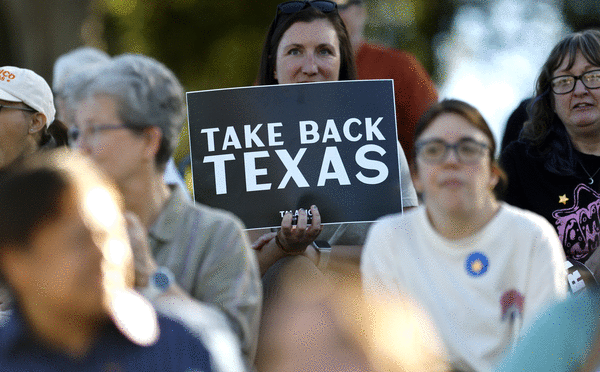
After years of widening political polarization in the U.S., signs are accumulating that red states and blue states are heading toward a stalemate.
The rules of daily life now diverge across the states to the greatest extent since the fall of Jim Crow six decades ago, a prospect that carries unsettling implications for the nation’s fundamental cohesion. But accepting such a separation may be less inflammatory than attempting to restore a single set of national rules on the fraught cultural and social issues dividing the states — such as abortion, LGBTQ rights, voting, diversity initiatives and classroom teaching.
The U.S. now faces a high-stakes choice: either side attempting to impose its vision on the other through federal action, or allowing a reversion to a pre-1960s world when Americans’ rights depended on their ZIP code.
The latest sign came during a CNN town hall last week when James Talarico, the Democratic Senate nominee in Texas, affirmed his support for a national ban on gender transition surgery for minors.
That’s a striking shift in emphasis for Talarico, who voted against a state-level ban as a Texas state representative. (He says the proposed law was too broad.) His new stand captures the Democratic retreat on transgender rights, an issue that Republicans have wielded against them to powerful effect since 2024. “Some Democrats who once stood with transgender people are turning their backs on our community,” laments Tyler Hack, founder and executive director of Christopher Street Project. “It’s a dangerous miscalculation.”
But Talarico’s move is also part of a much larger repositioning for Democrats. The party appears to be losing enthusiasm for using federal power to overturn red-state restrictions on fundamental rights. Democrats had ardently pursued that cause, though with little success, when they last controlled Congress during the first two years of Joe Biden’s presidency.
These signs of reconsideration among Democrats come after President Donald Trump and the Republican Congress have been stymied in their own repeated efforts to force blue states to adopt conservative social policies.
The national ban on transgender surgery for minors that Talarico endorsed is unlikely to become law any time soon. Republicans passed such a prohibition through the House last year, but it lacked the 60 votes required to break a Senate filibuster. Democrats would probably not allow such a proposal to reach the floor if they recapture either congressional chamber in November.
But it also seems increasingly unlikely that a Democratic Congress would move in the opposite direction — to overturn the red-state laws restricting rights for transgender youth. Democratic candidates everywhere this year have said they believe trans issues should be decided at the local level, which implies little enthusiasm for federal action.
That marks a shift since 2021, when every present House Democrat voted to approve the Equality Act. That law, which prohibited discrimination based on sexual orientation or gender identity, would have provided a strong legal basis for challenging state laws barring trans kids from playing sports or receiving gender-affirming healthcare. Virtually all red states, but only New Hampshire among the blue states, have adopted both policies.
That was just one of several actions House Democrats took during Biden’s first two years to override the red-state social offensive. The lower chamber also passed legislation to overturn the restrictions on abortion that most red states passed after the Supreme Court’s Dobbs decision in 2022 and to invalidate restrictive red-state voter identification laws. Both stalled in the Senate.
Beyond their bill banning gender-affirming care for minors in all 50 states, House Republicans have approved legislation barring transgender girls from school sports nationwide and also passed the SAVE Act requiring every state to adopt the most restrictive red-state voting policies. Those initiatives died in the Senate, too. Courts, meanwhile, have almost entirely blocked the Trump administration’s attempts to withhold federal funds from blue states unless they adopt red state policies on transgender issues, racial diversity in hiring and censorship of classroom instruction.
The next time Democrats control the White House and both congressional chambers, they will likely remain comfortable attempting to restore abortion rights in all 50 states; Democrats might also pursue some voting reforms. But those efforts will continue to struggle to reach 60 Senate votes. And while Democrats may recapture some prominent red-state governorships this year, they have little chance of breaking the gerrymandered Republican legislative majorities that would be required to repeal the red-state social regime. As Talarico’s comments suggest, it’s no longer clear that red-state Democrats would spend political capital seeking repeal, even if they could.
Over the roughly 60 years from the Supreme Court decision banning segregated schools to the ruling enshrining same-sex marriage nationwide, America’s general trajectory was to raise the floor of rights available everywhere and to limit states’ ability to impinge on those rights. But now, with the Supreme Court pulling up those floorboards by repeatedly enabling the red state restrictions, the separation between red and blue states has widened again. That’s hardly an ideal outcome — but allowing red states to retrench rights while blue states preserve them may be the least dangerous option for a country so visibly pulling apart.
____
This column reflects the personal views of the author and does not necessarily reflect the opinion of the editorial board or Bloomberg LP and its owners.
Ronald Brownstein is a Bloomberg Opinion columnist covering politics and policy. He is a CNN analyst and the author or editor of seven books.
©2026 Bloomberg L.P. Visit bloomberg.com/opinion. Distributed by Tribune Content Agency, LLC.


















































Comments