Lionel Laurent: Nolan's 'Odyssey' has a worthy French competitor
Published in Op Eds
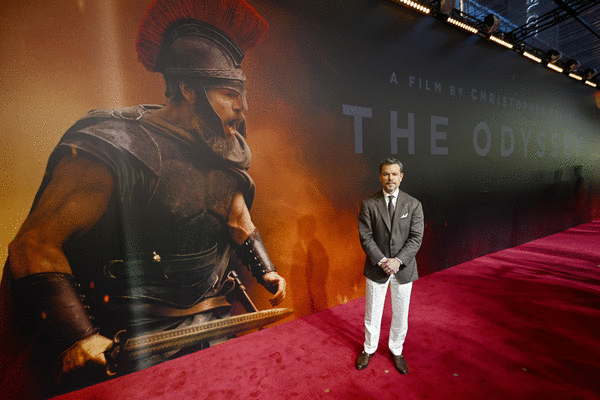
The political movie of the year tells the story of an odyssey: A grizzled war veteran in exile, desperate to return home to his family and country, leading a rump of an army through impossible odds as massacres, vengeance and mutiny rage.
No, not Christopher Nolan’s The Odyssey, but La Bataille de Gaulle: A two-part World War II drama about Charles de Gaulle that has taken France by storm a year ahead of elections. The pair of films, clocking in at a total of 320 minutes, has sold 4 million tickets in French theaters — not far off the mighty Odyssey itself — amid a wider 20% rebound in cinema attendance. The film is now set to land in international markets, including the UK.
There are many reasons for the film’s success at home, aside from it being very good; word-of-mouth support has helped, as has the heatwave pushing people into air-conditioned theaters. It also helps that the story of de Gaulle’s refusal to surrender in 1940 as the state’s military and morality collapsed is the kind of authentic display of heroism the French might be craving as they potentially sleepwalk into a far-right presidency that would test de Gaulle’s Fifth Republic like never before.
There’s also a transatlantic dimension in these Trumpian times. Director Antonin Baudry, a former diplomat who co-wrote Dominique de Villepin’s speech objecting to the U.S.-Iraq War, takes a risk by turning the WWII movie template into something very un-American. There’s no scene featuring Hitler in his bunker. The battles take place not in Dunkirk or Omaha Beach, but Libya and Tunisia. American YouTubers frothing over Nolan’s Odyssey might have a fit seeing how Franklin D. Roosevelt is portrayed — cold, scheming and disillusioned by a crippled France he views as a “child” incapable of defending itself.
This is by design, according to Baudry, who told French television last month that Europeans “inhabit a narrative told by Americans.” Namely, that the U.S. saved Europe and has been an Avengers-style force for good ever since. Or as Elon Musk posted on platform X last year while addressing former European Union official Thierry Breton: “American ‘foreign interference’ is the only reason you’re not speaking German or Russian.” De Gaulle might have replied, as he said to Eisenhower in 1959, that America only entered WW1 after three years of mortal peril in France and WW2 after the Nazis occupied Paris.
Baudry manages to correct the transatlantic record without falling into the trap of hagiographic dullness. That’s partly thanks to a British historian, Julian Jackson, who’s something of a muse for the director. The film’s de Gaulle isn’t a superhero wearing the cross of Lorraine on his chest instead of a spider. We see a quixotic, exasperating, haunted leader driving Winston Churchill to anger and tears, and advancing his own quest for French renewal through steely and unemotional political skill. “De Gaulle could be haughty, cold, abrasive and petty,” Henry Kissinger wrote in 2022’s Leadership. “Yet in his statesmanship…(he) remains exceptional.”
At the same time, the film shines a light on de Gaulle’s small contingent of Free French as the “Fighting French,” as Churchill would call them. Balancing the heated rhetoric between allies in London is the action of the resistance networks in France and the feats of epically outnumbered troops in delaying the Axis advance by precious days. The sight of a young female resistance leader taking pot shots at Nazis in Paris is highly symbolic at a time when conscription is returning to Europe.
Compare all of this with Nolan’s movie, which despite its Sicilian scenery is to its core a product of Hollywood: A huge budget, featuring a cast of U.S. movie royalty including Anne Hathaway, Matt Damon and Charlize Theron, and themes I suspect will resonate more in the Trump administration than in today’s Mediterranean. The MAGA crowd is obsessed with Roman virtues and gladiatorial physique, but the Greek superstitions and subterfuge shown in The Odyssey seem a better fit; Ezra Klein calls it the political movie of the decade.
I would contend de Gaulle is Europe’s own political blockbuster, just as Kissinger described the Frenchman’s life as an “odyssey.” Some will argue that he’s too specifically French a hero. Still, when the map of France carved up and administered by the U.S. appears on screen, is it so different to Donald Trump’s current claims on Greenland? When Roosevelt designs and prints a new currency for post-war France, is it so different to U.S. dollar dominance? And when Churchill lays out his strategy of choosing the open sea over Europe, isn’t it a premonition of Brexit?
If wily Odysseus is an apt guide through today’s world, so is de Gaulle, who conjured visions that transcended reality — much as an aging, fractured Europe will have to do again if it wants to survive this century.
_____
This column reflects the personal views of the author and does not necessarily reflect the opinion of the editorial board or Bloomberg LP and its owners.
Lionel Laurent is a Bloomberg Opinion columnist writing about the future of money and the future of Europe. Previously, he was a reporter for Reuters and Forbes.
_____
©2026 Bloomberg L.P. Visit bloomberg.com/opinion. Distributed by Tribune Content Agency, LLC.




















































Comments